

When intelligence chief Tulsi Gabbard resigned this past week, citing her husband’s health, the battle immediately began to shape the narrative — saying it was due to clashes with Trump over Iran, or being frozen out of the West Wing, or deep frustration with her own agency.
These stories all have one thing in common: they cast Gabbard as a martyr. But that isn’t what happened. If you look at what Gabbard actually did, the picture is less flattering.
She oversaw her agency’s National Counterterrorism Center move into purely domestic matters (contrary to its original design). The intelligence budget went up. The surveillance state tightened its grip on the American people, with Gabbard presiding over an intelligence community striking up alliances with private companies, including social media giants.
The real story is one of defeat. It’s the story of an intelligence chief discovering she wasn’t really in charge of much, and a national security system that strangles reform with such ease you almost have to stand in awe of it.
Gabbard’s title — Director of National Intelligence — was created in response to public outrage over the intelligence community’s failure to prevent 9/11. But because the member agencies (CIA, FBI, etc.) did not want to have to answer to a higher authority, the position was rendered so toothless and symbolic that one former DNI himself even called the position “neutered.”
Here is the story of how it got that way and why Congress is responsible.
The CIA’s in-house journal, Studies in Intelligence, recently published a remarkably candid 20th-anniversary retrospective on the Intelligence Reform and Terrorism Prevention Act of 2004 — the law that created the DNI. The lead essay is written by the senator who authored the law: Susan Collins (of electric toothbrush fame).
Collins opens with a reference to “sausage-making” — never a good sign:
“Remember that old saying that there are two things you never want to see made: sausage and legislation? In this article, I’m going to provide an insider’s account of the sausage factory in Congress, a behind-the-scenes look at how the most significant intelligence reforms in more than 50 years became law in 2004.”
The 9/11 Commission, in its 2004 final report, recommended a single, overarching intelligence boss with actual authority over the entire community — modeled, loosely, on the Goldwater-Nichols Act that instituted significant new powers for the Department of Defense.
But the moment Collins and Joe Lieberman started writing their bill, the keepers of the national security establishment began working against it.
Then-Secretary of Defense Donald Rumsfeld and Vice President Dick Cheney wanted nothing to do with a new official who could touch the intelligence budget of the Pentagon, which controls four of the five largest U.S. intelligence agencies. House Armed Services Chairman Duncan Hunter, doing Rumsfeld’s bidding, immediately held up the committee’s final report to stall the bill.
The memos detailing this saga are now publicly available in the historical record. On September 11, 2004 — three years to the day after the attacks the bill was supposed to address — Rumsfeld sent President George W. Bush a private memo dripping with contempt and titled, “Intelligence ‘Reform.’” Note the scare quotes around “reform.”
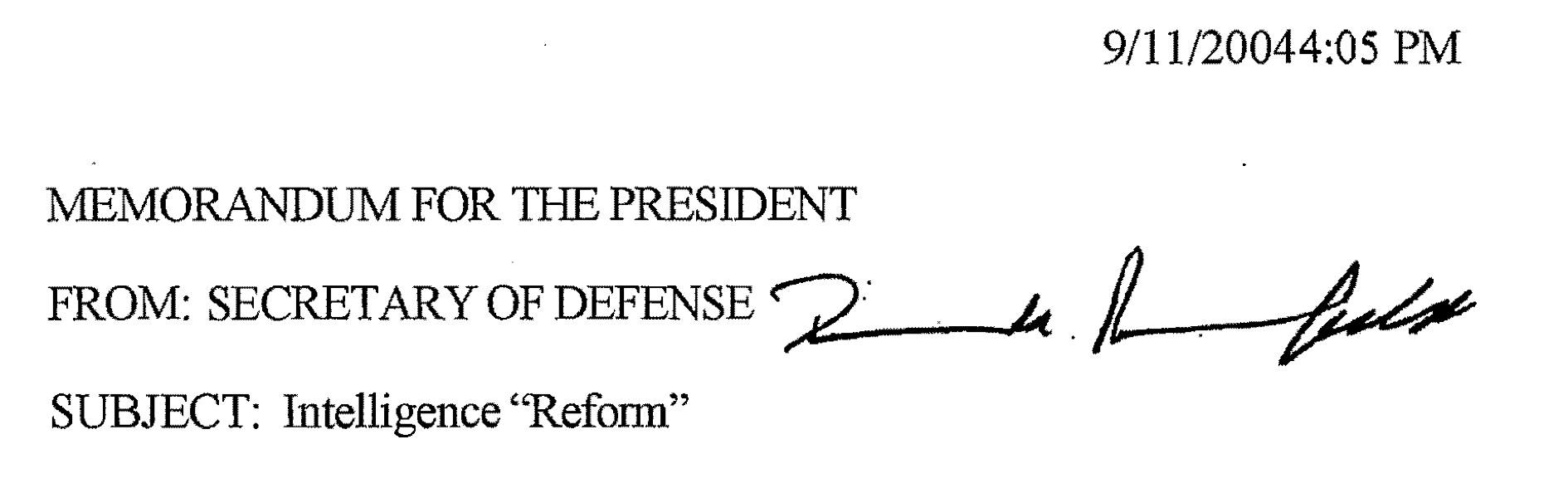
Rumsfeld warned the president that giving the new intelligence director “full budget authority” — the exact position Bush had publicly endorsed to appease voters — would create “a train wreck.” Instead, Rumsfeld proposed a precise blueprint for the toothless agency. The new director’s “importance and value,” Rumsfeld wrote, “is not as a collector or producer of intelligence — or as a super CIA director — but rather as the leader of the intelligence community.”
That word — “leader” — was intentionally hollowed out. Rumsfeld’s proposal sought to strip the position of any real budget authority, collection capability, and operational responsibility. “Leader” here meant about as much as a Burger King crown.

Rumsfeld closed his memo by warning Bush that the current Congressional draft was “undesirable,” would “harm US intelligence capabilities,” and most importantly, that Joint Chiefs Chairman General Richard Myers shared his concerns.
To back up that warning, House Armed Services Chairman Duncan Hunter held up the bill in committee. Behind the scenes, Hunter spoke to Lt. Gen. Ronald Burgess, the intelligence chief on the Joint Staff working for Gen. Myers. Burgess helped Myers draft a late-night letter to Hunter, making the Pentagon’s case in three short paragraphs: the intelligence budgets must pass up through the defense secretary, and the appropriations must flow right back through the defense secretary in turn — a loop Myers called a “vital flow.”
President Bush had promised real reform as a centerpiece of his reelection campaign, and his own staff realized the Pentagon had just blown a massive hole in the bill weeks before voters headed to the polls. Burgess writes that days later, Myers told him he’d received a frantic call from the White House saying the general had “just cost the president his chance at reelection.”
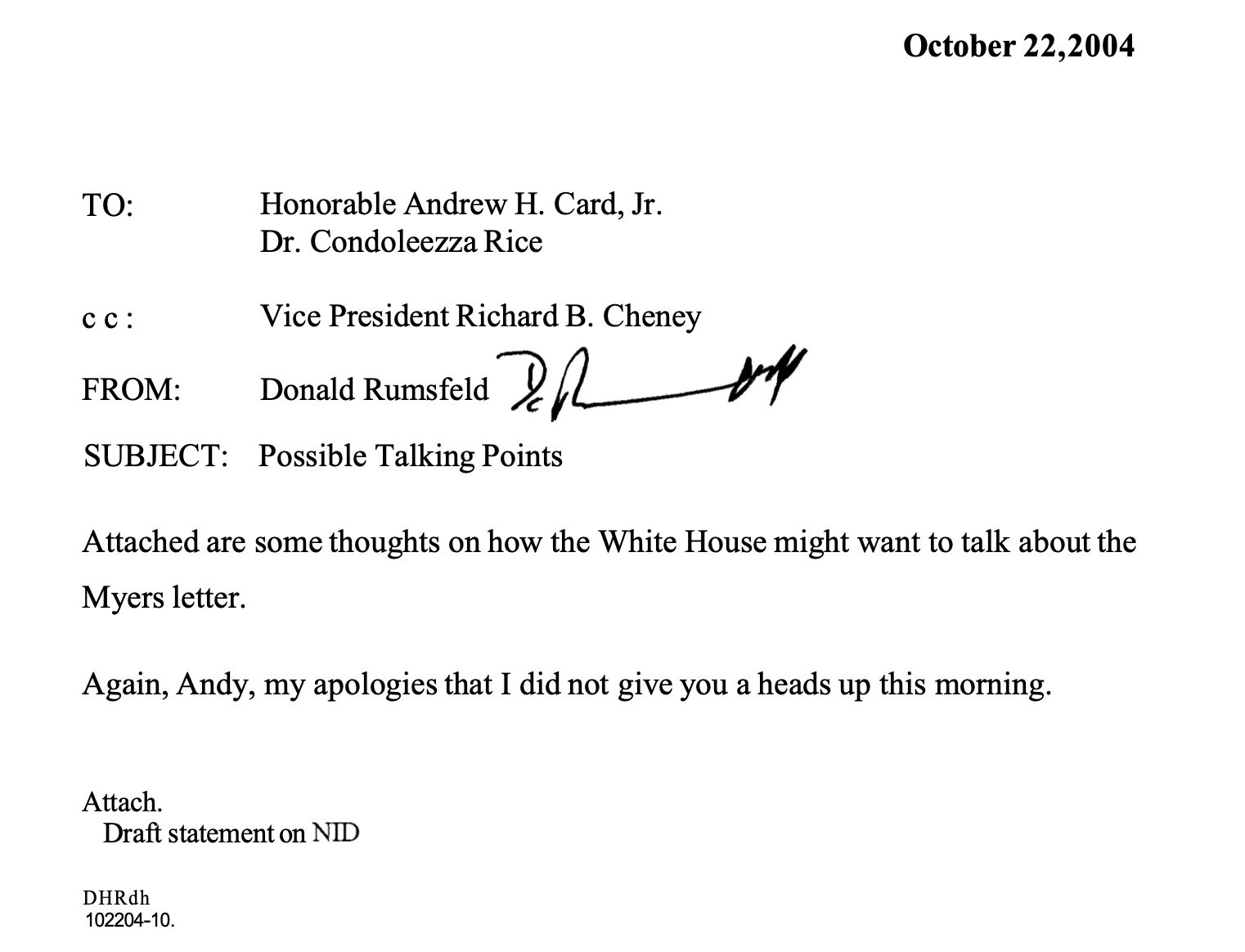
The day after Myers sent that letter, Rumsfeld fired off a memo to White House Chief of Staff Andrew Card and National Security Advisor Condoleezza Rice. Titled “Possible Talking Points,” Rumsfeld apologized for not giving the White House a heads-up, ran interference for Myers by insisting the chairman was legally obligated to give his best military advice to Congress, and provided a script to smooth things over with the public by selling the gutting of the bill as “reform.”
Congress caved instantly. As Collins cheerfully recounts in her essay, her staff counsel buzzed her BlackBerry with a solution: just insert four words stating that the bill shall “respect and not abrogate” the authority of the Defense Secretary. Collins texted Lieberman about the fix “in the middle of Billy Joel playing a tribute to Elton John,” she writes. What fun! Never mind that the compromise completely defeated the entire point of a centralized intelligence boss. It got the bill moving.
None of this shameful display of congressional subordination seems to bother Collins at all. To finalize the surrender, Vice President Dick Cheney personally carried the White House’s written language over to Hunter, as Collins recounts. With the loophole secured, Hunter gave his consent and signed off.
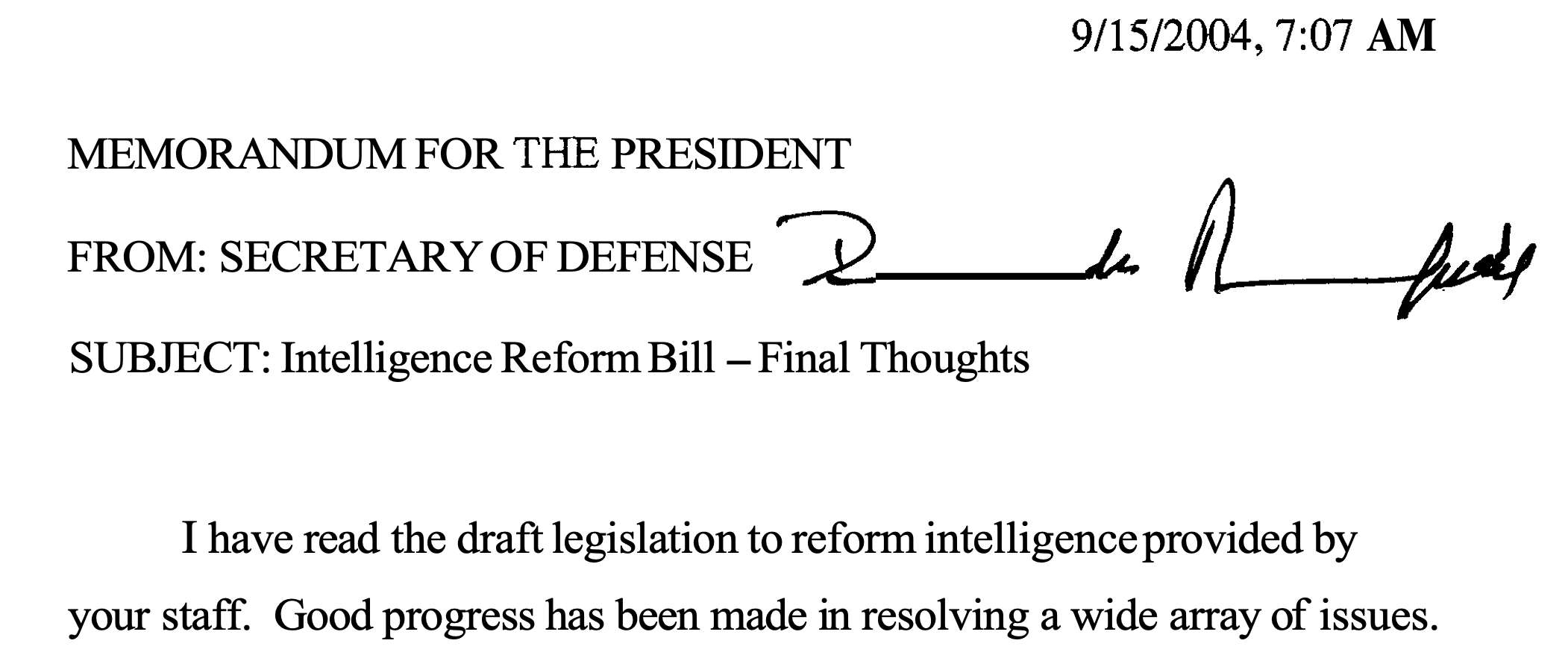
The Pentagon had won, and Rumsfeld knew it. In a later internal memo — this one lacking the scare quotes around the word reform — he expressed his relief over the final product:
“This is a substantial and welcome improvement over previous drafts … No one could suggest that the Secretary of Defense does not have ‘full budget authority’ over the Services and the Department of Defense. … We believe that this arrangement may also prove more congenial to those on Capitol Hill …”
This episode shows what the national security world thinks of Congress — that they’re a joke — and how the security apparatus effortlessly undermines the Constitution’s balance of powers. Nowhere does Collins express an ounce of frustration, because Congress has completely internalized its role as the ball-gag wearing gimp in Pulp Fiction.
The final receipt of this capitulation was proudly entered into the public record by the bill’s own sponsor, Joe Lieberman. On December 8, 2004 — the day of the final Senate vote — Lieberman asked unanimous consent to insert the Myers surrender letter into the Congressional Record alongside a “fact sheet” trying to put a brave face on the retreat. The sheet concedes the entire point: “the conference report accepted the recommendation of General Myers.” On the very day of the bill’s historic passage, its authors entered the exact document that gutted it into the permanent record.
As former Director of National Intelligence James Clapper later noted in that same CIA journal, the change to the law added by Rumsfeld resulted in “effectively neutering the rest of the act” — again, I stress, this coming from someone who literally held the job!
Senator Arlen Specter, who had been trying to consolidate intelligence authority since 1996, was the only member of Congress willing to stand on the floor and say what really happened.
The Pentagon, he said, had “successfully attenuated intelligence reform legislation.” The new DNI’s budget authority was “effectively the same authority that the current DCI is given.” The new official would have no power base, no troops, and “no actual authority.”
Then he voted yes!
The 9/11 Commission had officially exposed the fatal dysfunction of American national security. Congress had an idea of reform based on the conclusions and yet the authors mostly hated what they produced. The White House was upset with the final product. The chairman of the Joint Chiefs was a puppet of Rumsfeld who was a puppet of Cheney who was the high priest of national security and thus the demands of the religion.
One could make the mistake of saying that the main culprit here was pitbull Rumsfeld, who was protecting his turf, but the major actor wasn’t a person or an agency. It was “national security,” the mindset itself, and the religion behind it. The belief that the Chairman of the Joint Chiefs, the generals, the military brass, knows best. It was able to defy the will of the people, the president, and the Congress.
Tulsi Gabbard never had a chance.
— Edited by William M. Arkin
Excellent newsletter: Bravo. It reminds me when they were conjuring up the Patriot Act after 9/11.
Most of the surveillance law changes in the Patriot Act were part of a longstanding intelligence and FBI wish list that had been previously rejected by Congress on several occasions.
Congress only reversed course because it was pressured by the Bush Administration in the weeks after 9/11. And the rest is history—a federal appeals court knocked out most of the mass surveillance, which unfortunately under this administration is back with a vengeance.
The government may not be spying on us anymore (TBD), but it doesn’t apply to private companies who contract with the government; can you say DOGE and Palantir?…:)
One might still ask Tulsi: "so...you didn't know that the position you had accepted might essentially have been 'Director of National Nothing' when you took it? Seems to me that with even a little research, she'd have come across former DNI director Clapper's observations, or Sen. Specter's commentary (and is there an explanation as to why he voted for it, BTW?)