
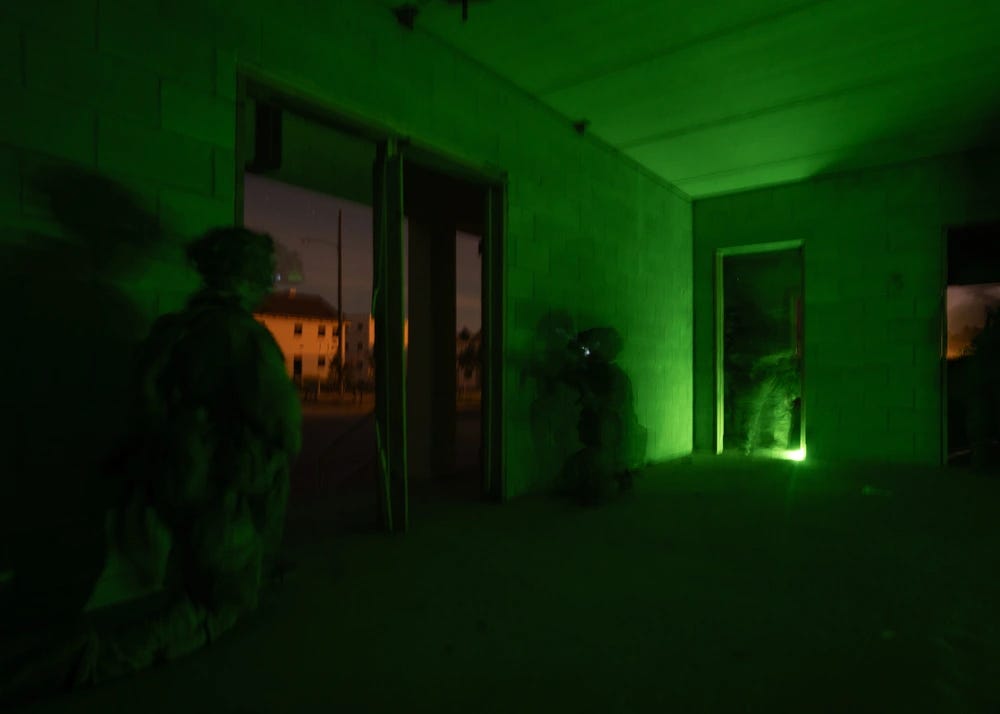
When the Pentagon announced that the 82nd Airborne was deploying to the Middle East in March, it concealed a key detail: some of the paratroopers were headed to Israel, as revealed in an Army deployment order I obtained.
A military source involved in war planning tells me the deployment is tied to new U.S.-Israeli joint contingency plans, completed since February, for seizing Kharg Island and carving out coastal territory inside Iran.
The 82nd Airborne Division is the Army’s premier quick reaction force, trained to parachute into hostile territory.
By keeping the deployment quiet, the Pentagon headed off public debate over a joint U.S.-Israeli operation inside Iran — a prospect many considered plausible at the time, amid a fever pitch of mainstream reporting on a potential ground invasion. The secrecy also sidestepped what's euphemistically called "host nation sensitivities." A joint U.S.-Israeli operation raises thorny questions for America's Gulf Arab "partners," especially over logistical support — hence the 82nd, which could launch directly from Israel without any Gulf state's consent to use its territory.
The Army deployment order, issued April 7, 2026, directs elements of the 2nd Battalion, 501st Infantry Regiment — the storied "Geronimo" battalion — to deploy to Israel on "temporary duty." The Israel deployment has not been previously reported.
The Pentagon has never acknowledged it; in public it has said only that the 82nd was bound for "CENTCOM," the military's term for U.S. Central Command, the combatant command responsible for the entire Middle East. The press echoed the vague terminology, suggesting the unit was headed to existing U.S. bases in Kuwait or Qatar.
Asked about the number of troops deployed to Israel and their mission, the Pentagon referred my request to CENTCOM, which at the time of publication had not yet responded.
In late March, the New York Times reported that senior military officials were “weighing a possible deployment of a combat brigade from the Army’s 82nd Airborne Division … to support U.S. military operations in Iran.” The forces would come from the division’s Immediate Response Force — a brigade of roughly 3,000 soldiers able to deploy anywhere in the world within 18 hours. Those forces, the Times noted, “could be used to seize Kharg Island, Iran’s main oil export hub.”
The groundwork had been laid weeks earlier. The Army abruptly pulled the division’s 300-member headquarters from a planned exercise at the Joint Readiness Training Center in Louisiana, officials told the Times, so the command element wouldn’t be “caught out of place if the balloon went up.” The Aviationist reported that the division’s commander, Maj. Gen. Brandon Tegtmeier, and his command element had been ordered to deploy, and tracked a string of flights leaving Pope Army Airfield, which serves Fort Bragg, for the Middle East.
When the Pentagon finally did talk about the 82nd publicly, it took pains to keep Israel out of it.
At a May 5 briefing, Secretary of Whatever Pete Hegseth and Joint Chiefs Chairman Gen. Dan Caine devoted much of their remarks to “Project Freedom,” the self-described “defensive” operation that the Trump administration says is keeping commercial shipping moving through the Strait of Hormuz. Caine singled out the 82nd Airborne for praise, telling reporters that elements of the division were synchronizing air operations for more than 100 aircraft over the Strait and “doing so in support of Project Freedom as we speak.”
“When the President or the secretary need immediate, scalable and lethal combat power in CENTCOM or elsewhere, the All American Division answers the call,” Caine said.
He went on to describe the paratroopers as "constantly ready to jump from Air Force aircraft into ground combat [to] seize key terrain if ordered to do so, just like their predecessors did in Sicily and Normandy in World War II, or to secure or enable the follow-on forces to flow into theater as they did in Grenada or Panama."
That is a description of readiness to seize a piece of Iranian terrain — which makes me suspect the New York Times and others were being used to "message" Tehran that such an operation was imminent.
“Beyond Project Freedom,” Caine said, “CENTCOM and the rest of the joint force remain ready to resume major combat operations against Iran if ordered to do so. No adversary should mistake our current restraint with a lack of resolve.”
So why the sensitivity about naming Israel, when the U.S. has acknowledged stationing American air defenses and F-22 fighters there? First, the breadth and depth of U.S.-Israeli military cooperation goes far beyond arms sales and “deconfliction.” Second, the two countries are deepening intelligence sharing aimed at making Israel a sixth “eye” in the so-called Five Eyes alliance of the U.S., Canada, Great Britain, Australia, and New Zealand. Third, naming Israel would expose how much of the U.S. assault on Iran is in fact a joint U.S.-Israeli attack — not a Trump-Netanyahu brotherhood, but cooperation at the military-to-military working level, where combined war plans are now reality.
Charlie Company of the 2nd Battalion is still in Israel, from which no dispatches have emerged in two months. I’m not saying a ground operation is imminent or inevitable. But if one were coming, wouldn’t it be nice to know?
— Edited by William M. Arkin
Damn we do hella defensive operations in what appears to be an offensive fashion that’s really interesting. What talent.
*groans*