

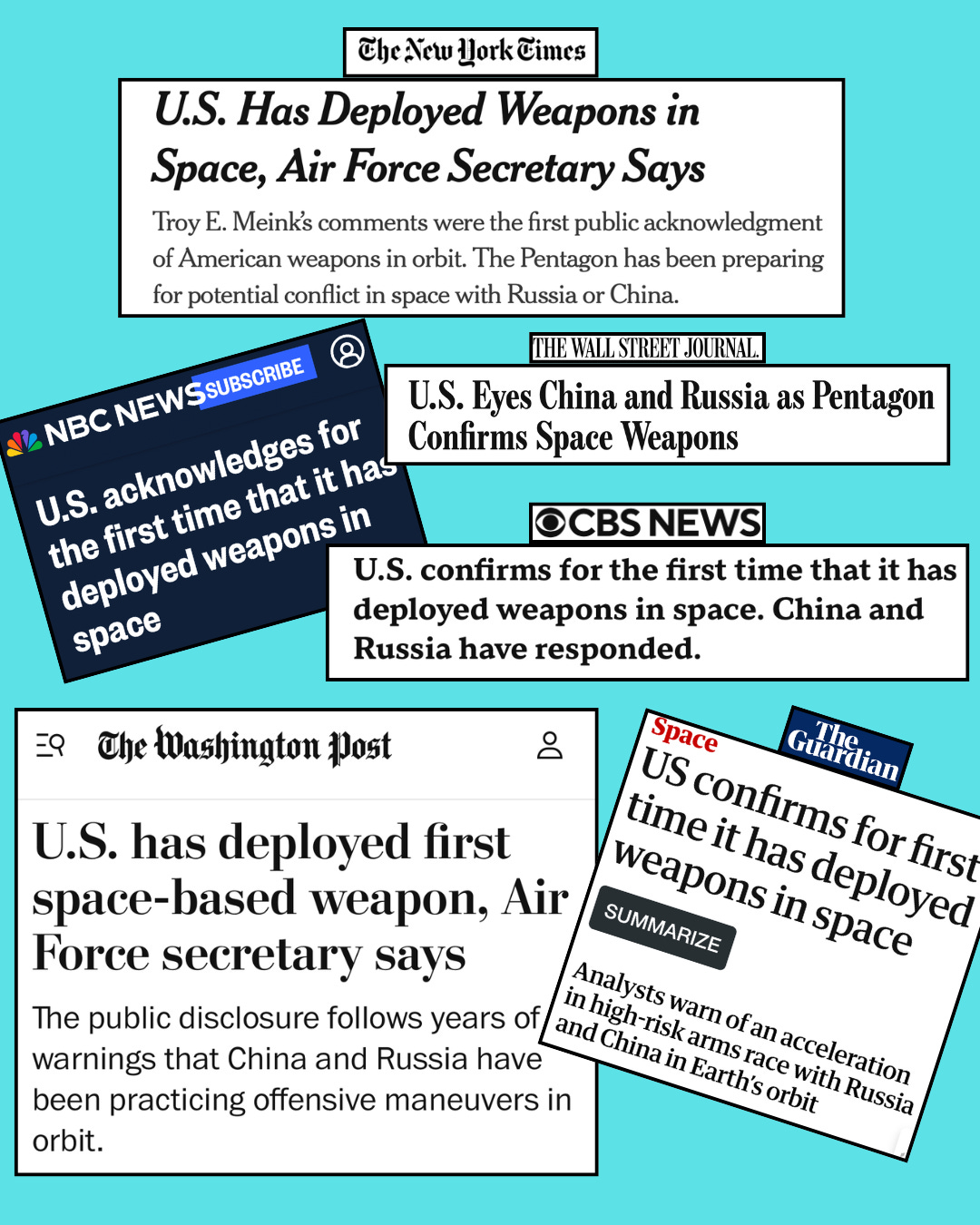
The Air Force’s announcement that it has “on-orbit space control weapons” generated a flurry of identical articles, nearly all about potential war with China and Russia. The coverage was bristling with Cold War-era defense-speak: deterrence, stability, signaling.
The real reason for the announcement came a few sentences later in Air Force Secretary Troy Meink’s keynote at the Air, Space & Cyber Conference. It had little to do with space weapons, which were never actually identified (but I’ll reveal them in a moment). It was about drumming up money.
“In today’s rapidly changing threat environment, we cannot expect a world-class military if we choose not to invest in it,” Meink said. “Many of the weapons, components, or systems we have to buy have outrun the cost curve. They perform extremely well, but the costs are growing faster than the rate of inflation.”
He then lamented: “Today, we face a mix of rapidly changing technologies … and a budget process for a different pace of warfare.”
Chief of Space Operations Gen. Douglas Schiess was even more blunt this week.
“In the coming years,” he said, “we will make disciplined and responsible choices about how we build and sustain our combat advantage, which means scaling our ability to respond to threats.” Then he threw in: “We need your help, Congress.”
Translation: money, money, money. Your money.
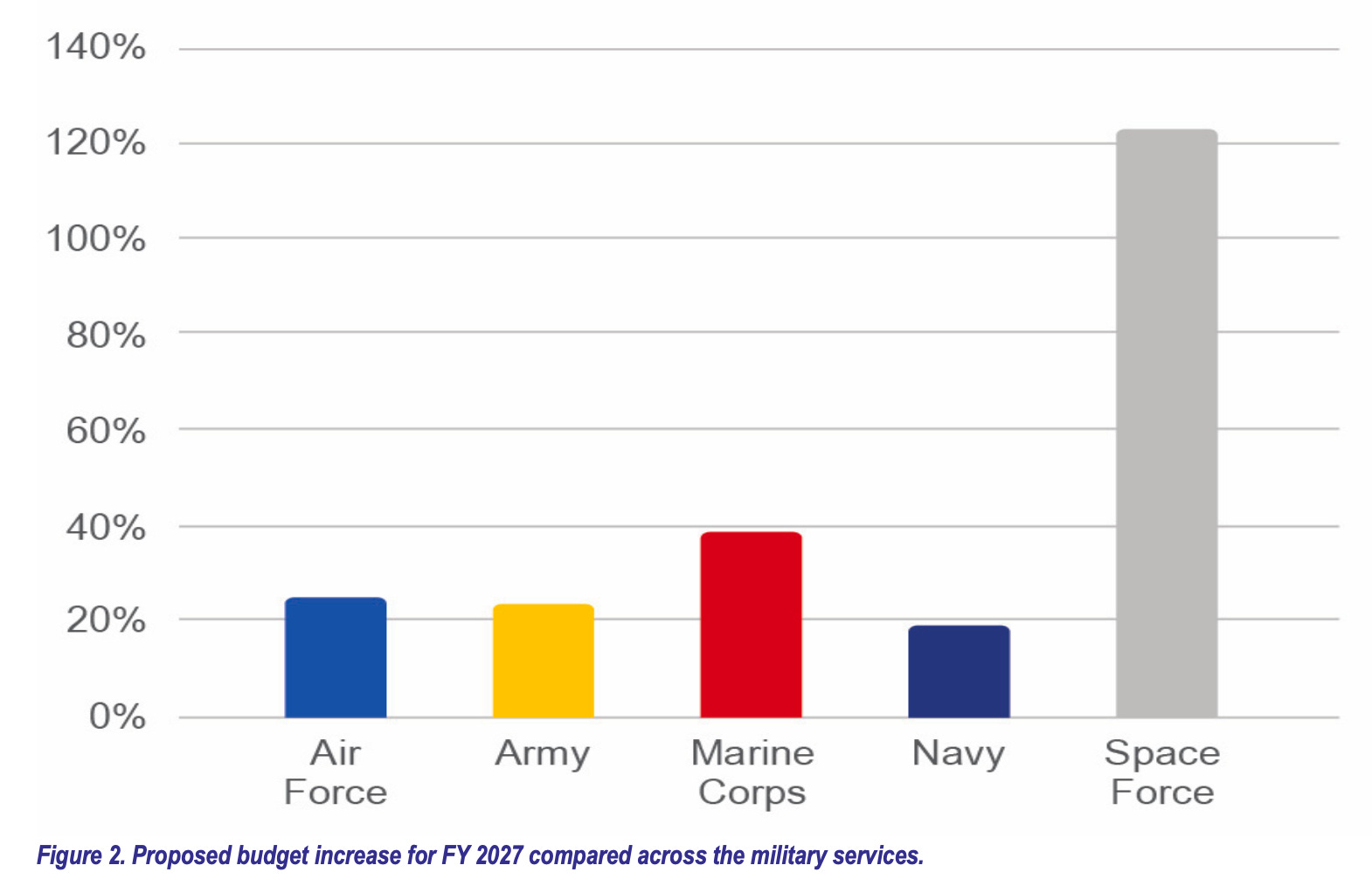
Today, by complete coincidence I’m sure, Space Force posted a new “Space Threat Fact Sheet.” The Space Force wants you to know that what you’ve already given (over $100 billion) is not enough. So now they’re asking for another $71.3 billion — the biggest one-year jump any military branch has gotten since 1952, according to the Aerospace Center for Space Policy and Strategy.
Space Force has some spaceballs!
If you think I’m being too cynical, Secretary Meink all but says it himself in explaining why he announced the “new” space weapon at all.
“... at this point, we are trying to say that we also need capabilities to not only defend the joint force from space-enabled attack, but defend our assets. And so, I think it was time that within the Department of War we talked about it, and it’s time to talk about that we have the capabilities to make sure that we can do what the joint force needs,” Meink told Defense One (which, to its credit, also pointed out the enormity of Space Force’s budget request).
In other words: show me the money!
Down the hall from the keynote, STARCOM commander Maj. Gen. James E. Smith hammered home the same message: “Predictable budget resources will remain vital as we scale operations to maintain our FY27 momentum.”
Don’t you just love how they’ve now decided to say “scale” instead of increase?
If you’re wondering how the Pentagon managed to get what is essentially an infomercial for more money into every major media outlet, take a look at the Air Force’s own write-up.
“Meink also acknowledged for the first time that Space Force has deployed weapons in space,” it says.
“For the first time” is irresistible to a journalism 1.0 reporter. Mainstream media defines newsworthy as simply that which is “new” (I guess they just dropped the “worthy” part).
The irony is that it was already pretty widely known that the U.S. military has weapons in space.
“On-orbit space control weapons” sounds ominous, like the United States has some photon torpedo of the future. The reality is a little more pedestrian and a lot more routine than a screaming “news” story would suggest.
Every 90 minutes, a super-secret X-37B mini-space shuttle orbits the earth, a “weapon” in space that has been doing so for the last 16 years. The one up there right now — spaceplane 8 — has been orbiting since August 21 of last year. Round and round it goes, part of a Top Secret “special access program” that’s an open secret, but one where the security goons have managed to keep the true purpose secret for more than a decade.
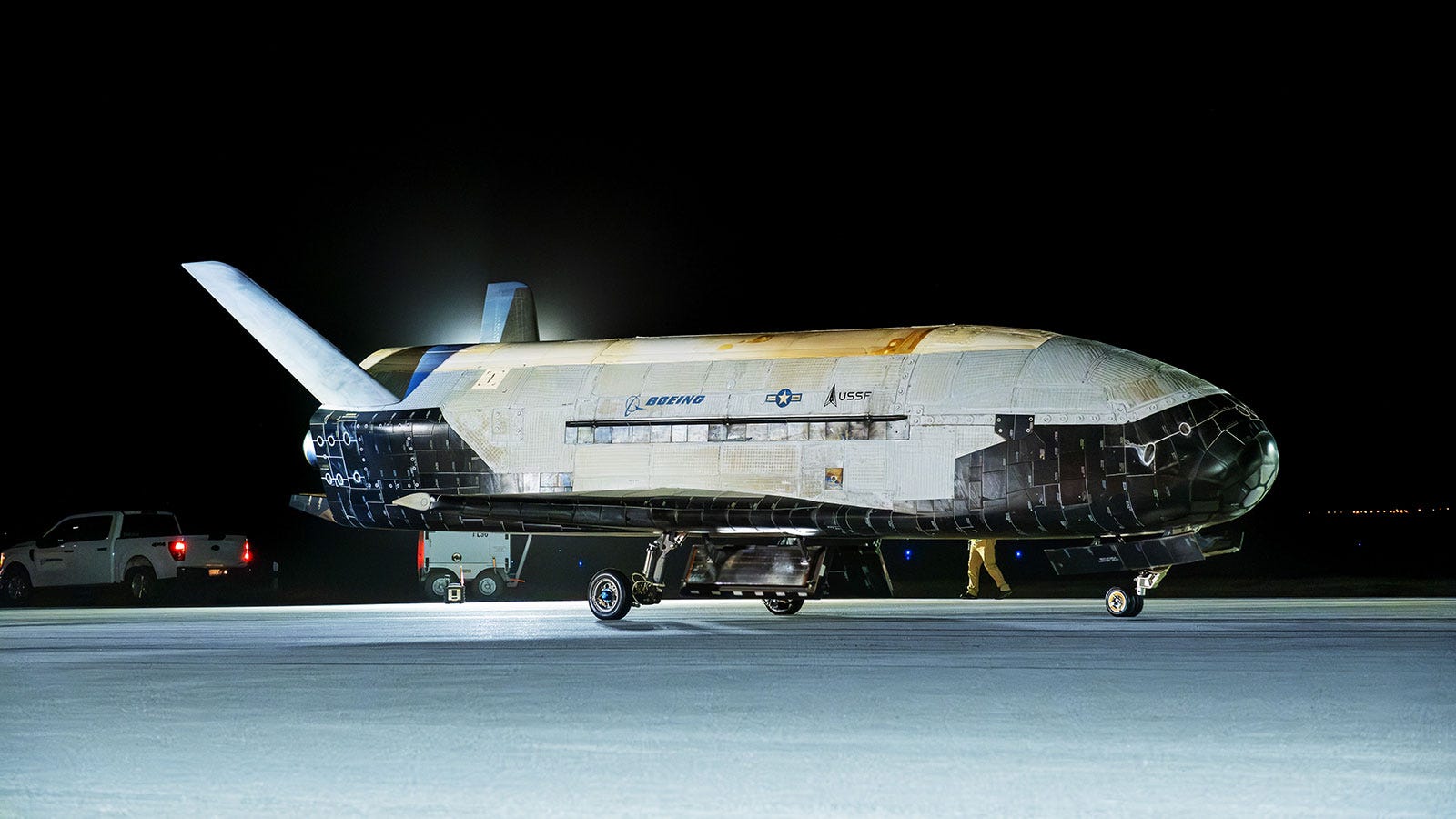
When the spaceplane was first sent into orbit in 2010, it was decidedly pointed downward, “testing” new hardware in real space environments, the military said. It also harbored an even deeper secret: a “Rods from God” weapon that would be able to attack any point on earth, literally a bundle of steel penetrators that could arrive in seconds and from who knows where.
Rods from God is now an obsolete idea. Despite fake reports of the U.S. running out of weapons because of the Iran war, it has more than enough rods to destroy anything and everything on the planet.
In 16 years, though, the world has changed. China and Russia have developed their own robust space capabilities and have deployed a variety of satellites and payloads that can engage in “orbital warfare,” as the military calls it. War in space is now indeed in space — the focus being up there, where the U.S. and allies have become ever more dependent on our own satellites. (Did you know that the U.S. has more than 10,500 satellites in active orbit, more than 90 percent of which are part of the SpaceX Starlink mega-constellation?)
The X-37B is not the only “on orbit” weapon, either, as satellites themselves are now part of the space arsenal. Earlier this month, the military conducted Apollo Maneuvers 26, an exercise practicing on-orbit maneuvers of satellites to position them to conduct offensive operations to destroy enemy communications, navigation, and spying capabilities. The military openly talks about these “Rendezvous Proximity Operations.” It is decidedly quiet about the “weapons” themselves, whether they be electronic warfare jamming and spoofing or other forms of cyberattack.
Meink also said that a U.S. space-based interceptor program had moved “from initial contract to flight-ready hardware in less than one year,” indicating that something new was recently developed. It could be as simple as a ramming satellite, but that is much too simple for the gold-plated developers. Instead, military sources and documents tell me, it is more likely a “directed energy” weapon, either a laser or high-power microwave, or something even more exotic.
According to one contracting document I’ve obtained, the military laboratories are still working on developing a “space-based neutral particle beam weapon,” a Reagan-era Star Wars dream that manages to still suck tax dollars out of us despite nothing to show for it. Again, directed energy is an open secret, but the specifics of whatever space weapons exist are not only under “special access programs,” they are also part of “special technical operations” that demand a different security clearance.
One military document describes the world of orbital warfare as “deception, disruption, denial, degradation, and destruction.” Many of those five D’s take place from earth. Space systems with code names like Bounty Hunter, Silent Sentry, Falcons, Browns and Meadowlands have been generally described in budget and other documents. Others, like the space-related Red Cloud electronic warfare system, or the Red Dragon and Kraken cyberspace warfare systems, have not been publicly acknowledged or explained.
The bottom line? The United States has a new space weapon, but the definition of “weapon” is unclear — and what’s new is questionable. That’s another important distinction the media coverage missed. What is a weapon these days often defies description. But the imperfect word still connotes a bomb or missile, that is, launched from an airplane, ship or tank. Space indeed might be the final frontier, but one reason the Spaceballs think they need more is that so much already goes to old-fashioned hardware, built around a now obsolete image of war.
Let’s hope we don’t end up shoveling an extra half-a-trillion dollars into the Pentagon money pit next year alone, as they’ve requested.
May the Schwartz be with you, Congress.
— Edited by William M. Arkin
The bottom line is the Department of Defense—now more frankly, of War—has been a money pit since the end of WW2. The Pentagon wastes money left and far right, its budget ought to be halved and efficiency made paramount.
The Masters of War never stop creating destruction. Onward Christian soldiers….