
From almost the beginning of the Iran war, the experts have complained that the Pentagon is running out of missiles, a supposed problem that says more about the nature of the national security debate than the state of the US military.
Washington officials are stuck on this half-propaganda, half-operational conundrum. They both want more money for the military and they want to make clear that no weapons shortages are constraining the US from fighting Iran.
This desire to have it both ways reached comic levels this week when U.N. Ambassador Mike Waltz said to Meet the Press that Biden was to blame for the missile shortage, before immediately insisting there was no shortage and that whoever is leaking that there is should be prosecuted.
Waltz's first instinct was to embrace the missile shortage, which is the instinct almost everyone has, and it reflects a broader unwillingness to entertain the possibility that the military has enough — not because that's wrong, but because it's inconvenient. Say it and you're defending the Trump administration, or waving off the danger to our beloved troops. So no one says it.
Under these circumstances, all sides win: proponents, opponents, and of course the Pentagon, which gets more money to close the supposed missile gap. Meanwhile, we are left in a trap that prevents us from answering the very sensible question of how the hell our $1 trillion military keeps getting hit by Iran’s missiles.
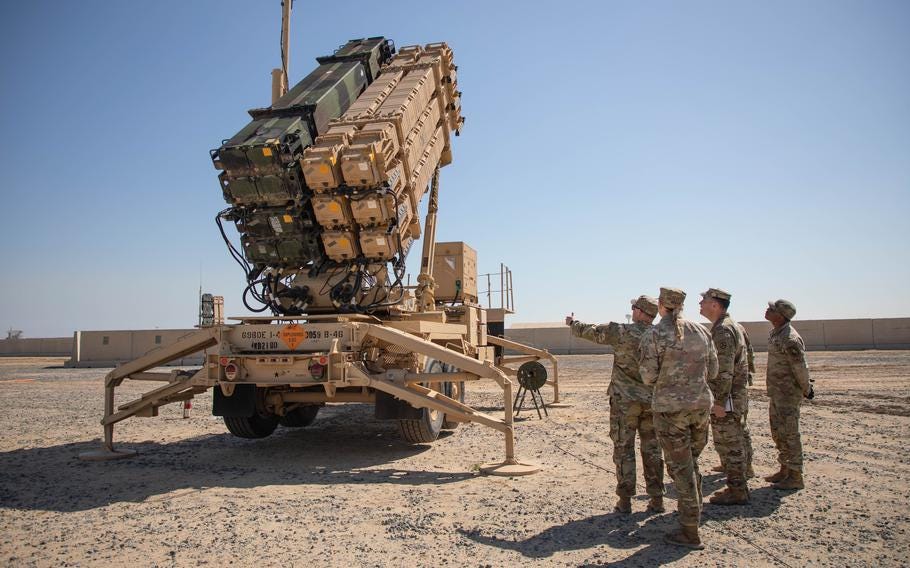
First, some facts. The missiles we are talking about are air defense missiles, those that are used to shoot down Iran’s missiles. According to the Center for Strategic and International Studies, the US pre-war inventory of the most modern missiles of these types (Patriot, THAAD, and Navy Aegis-related) was some 2,750 to 2,950. In the ways of the Pentagon, those missiles are split up between various geographic commands, some in Asia, some in Europe, some in the Middle East, etc. Israel has its own missiles, and the Gulf states own a substantial number of their own inventories, almost all purchased from the U.S. (it’s big business).
Given that Iran itself was estimated to have a pre-war inventory of just over 2,000 missiles and thousands of attack drones, clearly the stockpile of these defensive weapons was grossly inadequate if one factors in that they are supposed to be sufficient to deal with not just Iran, but also North Korea, China and Russia.
Before you jump up and say aha, he’s also arguing that we need more, read on.
The U.S. buys all sorts of weapons but clearly the ones that might be most important to fight a modern war (that is, to counter enemy missiles and drones) are not the priority, or even a priority. That’s because the military is all about offense, and particularly about bombing and attacking and maneuvering forces, even in the current environment whether it be the Middle East, Ukraine, Taiwan, or South Korea where the most effective weapons of the enemy are missiles and not tanks.
Partly this is western military culture. The pilots with their silk scarves and the tankers with their binoculars and the soldiers with mud on their faces — they get all the glory. Does anyone care about the dweebs far behind the front lines pressing buttons to shoot defensive missiles? Nope. “No guts, no glory,” as the saying goes.
Which just leaves a giant stockpile of questions: Did no one anticipate this? Iran has been an enemy for 40-plus years and, after 9/11 in particular, has specialized in creating an indigenous missile and drone force, selling them to Russia to fight the Ukraine war.
And if you say that the inventory of missiles is instead intended for war with Russia or China, then the situation is even worse, for those two countries have even larger inventories of missiles and drones. One might think that a priority for the Pentagon would be to have larger inventories of defense missiles to counter Russian and Chinese missiles. One might think. But these are not the sexy weapons.
From Star Wars to Iron Dome and now the Golden Dome, there’s been quite the effort to make defense look sexy. But that rubs up against the longstanding American way of war, which is to send out offensive missiles and attacking airplanes to destroy enemy missiles on the ground, followed by destroying the missile-supporting infrastructure. That’s certainly been the practice in the current Iran war.
So clearly the offense needs to be balanced with a defensive portfolio to shoot down those enemy weapons that thwart or circumvent the offense. But nope. There is no balance. Not for contingencies in dealing with Iran, and certainly not for China. Which should raise even bigger questions about how decisions are made in the Pentagon and how money is spent and why.
The argument during the nuclear era has been dominated by those who said that “ballistic missile defense” was bad because it might upset the balance of terror and undermine nuclear deterrence. The argument by this camp since Reagan’s Star Wars speech in 1983 is twofold. First, that missile defense makes nuclear war more likely because the Russians might perceive that they can’t ensure destroying the world so they would destroy the world to prove that their ability to destroy the world is preserved. And second — this is another important legacy that reverberates today — the argument that missile defense would never work, which is to say, when it comes to nuclear weapons, they wouldn’t work 100 percent, so it’s all or nothing.
Nothing has prevailed as the conclusion, and that has influenced the view of missile defense on the battlefield and regional level, creating a little bit of a prejudice against Patriot and its brethren.
As you’ve seen in my arguments above, every faction is responsible for not having enough missiles. But that’s because the debate is so ill-informed and the arguments are so narrow and everyone wins something by continuing to argue (or not argue) as they’ve been doing.
So, does the United States have enough missiles? The answer is as complicated as the missile gap of the 1950s. Except for one difference: how many missiles Iran has (or China or Russia) is known a lot better than eight decades ago. But clearly the models and the projections are no better, and many of the same biases exist. After all, the “missile gap” with the Soviet Union was used to justify building more nuclear weapons, that is, more offense.
That’s about what it boils down to today.
— Edited by William M. Arkin
This is offensive, not defensive. We don't need more. We need to stop.
Mike waltz has the IQ of a peanut.