
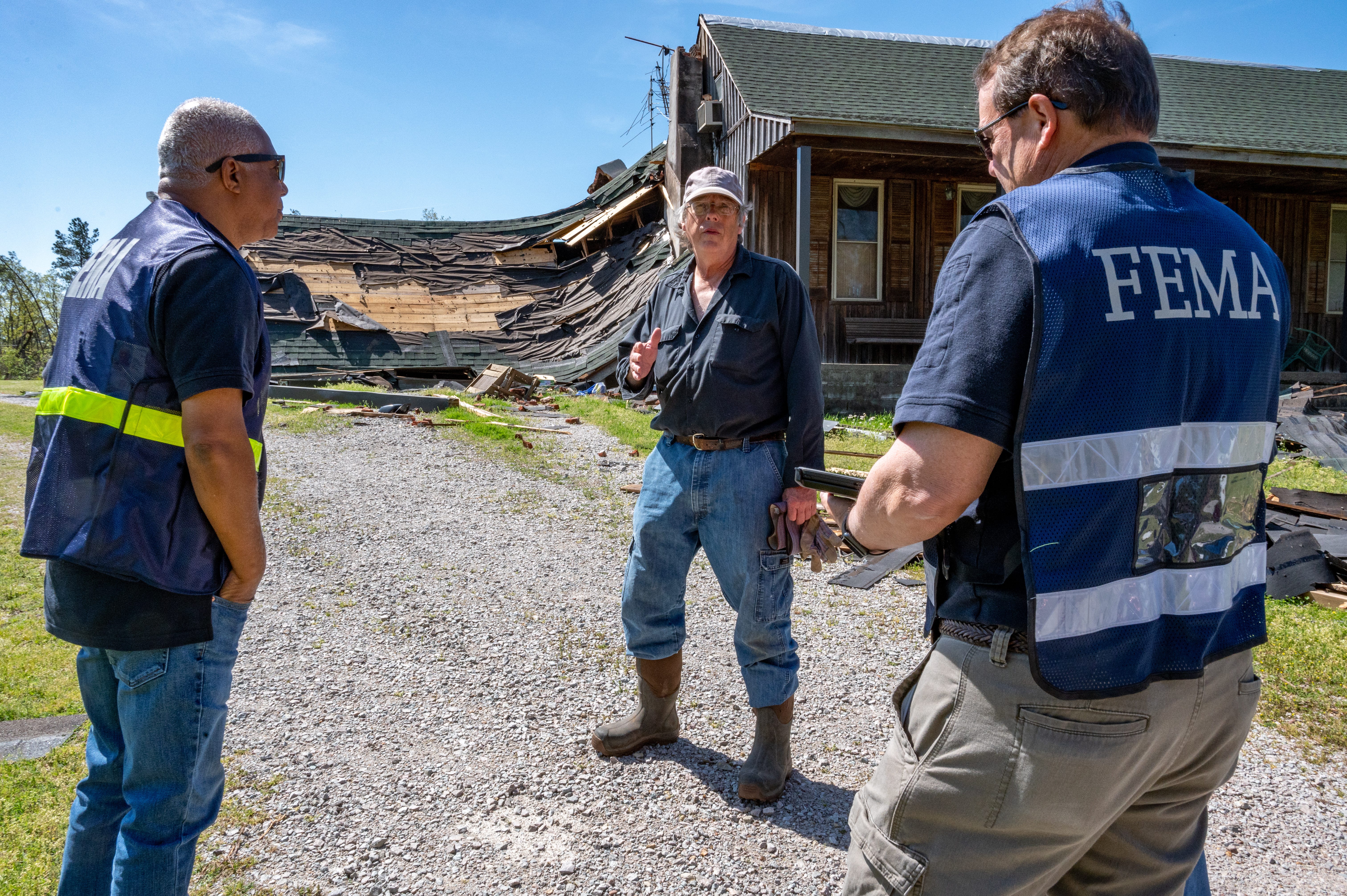
The Federal Emergency Management Agency, often criticized for its inadequate response to natural disasters like wildfires, floods, hurricanes, and tornadoes, has been assigned a new mission: “domestic terrorism.”
Now FEMA is shelling out grant money to state and local authorities to build up capacity to carry out pre-crime operations against “organized political violence,” as one FEMA information bulletin I obtained says.
The bulletin, dated July 9, instructs local authorities to prioritize “domestic terrorism” in their grant applications. Titled “Implementation of National Security Presidential Memorandum-7…,” the document echoes President Trump’s emphasis on rooting out suspected domestic terrorists before an attack takes place.
To head off these attacks, the bulletin tells states what to buy: training to spot “social media-based indicators,” analysts to monitor “online behaviors and digital footprints,” and teams for “managing persons of concern whose behavior indicates a potential trajectory toward domestic terrorism.”
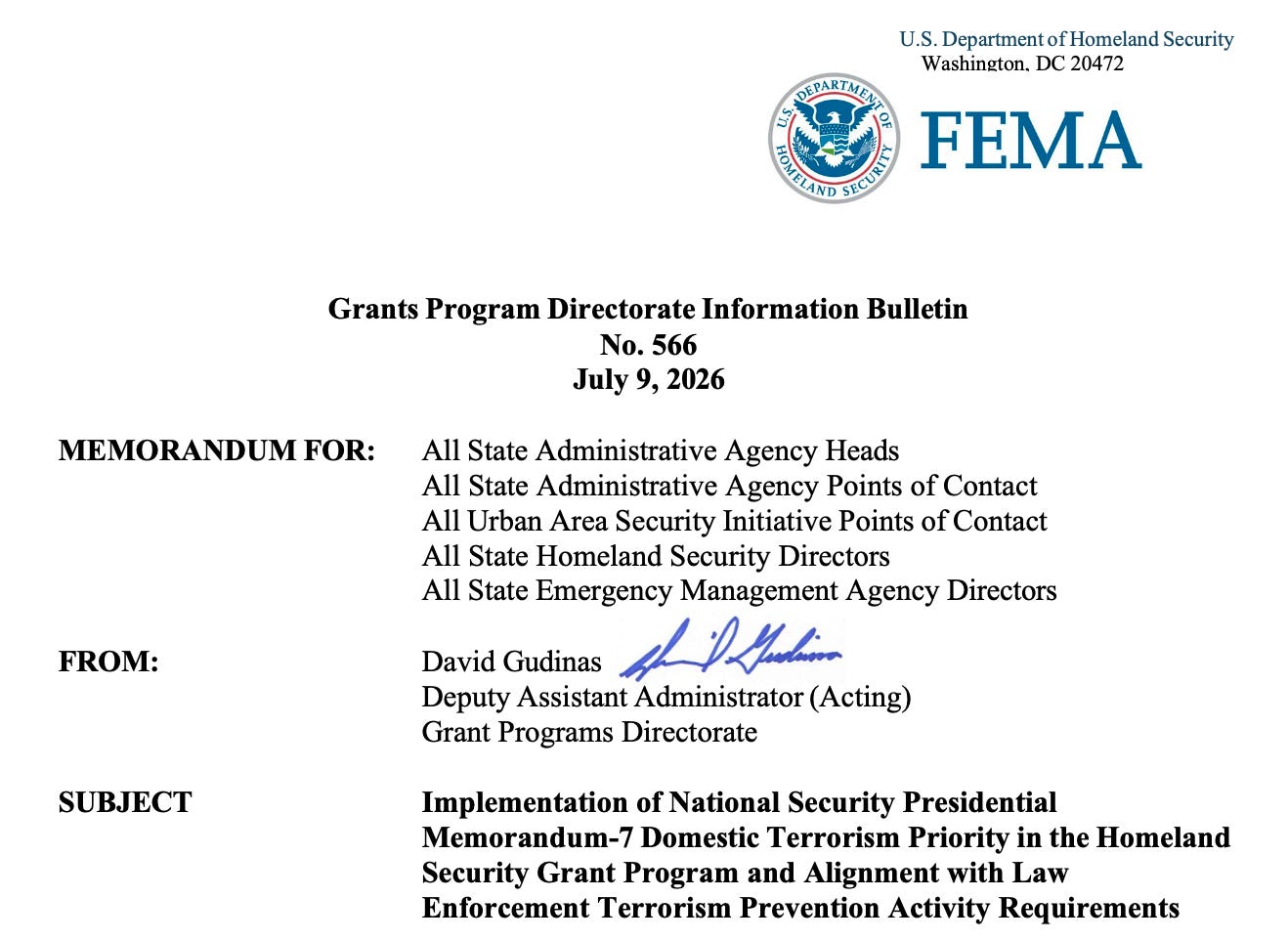

Some form of the word indicator — indicators, indicative, indicates — appears ten times in the eight-page FEMA bulletin. It is a favorite euphemism of law enforcement because it obscures what’s really happening: pre-crime. Indicators are something a person said or did that an officer has been trained to read as a sign of a crime that hasn't happened and may never happen.
Under this approach, the old requirement that evidence of a crime come first before any investigation is replaced by a forecast. It’s vibes-based law enforcement, divination but with the imprimatur of national security respectability. And while it’s mostly only been used against real, organized foreign terrorist organizations like Al Qaeda and ISIS, it’s now being deployed against Americans.
To give you a sense of just how central pre-crime is to this approach, consider the following grant proposals the FEMA bulletin calls for:
Learn “the latest tactics and trends used by domestic terrorism actors in order to recognize indicators prior to an attack.”
“Prepare and train communities to identify and report threatening or concerning behaviors that may be indicative of larger threat plotting and/or activity.”
Conduct “Surveillance and counter-surveillance training to detect pre-operational casing and hostile surveillance of domestic targets.”
As for why any state or local government would entangle itself in such fraught activities, a second document I obtained — from FEMA’s parent agency, the Department of Homeland Security — explains why. It contains a not-so-subtle warning to authorities that don’t adhere to the new domestic terrorism priority, saying:
“Failure to meet NPA [National Priority Areas] spending requirements will result in a hold on affected funds until compliance issues are resolved.”
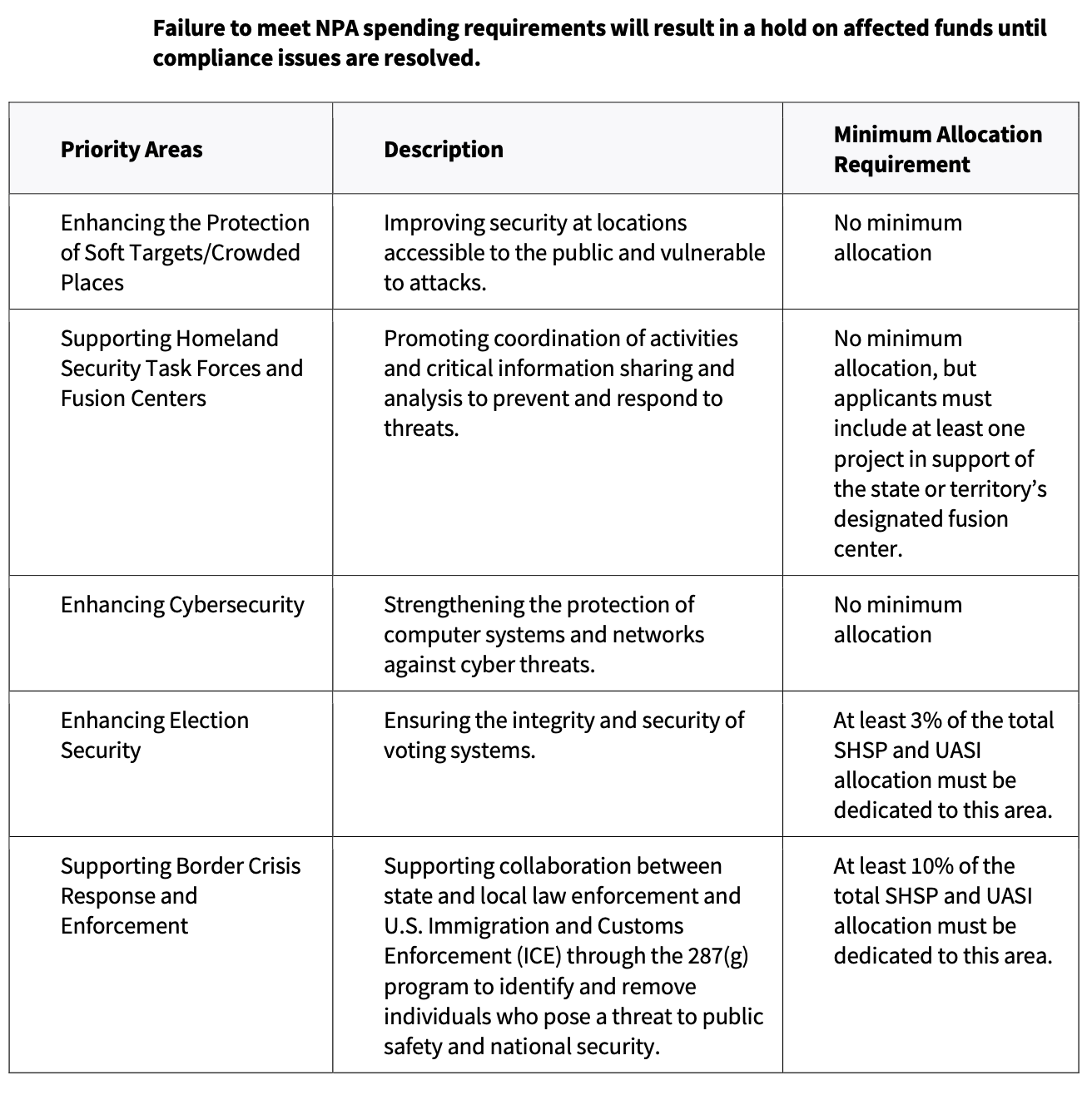
That second document, a Department of Homeland Security grant program notice, is a $1 billion shopping list of available federal money. But there’s a catch: thirty-five percent, it says, must go to terrorism prevention. Another thirty percent is allocated for five designated Department of Homeland Security priorities:
“Supporting Border Crisis Response,”
“Enhancing Election Security”
“Supporting Homeland Security Task Forces and Fusion Centers”
“Enhancing the Protection of Soft Targets/Crowded Places”
“Enhancing Cybersecurity”
The priorities track the president's own preoccupations. Just this month, Trump gave a primetime address claiming China had compromised the 2020 election. The “border crisis response” priority, meanwhile, points states straight at ICE's 287(g) program — which, as I've reported, turns local law enforcement into bounty hunters by paying them to do immigration enforcement, including bonuses tied to how many people they find. The “Homeland Security Task Forces” priority refers the new federal-local strike forces Trump created by executive order on his first day back in office to hunt cartels and enforce immigration laws.
And the “crowded places” priority has its own ghost: the assassination of conservative activist Charlie Kirk, shot in front of a crowd at a university event last September.
That murder is what precipitated all of this. Three days after signing an executive order declaring “Antifa” a domestic terrorist organization, Trump issued NSPM-7 on September 25, 2025 — a national security order that opens with a reference to Kirk’s murder and builds a counterterrorism program meant to prevent the next one.
NSPM-7 asserts that political violence in America “does not emerge organically” but is the product of “sophisticated, organized campaigns.” It identifies its own “indicators” of domestic terrorism to investigate, including: “anti-Americanism, anti-capitalism, and anti-Christianity; support for the overthrow of the United States Government; extremism on migration, race, and gender; and hostility towards those who hold traditional American views on family, religion, and morality.”
Until now, NSPM-7 has largely pointed at federal machinery, like the FBI and IRS. But a brief section toward the bottom of NSPM-7 reaches down to your county sheriff. It orders the homeland security secretary to develop grant programs to pay local law enforcement to go after domestic terrorism.

Washington knew this would happen, long before Trump entered the White House.
FEMA was created in 1979 as an independent agency. But after the 9/11 attacks, in 2003 it was folded into the new counterterrorism-focused Department of Homeland Security. FEMA’s preparedness functions and grant programs were pulled out and scattered across the department.
That September, the undersecretary for emergency preparedness and response sent Homeland Security Secretary Tom Ridge a seven-page memo warning that the reorganization would cripple America's ability to respond to disasters. He was overruled. Two years later came Katrina.
By October 2012, a bipartisan congressional investigation reported that the Department of Homeland Security could not say how much it had spent on fusion centers (the state and regional intelligence hubs, built after 9/11, where local police, federal agents and analysts pool information). DHS’s own estimates ranged from $289 million to $1.4 billion. The intelligence coming out of them was “of uneven quality,” the Senate concluded, finding it “oftentimes shoddy, rarely timely, sometimes endangering citizens' civil liberties."
Reviewing thirteen months of fusion center reporting, investigators found nothing that uncovered a terrorist threat and no contribution to disrupting an active plot. Of 610 reports, 188 were never published, many because they lacked useful information or risked violating civil liberties protections. Among the reports flagged: a Muslim community group's book recommendations, parenting advice, and a motorcycle club's pamphlet advising members to be polite to police during traffic stops.
Fourteen years later, the machine is being handed a mandate to watch digital footprints for indicators of anti-American sentiment.
FEMA, meanwhile, has absorbed roughly a 14 percent workforce reduction since January 2025 while managing more than 300,000 projects across more than 600 open disaster declarations.
Even in my little corner of the world, in Wisconsin, I can see how desperately the country needs a functioning disaster response agency. Yesterday afternoon a tornado came through the Fox Valley, about a hundred miles northeast of where I live. The National Weather Service issued a Particularly Dangerous Situation warning, a designation it saves for the worst of them. Video of what it left behind is heartbreaking and all over social media today: homes torn open, everything inside gone.
I’m sure the people who lost their homes will be relieved to know that they’re safe from domestic terrorism.
What is needed now is the thing FEMA was actually created to do, done by a civil agency neither militarized nor given over to an anti-political terrorism agenda. Instead we see a climate-change denying, domestic terrorism-obsessed administration creating its own disaster, with a do-nothing Congress standing idly by.
— Edited by William M. Arkin
I bet Trump would weaponize the Education Dept. to target other students—had he not defunded it completely.
He’s creating a new Stasi in America, you can’t even criticize Christian’s as part of free speech!
This might be comical, but we’ve already seen how he has sent members of ICE’s OPR to terrorize anyone who sent ICE a letter being critical of their methods. OPR is supposed to investigate ICE—instead they’ve become Trump’s personal assassination squad! Good times!…:)
So it looks like they are going to go after our vote by “enhancing election security”.This resembles a police state.