
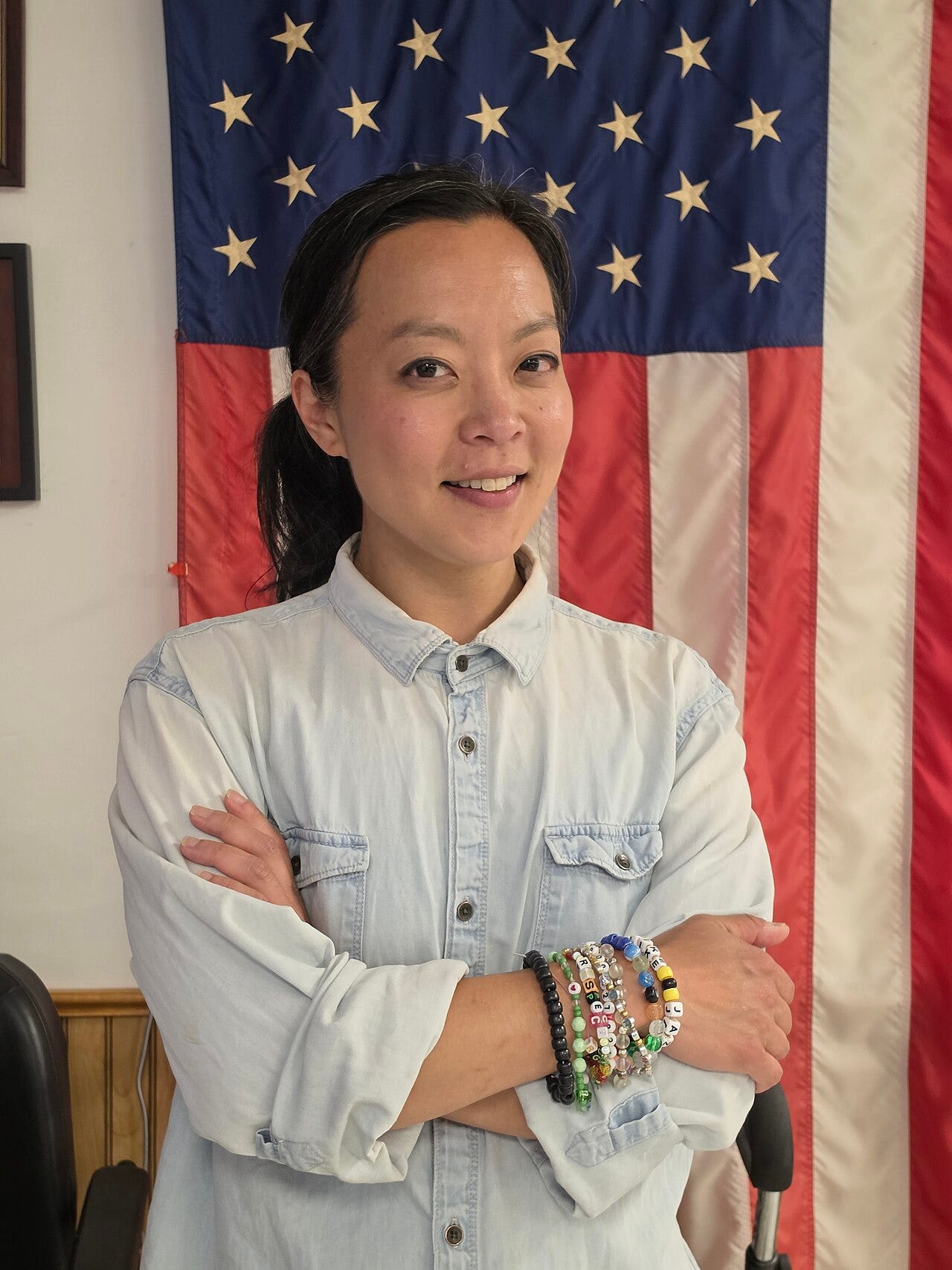
Francesca Hong’s insurgent campaign for governor of Wisconsin (where I live) echoes Zohran Mamdani’s rise, but with a striking difference.
She has something to say about national security.
Hong, 37, is a state legislator and chef based in Madison, where she was born and raised. The Democratic Socialists of America member entered the race for governor last September and has consistently led in the polls since March.
Whereas the New York mayor, for all his boldness in other areas, has largely avoided the issue of national security, Hong is facing it head on. I sent her a detailed questionnaire about her thinking on the Iran war, the president’s national security directive NSPM-7, and Wisconsin’s role in the war machine, and she came back with lengthy answers.
On an issue that many assume their governor has no role to play, Hong has proven otherwise. Most striking is her vow of a showdown with President Trump over the Wisconsin National Guard. As Hong told me:
“The focus of this campaign is on improving the lives of working people and families. That said, we do not live in a vacuum. As governor, I will tirelessly defend the people of this state against egregious federal encroachment and infringement upon our constitutional rights. I oppose any additional further deployments of the National Guard under federal status.”
This isn't hypothetical. Wisconsin Army National Guard troops have deployed in support of the war on Iran. Gen. Dan Caine, the Joint Chiefs chairman, volunteered it from the podium at a March 2 Pentagon briefing, singling out "the Wisconsin Army National Guard operating in Kuwait and Iraq." Governor Tony Evers confirmed it the next day.
Governors used to be able to say no. When a few of them refused to send Guard troops to Central America in the 1980s — Wisconsin's Tony Earl considered joining the lawsuit — Congress stripped them of that power under the Montgomery Amendment, a law upheld by the Supreme Court.
So I asked Hong: does a governor have any role left?
Hong replied:
“It will be my sworn duty as governor to defend the Constitution and to speak truth to power. I fully condemn Trump’s use of Wisconsin’s committed servants to execute his illegal war in Iran. I will refuse to comply with any request from this administration that perpetuates war and genocide around the world to the extent I can — and I will work with the state attorney general to file a lawsuit protecting Wisconsinites where executive authority cannot.”
And on the amendment itself:
“The Montgomery Amendment was an abandonment of checks and balances, and the Supreme Court offered a blank check to the president to federalize a state’s National Guard troops.”
Hong’s answers suggest a willingness to stand up to the federal government even when the odds look slim. That stands out at a time when so many see the Democratic Party as pre-folded lawn chairs allergic to conflict. The sense I get from talking to her supporters is that this willingness to throw a punch is a big part of her appeal.
“Trump’s test of our country’s limits will end with me”
The second section of the questionnaire dealt with NSPM-7, the September 2025 presidential order that instructs the federal national security system to treat “anti-Americanism,” “anti-capitalism,” “anti-Christianity,” and “extremism on migration, race, and gender” as supposed indicators of domestic terrorism.
It’s already produced results: eight defendants sentenced in the Prairieland case in Texas to a near-half millennium in federal prison; and 15 anti-ICE protesters indicted in Minnesota, where the U.S. Attorney cited NSPM-7 by name, to mention just a couple examples.
While NSPM-7 is a federal order, it’s carried out at the state level through FBI-led Joint Terrorism Task Forces in which local law enforcement participate. JTTFs were created in response to 9/11 and exist in every state but which no governor has ever terminated or even curbed.
Hong may be the first to do so, telling me:
“Because of the seriousness of the Trump threat, I would use my authority over state police forces to cease any cooperation with a federal joint operation task force that is designed to target American citizens exercising their civil liberties.”
On the existing memoranda of understanding that bind local departments to federal operations — the paperwork nobody covers and everybody signs — Hong said:
“These MOUs are a loophole to essentially federalize local police forces. I do not wish to see Wisconsin become a patchwork of communities where people are unsure if they are safe depending on which side of the county line they may find themselves.”
As with the Guard deployments, agree or disagree, there’s no question where Hong stands. She even called for the “immediate abolition” of ICE and vowed a showdown with President Trump, should he invoke the Insurrection Act.
Here’s how she put it:
“I am calling for the immediate abolition of the fascist brigade known as ICE, the banning of masked agents in our communities, and the protection of essential public spaces for all individuals. Furthermore, I will never concede to Trump’s demands to invoke the Insurrection Act. Our National Guard troops and, frankly, the National Guard troops of other states will not be engaging in police activities in Wisconsin. Trump’s test of our country’s limits will end with me.”
Going nuclear
I also asked Hong about her position on Wisconsin’s manufacturing role in the overall war machine of the country.
More than 300 suppliers across the state feed the Navy’s Columbia-class ballistic missile submarine program — the future sea leg of the nuclear weapons arsenal. One of the boats is even named the USS Wisconsin. In addition, Marinette builds warships. Oshkosh has built tens of thousands of armored trucks for the Army, and Sen. Tammy Baldwin is currently fighting to claw a military truck contract back from an out-of-state competitor.
This is the question that separates anti-war rhetoric from anti-war politics, because the answer costs union jobs in a state where union jobs are the whole ballgame. Hong took the swing, saying:
“I oppose militarism, and nuclear proliferation. I believe in President Eisenhower’s dream that we use ‘atoms for peace’ and orient all our magnificent scientific achievements towards aims that benefit all people. Republican talking points like to suggest that our desire for peace comes with the price of job loss. We are ready and prepared to expose that lie.”
She proposes conversion rather than shutdown, saying:
“Just as the nation rallied and pivoted to war production in 1941, I ask why we couldn’t generate the same urgency and enthusiasm towards producing energy and environmentally efficient vehicles, homes, and businesses.”
Her economic case is that public spending yields more jobs than military spending:
“Engaging in the same old corporate welfare for arms manufacturers neither makes the world a safer place nor develops the Wisconsin economy... military spending creates five jobs per million dollars spent, compared to 13 in education.”
And the tell that she knows exactly how dangerous this terrain is:
“We will not arbitrarily nor deliberately cost workers their jobs... We needn’t ask whether Wisconsin can transition to a peace economy, but who writes the transition plan.”
Whether or not you buy it, notice what it is: an actual position, in a state with a defense industrial base, from a candidate who could be governor in five months.
Everyone else
I asked the other two leading candidates to answer the same questions, and former Lt. Gov. Mandela Barnes answered, more cautious, but still recognizing that a governor has to have a position on something that many think is too remote or unchanging.
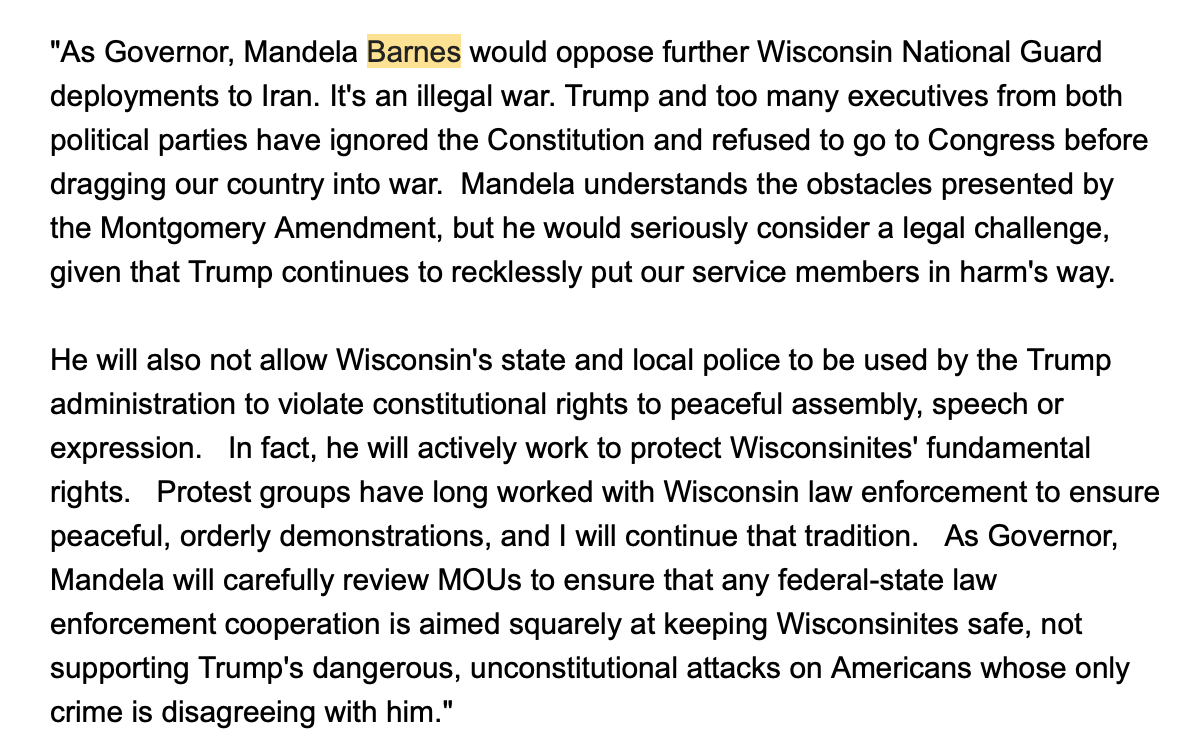
“As Governor, Mandela Barnes would oppose further Wisconsin National Guard deployments to Iran,” Lauren Hitt, a spokesperson for the Barnes campaign, told me. “Mandela understands the obstacles presented by the Montgomery Amendment, but he would seriously consider a legal challenge, given that Trump continues to recklessly put our service members in harm’s way.”
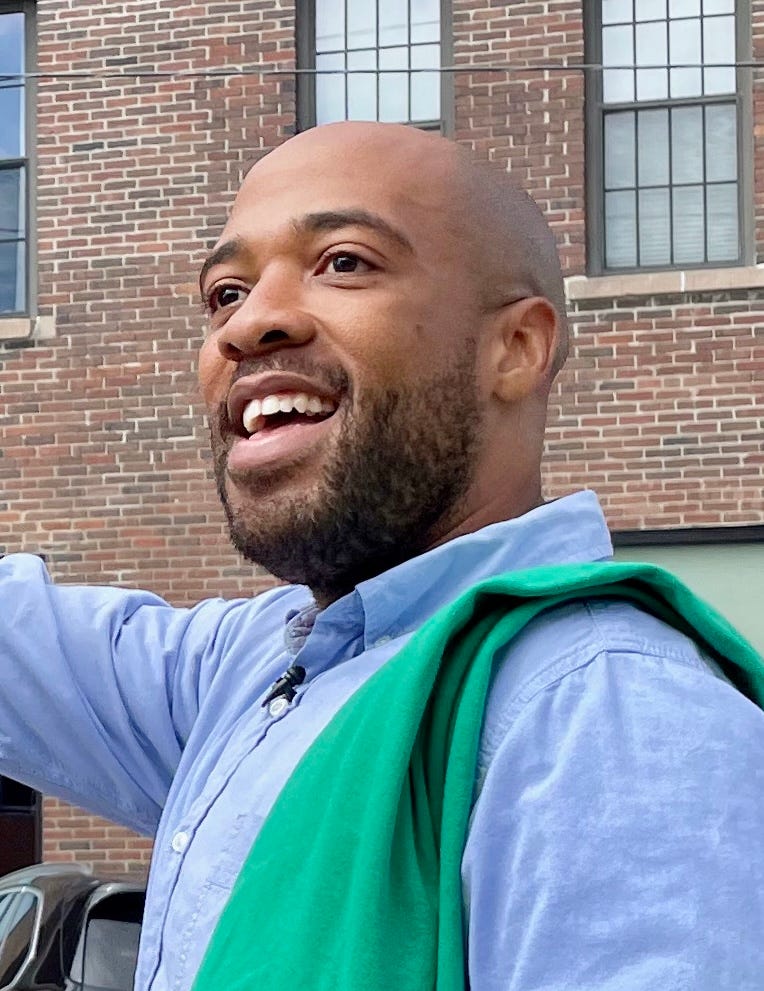
If true, this represents a challenge to federal power the likes of which we haven’t seen from a Governor in decades. Barnes’ language is far more conservative than Hong’s, but it’s also not nothing.
There’s also a hint of skepticism of the MOUs between state and federal law enforcement:
“As Governor, Mandela will carefully review MOUs to ensure that any federal-state law enforcement cooperation is aimed squarely at keeping Wisconsinites safe, not supporting Trump’s dangerous, unconstitutional attacks on Americans whose only crime is disagreeing with him.”
A promise to “carefully review MOUs” is, of course, not a promise to change them. But it’s more than I got from Milwaukee County Executive David Crowley, who did not respond to my questions.
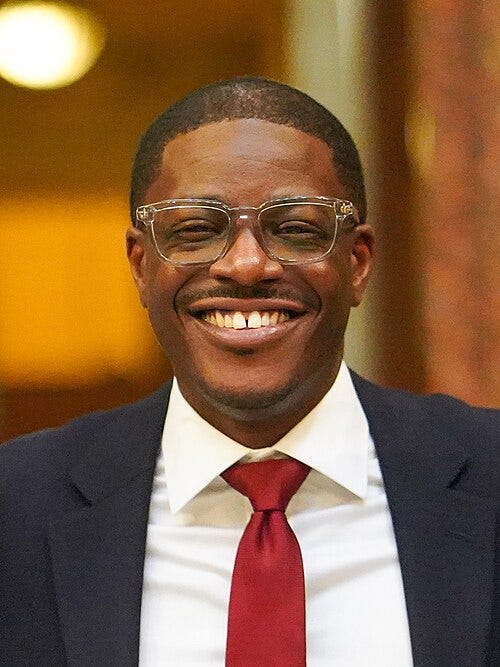
It’s hard to overstate how strange this primary has been.
74-year old Evers announced last summer he wouldn’t seek a third term, opening Wisconsin’s first genuinely competitive governor’s race in roughly a generation. Around a half-dozen Democrats piled in. Barnes, who came within about 27,000 votes of unseating Senator Ron Johnson in 2022, was the presumptive favorite from day one. Hong was the wildcard — a state rep from Madison’s bluest district with no statewide profile, polling around 14 percent in March.
Then the field started coming apart.
In early July, former Wisconsin Economic Development Corp. CEO Missy Hughes and Crowley both quit and endorsed Lt. Gov. Sara Rodriguez, who had just won the straw poll at the state party convention. For about a week, Rodriguez looked like the consolidation candidate — the establishment’s answer to Hong.
Then the $1 million TV ad blitz Rodriguez’s campaign had announced on July 7 never aired.
Rodriguez said she had hundreds of thousands of dollars less on hand than she’d been told. She fired her campaign manager, citing “serious mismanagement,” held a Monday press conference calling it a bump in the road — but by Friday was out of the race.
“I am deeply hurt and betrayed by what happened,” Rodriguez then said. Campaign finance reports filed that week showed her with less cash than every rival in the race, including Hong.
Roughly 24 hours later, Crowley un-quit. He relaunched his campaign Saturday in Milwaukee, telling supporters, “We cannot allow the GOP to choose the Democratic nominee for governor of the great state of Wisconsin, period” — a slight clearly directed at Hong.
Governor Evers quickly endorsed Crowley, prompting backlash over suspicions that the party establishment was putting its thumb on the scale to defeat Hong.
For his part, when Crowley was asked about people’s concerns that he’s the establishment’s pick, he replied: “"When you think about the establishment candidate, I don't think you see a black kid from the city of Milwaukee."
The primary is August 11. The winner faces congressman Tom Tiffany, one of the most conservative members of the House and Trump’s endorsee.
Something’s up
Francesca Hong was born in Madison in 1988 to Korean immigrant parents, graduated from Madison West, enrolled at UW–Madison to study Spanish and journalism, and dropped out to become a cook. She started in 2009 washing dishes and taking every part-time kitchen job she could get, worked her way up to executive chef at 43 North, and in 2016 opened Morris Ramen downtown with her then-husband. One of the restaurant’s first events was a Planned Parenthood fundraiser. Morris Ramen closed in 2024, killed by rent and costs.
Hong ran for the Assembly in 2020 because of the pandemic, won a seven-way primary with 28 percent, and became the first Asian American elected to the Wisconsin Legislature. She takes no corporate PAC money. She is one of four socialist caucus members in the Assembly, and a single mother known — per the Wisconsin Examiner — for prodigious cussing and karaoke fundraisers. (“I curse because I care,” she’s said.)
The state GOP chair’s summary of the electability case against her: “We’re in Brooklyn, Wisconsin, not Brooklyn, New York.”
Maybe, but I don’t buy it. Wisconsin also elected socialist mayors in Milwaukee for most of the first half of the twentieth century, and Hong is explicit about claiming that lineage rather than the New York one.
Here’s what I actually want to flag, apart from who wins on August 11.
For a decade, the Democratic Party’s answer on national security has been to have no answer — to treat war, surveillance, and the security state as federal weather, something that happens to a state rather than something a state participates in. Governors sign the MOUs. Governors sign off on the Guard. Governors hand out the tax credits to the defense contractors. And then governors say national security is above their pay grade.
Hong’s questionnaire answers are obviously not, on their own, proof that she’d follow through.
But as candidate for governor, she clearly read the statute, named the precedent, and says what she’d do inside the constraints and what she’d sue over outside of it. Her opponent Barnes, though hedging, puts himself on record against further Iran deployments and floats a legal challenge — a position he almost certainly would not have volunteered two years ago.
Something is shifting here. National security is coming home.
Previous insurgent candidates like Mamdani spent 2025 proving that a candidate in America can win on affordability issues like rent and groceries. Hong is testing something harder: whether a state-level candidate can also challenge the national security establishment.
They aren't separate questions. The Pentagon is seeking $1.5 trillion a year — which over four years would be more than the United States spent on all of World War II (yes, adjusted for inflation). With crushing expenses like that, it’s hard to imagine much money being left over for an affordability agenda.
That’s the Hong innovation. Not simply that a democratic socialist is leading a poll in a swing state — that’s the horse race. It’s that someone running for an office with real, if limited, power over matters of national security is finally treating that as part of the overall job.
I’ve enclosed copies of Hong’s and Barnes’ answers to my questions in full below. Please chip in to help support this coverage by becoming a paid subscriber or with a contribution to my GoFundMe here.

— Edited by William M. Arkin
WOW! She was totally unknown to me until this. Her position on the Wisconsin National guard not being deployed in Foreign wars is something I support 1,000%.
So many were deployed several times to the Iraq war and came back missing limbs. I was so disgusted! Our boys need to remain HERE.
I was supporting Mandela Barnes but I prefer her as a candidate now: The woman has something to say, and contrary to so many politicians, she's not nebulous or ambivalent about it.
From the details you give, it appears that she's studied the situation in depth.
Thanks, Ken. Your writings are always on point. It's blogs like yours that even the chances of good candidates and erase a money advantage.
Thanks for covering this race, Ken!! Go Francesca!!!