
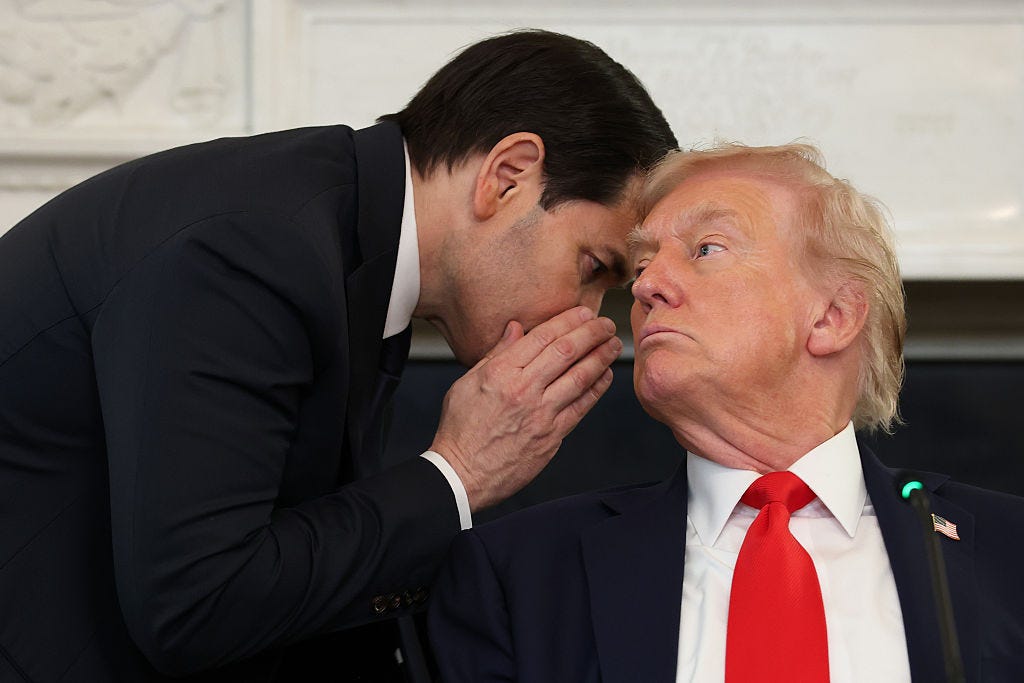
Secretary of State Marco Rubio will be hosting a big diplomatic summit in Washington on Thursday — not about the Iran war, but about “political terrorism.”
Sterile as that may sound, it’s a resurrection of an obscure Nixon-era term pointed squarely at the political left and recruiting foreign governments to assist its war on domestic political opponents. As a U.S. diplomatic cable leaked to me puts it, all of this is about combatting “far-left terrorism.”
To the extent that media have noticed the summit at all, they’ve focused on the confusion and wariness among some of the over 60 countries invited; but the significance of the term has been completely overlooked. Put simply, it’s a more powerful attack on protest, free speech and the Democratic Party than Trump’s designation of “Antifa” as a domestic terrorist group or NSPM-7.
The summit is called the “Ministerial on the Resurgence of Political Terrorism.” Unlike familiar organized terrorist groups like Al Qaeda or ISIS, “political terrorism” refers to domestic opposition, here and abroad.
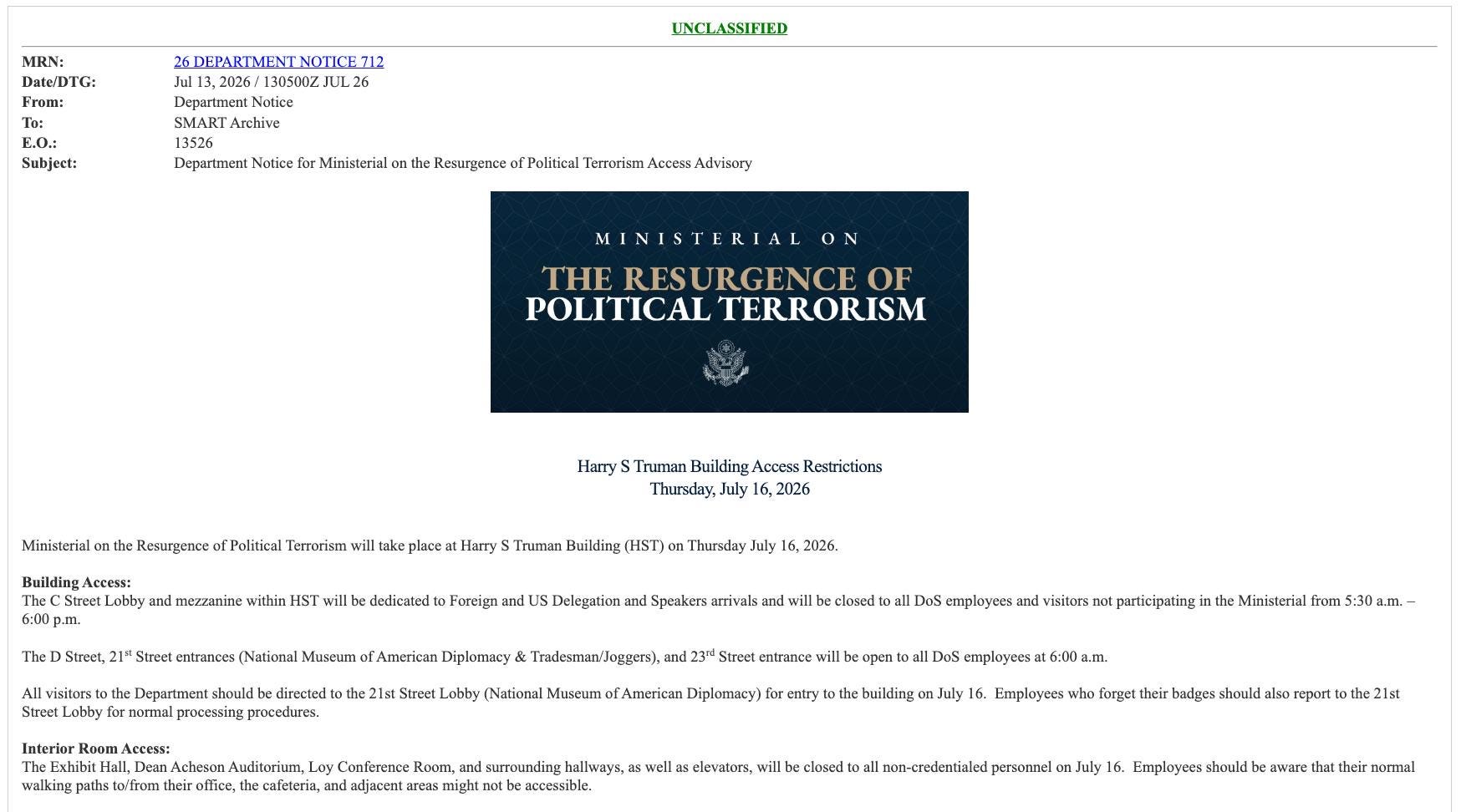
If you’ve never heard the term, it’s because the Trump administration has up to now never used it. In fact, this is the first time it’s been used by the federal government in decades.
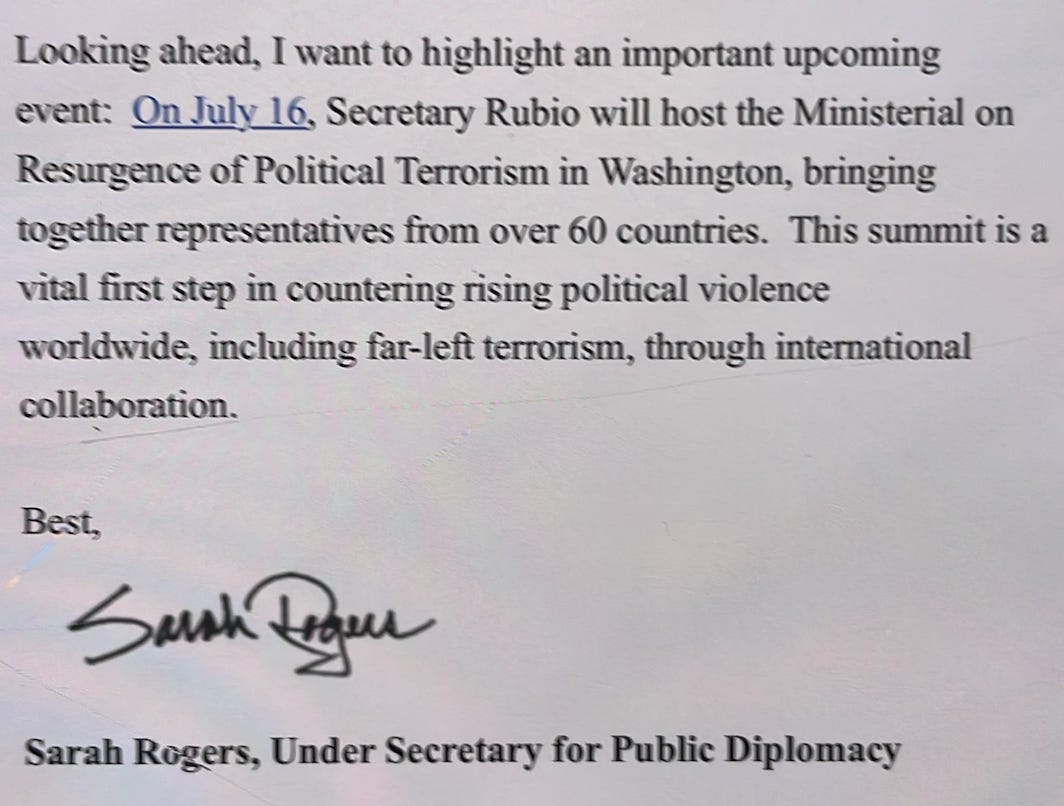
“This summit is a vital first step in countering rising political violence worldwide, including far-left terrorism, through international collaboration,” a U.S. diplomatic cable dated July 13 says.
“Political terrorism” is a term first adopted by the Nixon administration for its war on “subversives,” carried out in the darkest days of the Vietnam war and a period of intense public protest. Sometimes referred to as “COINTELPRO” (an acronym for Counterintelligence Program), it was a series of covert and illegal actions by the FBI from 1956 through the early seventies that aimed to surveil, infiltrate, entrap and undermine leftist political organizations, everything from civil rights and anti-war groups to the Black Panthers.
State Department spokesman Tommy Piggot hinted at the historical significance last week.
“The resurgence of violent far-left political terrorism is not a new phenomenon — it is an old threat re-emerging with strong transnational links and new convergences,” Piggot said in a statement on the summit.
The administration’s obsession with left-wing terrorism was precipitated by the murder of conservative commentator Charlie Kirk — a personal friend of Trump’s and many in the administration. In my reporting at the time, based on interviews with friends of the alleged gunman, Tyler Robinson, I warned that there wasn’t any evidence that the murder was a partisan act, nor that he was a leftist or even political in general.
That reporting, criticized at the time in an environment where seemingly everything was polarized into Team Red White and Blue, has now been vindicated to an extent that I did not anticipate.
Just last week, Robinson’s lover, Lance Twiggs, who is cooperating with federal prosecutors, testified that Robinson barely ever discussed politics and had never once mentioned Kirk before the shooting.
It’s an extraordinary revelation, made under the clearest penalty of perjury one can imagine, given the Trump administration’s investment in framing the killing as an act of “political terrorism.” After the shooting, FBI Director Kash Patel even testified before Congress that the Bureau was investigating every other member of Robinsons’ discord chats and even the possibility of a foreign nexus. This was based on his suspicion that the killing was carried out by some kind of organized cell, a theory that promptly fell apart.
The killing was, by all appearances, just a young man with a gun, pissed off about what Charlie Kirk said about the LGBT community.
To the Trump camp, Kirk’s killing solidified their thinking that a vast conspiracy existed amongst the left to destroy the nation. Their counter to this imagined national security threat has been to link Trump’s NSPM-7 national security directive, the nihilist violent extremism label, and the executive order designating “Antifa” as a terrorist organization into a larger umbrella: “political terrorism.”
Or as I call, POLTERGEIST, because the “political-terrorism” term is an attempt by the Trump administration to summon a ghost from the Nixon years.
Perhaps the only official definition of political terrorism appears in a declassified 1970 CIA intelligence report.
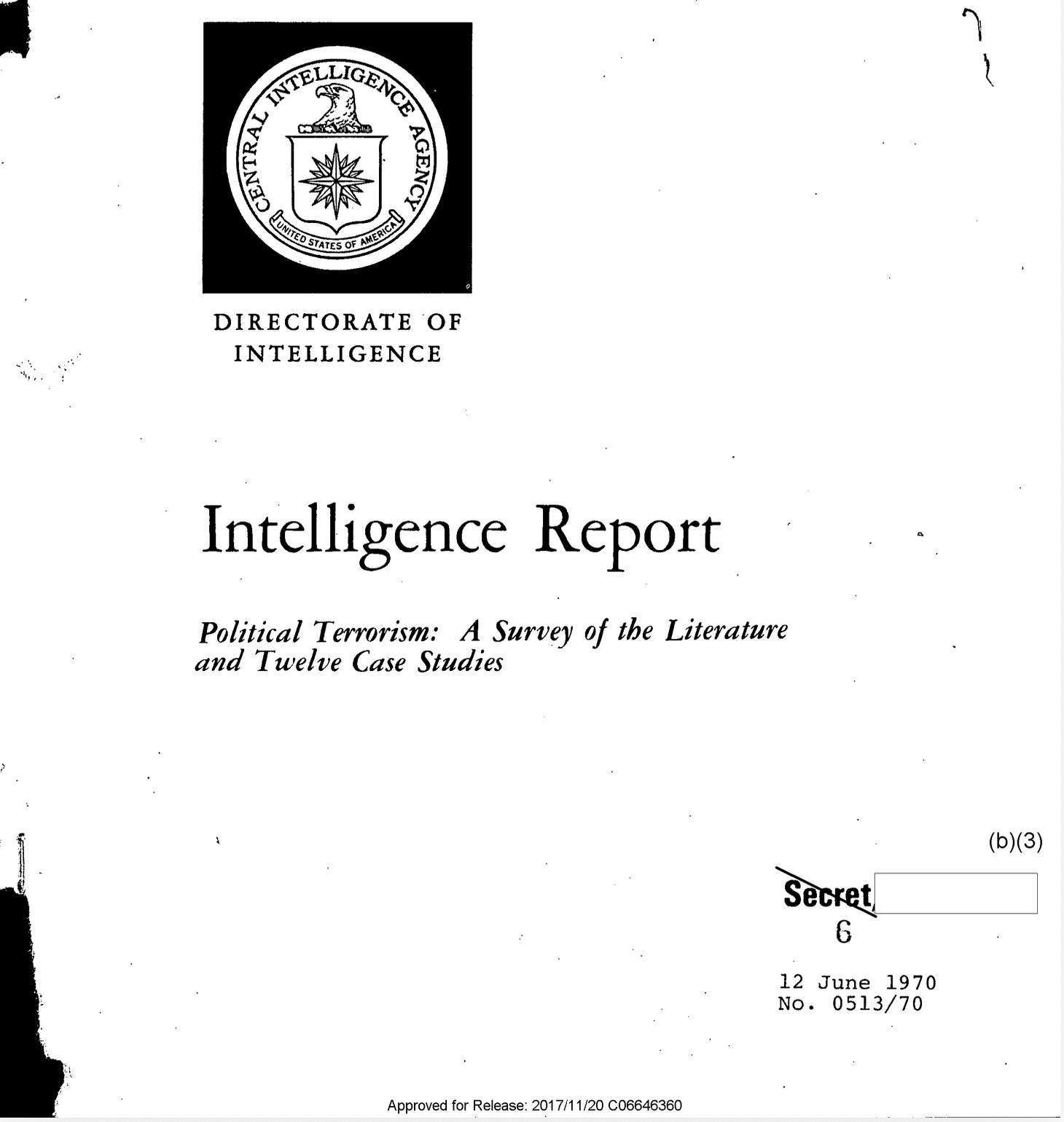
“Political terrorism is symbolic action, by those out of power, designed to achieve political ends through the systematic use of violence,” the report says.
It goes on to differentiate political terrorism from other forms of violence, saying:
“It is distinguished from intimidation (which emphasizes threats), mob violence (normally unplanned and uncontrolled), mass insurrection (larger in scale, later in time), and governmental terrorism (presented as law-enforcement). It may be practiced by anarchists, by nihilists, by their successors the modern totalitarians, by nationalists, and by a variety of social groups with genuine or fancied grievances.”
In 1972, responding to the Black September terrorist attack at the Munich Olympic Games, Nixon issued a formal presidential memorandum that officially institutionalized counter-political terrorism by creating a Cabinet Committee. Nixon’s 1972 mandate explicitly ordered the heads of the State Department, DOJ, CIA, FBI, Treasury and other agencies to coordinate government-wide actions to “prevent terrorism here and abroad.”
Again, not terrorism as we normally think of it, but political opposition.
In response to the memo, the State Department appointed its first-ever Special Assistant to the Secretary of State and Coordinator for Combating Terrorism. Within days, the new Special Assistant was peppering the term “political terrorism” in internal memos.
Unlike the Kirk assassination, the Munich Olympics massacre really was carried out by a terrorist group. Black September was a highly structured, centrally-commanded paramilitary with the explicit political goal of compelling the release of Palestinian political prisoners and forcing global visibility onto the Palestinian nationalist cause. It counted among its leaders the intelligence chief of the Palestinian Authority, Amin al-Hindi.
Now compare that with Tyler Robinson, an angsty 23-year-old from a Mormon family who was dating Lance (known to him as “Luna”) Twiggs and was upset enough about Charlie Kirk’s rhetoric on LBGT people to take action, allegedly.
In Trump’s National Security Presidential Memorandum 7, or NPSM-7, the president directs the Departments of State Treasury, Justice and various other federal agencies to prioritize investigating and preempting left-wing violence. Sound familiar?
In a section examining the effectiveness of terrorism in different political environments, the CIA report from 1970 says:
“Terrorism can pose a serious challenge to free societies in which great social injustices or severe economic problems exist (e.g. Guatemala), but terrorism does not do well in free societies in which serious grievances are not widespread [redacted].”
Good thing Americans perceive no “great social injustices” today!
— Edited by William M. Arkin
From a radical left scum, I say bring it. I don't think this regime understands just truly how angry the people are.
Come on USA.......keep taking people on the so-called 'left' down.
YOU will NOT win this game.
Much of the world has woken up with thanks to dear Ken and others.