
While the media fixates on AI extinction scenarios, government and industry are fighting over something far more concrete: who gets to control America’s response to AI.
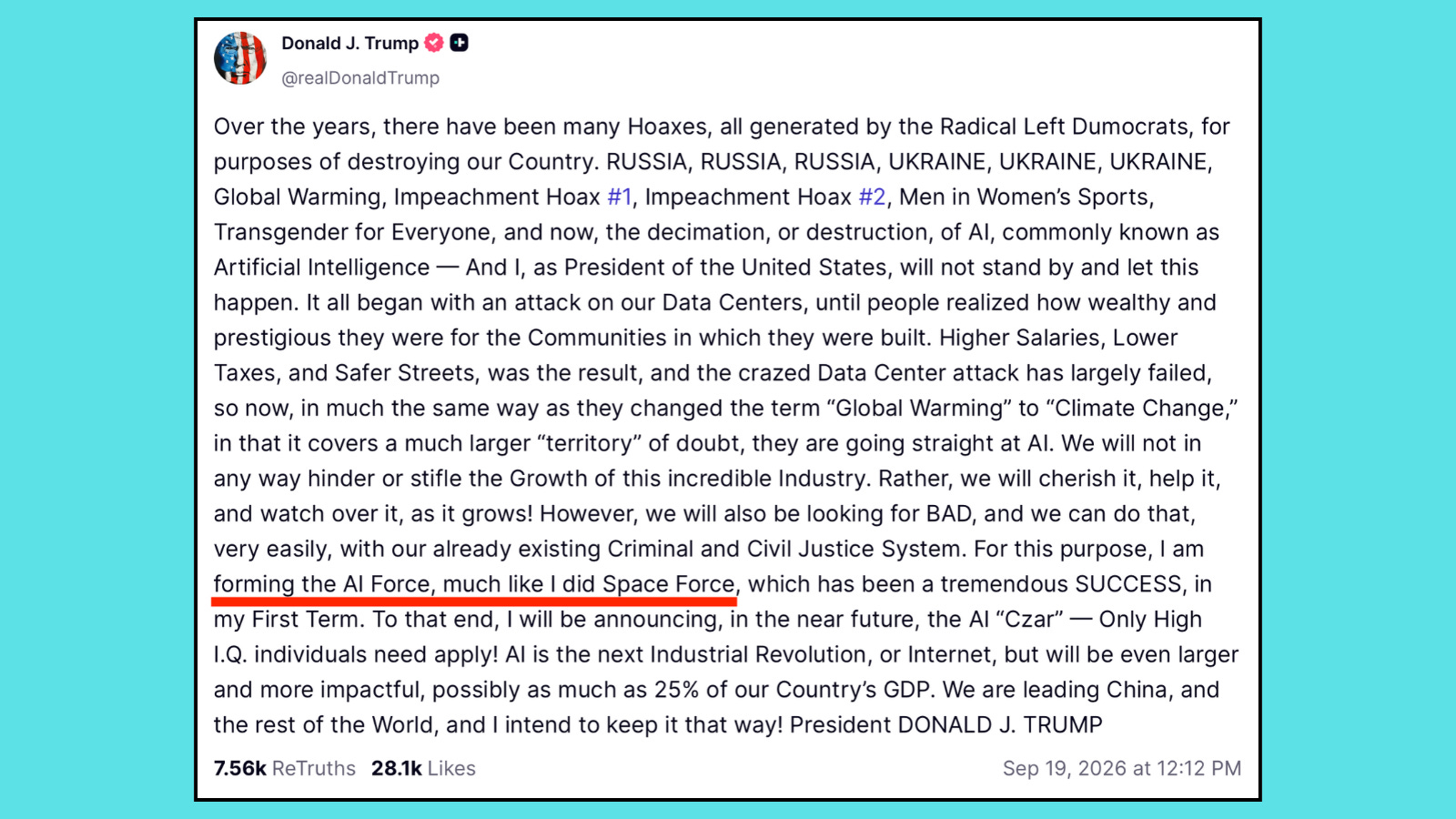
“I am forming the AI Force, much like I did [the] Space Force,” Donald Trump said last Saturday.
Almost immediately, the AI shark tank started circling, eager to shape the president’s musings into something concrete, something that would benefit — them.
It’s a Washington playbook and a kind of Rorschach test: the movers and shakers, the experts and the moguls telling you what the president “meant,” what an AI Force should be, whether it’s needed, and if it’s not, what’s needed instead. It’s a trillion-dollar Christmas wishlist you’re paying for but have no say in the contents, which will dictate the future of AI.
A seventh military branch, alongside the Air Force, Army, Coast Guard, Marine Corps, Navy, and Space? Another military command alongside Cyber Command or Strategic Command? Another powerful agency like NSA?
Trump’s Space Force comparison is “the shape of an answer, but without the substance,” Philip Reiner, CEO and co-founder of the Institute for Security and Technology, told Defense One. Everyone is rushing in to fill that empty vessel.
“Space Force works because Congress can give it a doctrine, a budget, a personnel system, but there’s no equivalent for AI,” Reiner said, adding: “this is more of an actual [Defense Department] lane…”
Then there’s Leah Siskind of the hawkish Foundation for Defense of Democracies, who said that she sees Trump’s AI Force as “a key vehicle for bolstering artificial intelligence expertise across the Defense Department and the rest of the federal government.”
Of course the naysayers point to impediments like the need for new laws, a budget, and an act of Congress, yadda yadda, but that’s not how things congeal. Quickly the consensus has formed that some kind of military entity needs to take over.
Congressman Rich McCormick (R-GA), a member of the Armed Services Committee and former Navy commander, embraced Trump’s idea.
“President Trump’s proposal for an AI Force Czar puts a needed focus on accelerating American innovation and cutting through barriers that slow us down,” McCormick said. “China is moving fast. America needs to move faster.”
Okay, he says Czar, which suggests civilian rather than military, but the national security red card has been flashed: that because of China, we need to do something big. Before you know it, Washington has declared an AI war.
At least one tech industry figure expressed misgivings, noting that the Space Force comparison portends a military takeover of the tech sector.
“Rather than use civilian agencies to regulate it, use the Pentagon to try and dominate it,” an industry representative told Politico.
One person who has called for civilian coordination is White House Office of Science and Technology director Michael Kratsios. “These implications of AI spread across so many different agencies,” he told Fox News, adding that “to have someone at the White House to be able to work on all those issues across the agencies is really critical.”
No surprise that a White House official wants Trump’s AI Force to reside in the White House; but when it comes to big money and calls of national security, the military is the colossus, even if the organizational design is yet unclear.
So, as is often the case with the military, secrecy comes to the rescue. Some tech leaders are actively asking for their work to be absorbed into the military’s black budget. Guillaume Verdon — founder and CEO of AI hardware startup Extropic and a former Google researcher — argues for locking AI development safely behind classified doors.
“Any sort of AI Cyberdefense or AI Biodefense work should be a contract from the US AI Force and under strict clearance/export control, just like any sensitive defense work,” Verdon said.
Trump muses, and everyone from Silicon Valley tech execs to the Pentagon brass smells fresh meat, ready to make an AI Force follow their design and their interests. Concerns about AI itself, the coming AI war, or the future of humanity are subsumed into an organizational turf war. Meanwhile, secretly, everyone is eager to siphon off billions and develop secret weapons while the legislators and the bureaucrats are busy fussing with org charts.
I’m a skeptic of the AI apocalypse narrative (see: “Is The AI Apocalypse For Real?”). However, I do see the dynamic shaping up where some 50-year debate ahead of us (like the nuclear debate) generates dinners and seminars and conferences and proposals and guardrails and agreements and treaties. Through all of it, an AI Force will form and the weapons of our destruction will emerge, with the people shut out both because it has become a matter of “national security” — which is to say, none of our business.
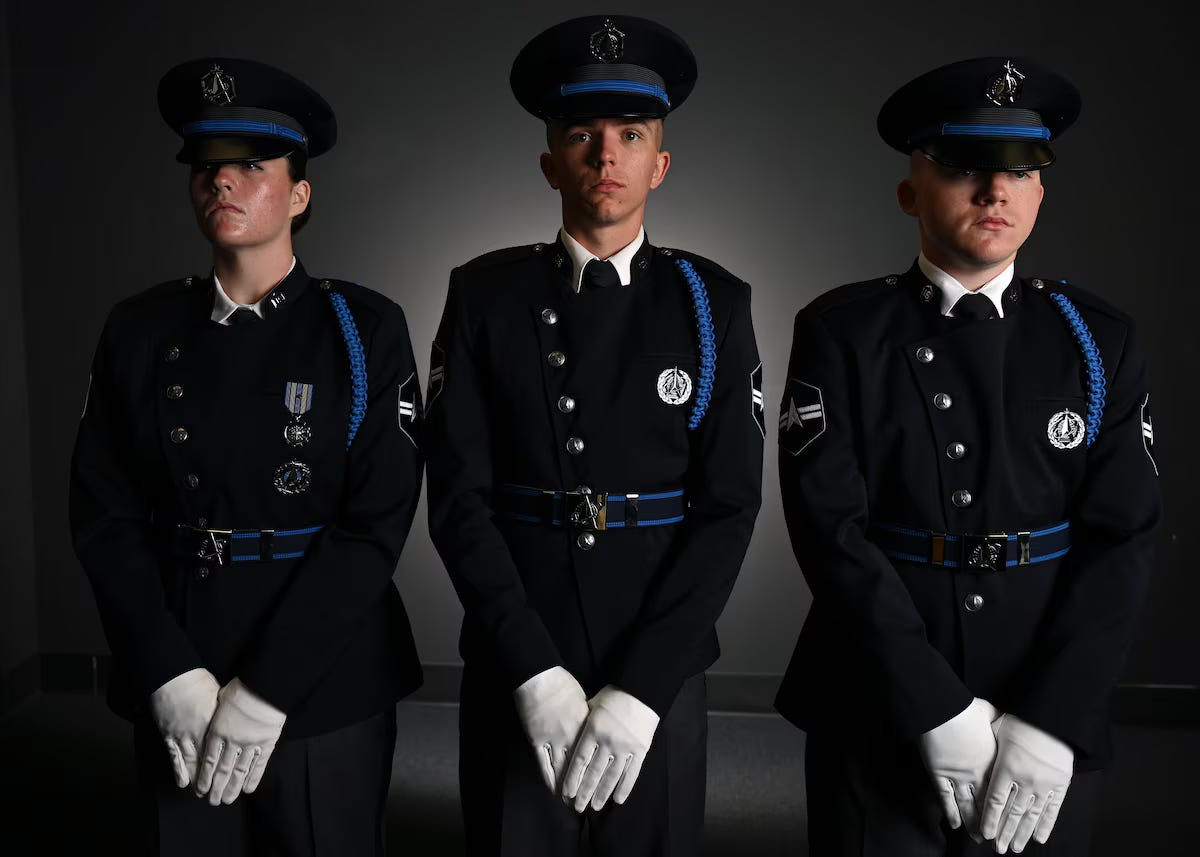
Then we’ll be asked to enter the contest to design the new AI Force uniform.
Suggestions anyone?
— Edited by William M. Arkin
Suggestions for the AI Force uniform?