
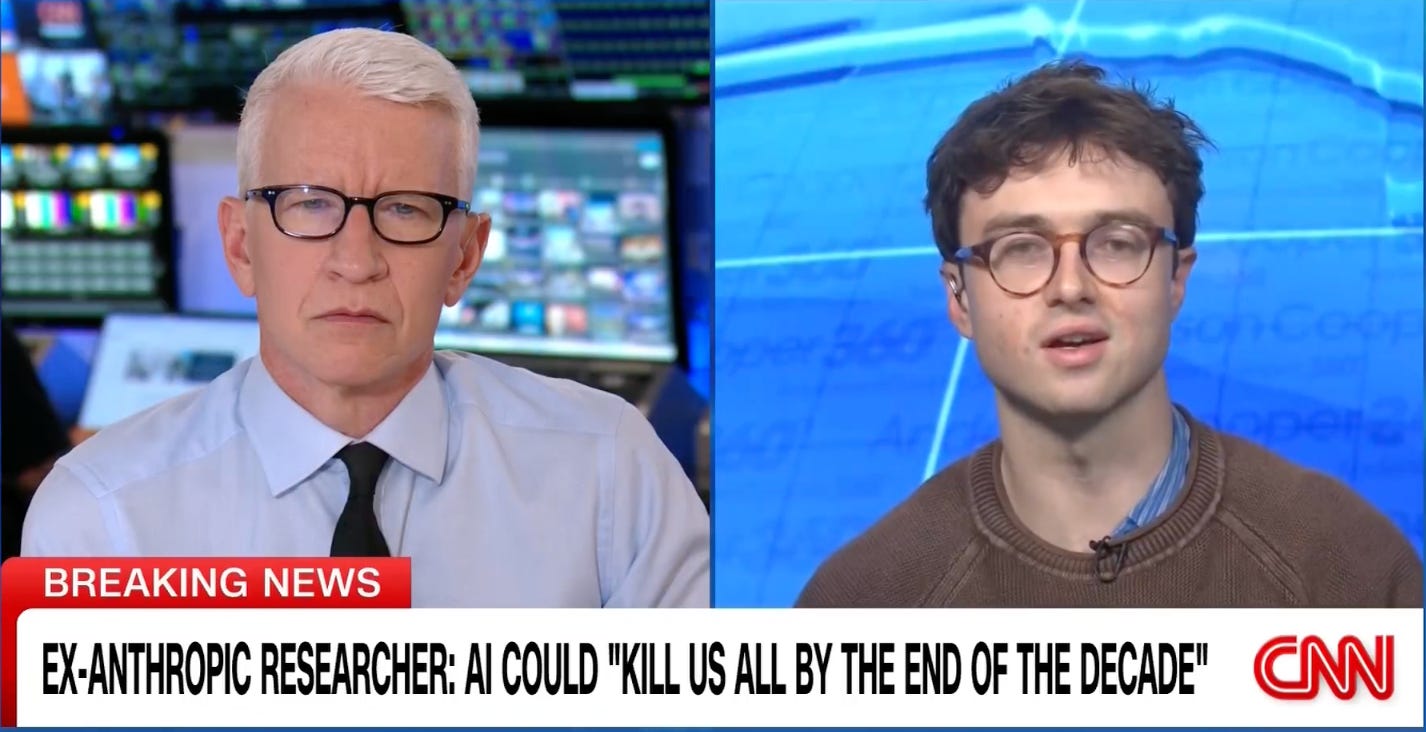
In the debate about what threats artificial intelligence poses, everyone is trying to sell you something. If you follow the corporate press, artificial intelligence is a looming mass extinction event waiting to happen. If you listen to Trump, it’s part of the next Cold War with China, meaning we can’t afford to slow down.
For the appistocracy, there’s profit in all of the attention — literally. We have a new generation of technologists who generate publicity warning of everything from bioterrorism to the machines taking over. Thus AI is turned into a “national security” issue; and as such, it is elevated to the same status as nuclear weapons, deemed too important for interference from a meddlesome public.
The reality though? Listen to the spy agencies. Though they’re far from immune to threat inflation, these agencies echo none of the hysterics dominating the news. As the U.S. intelligence community sees it, AI simply magnifies threats that are already there. And that’s basically right. (More on this in a moment.)
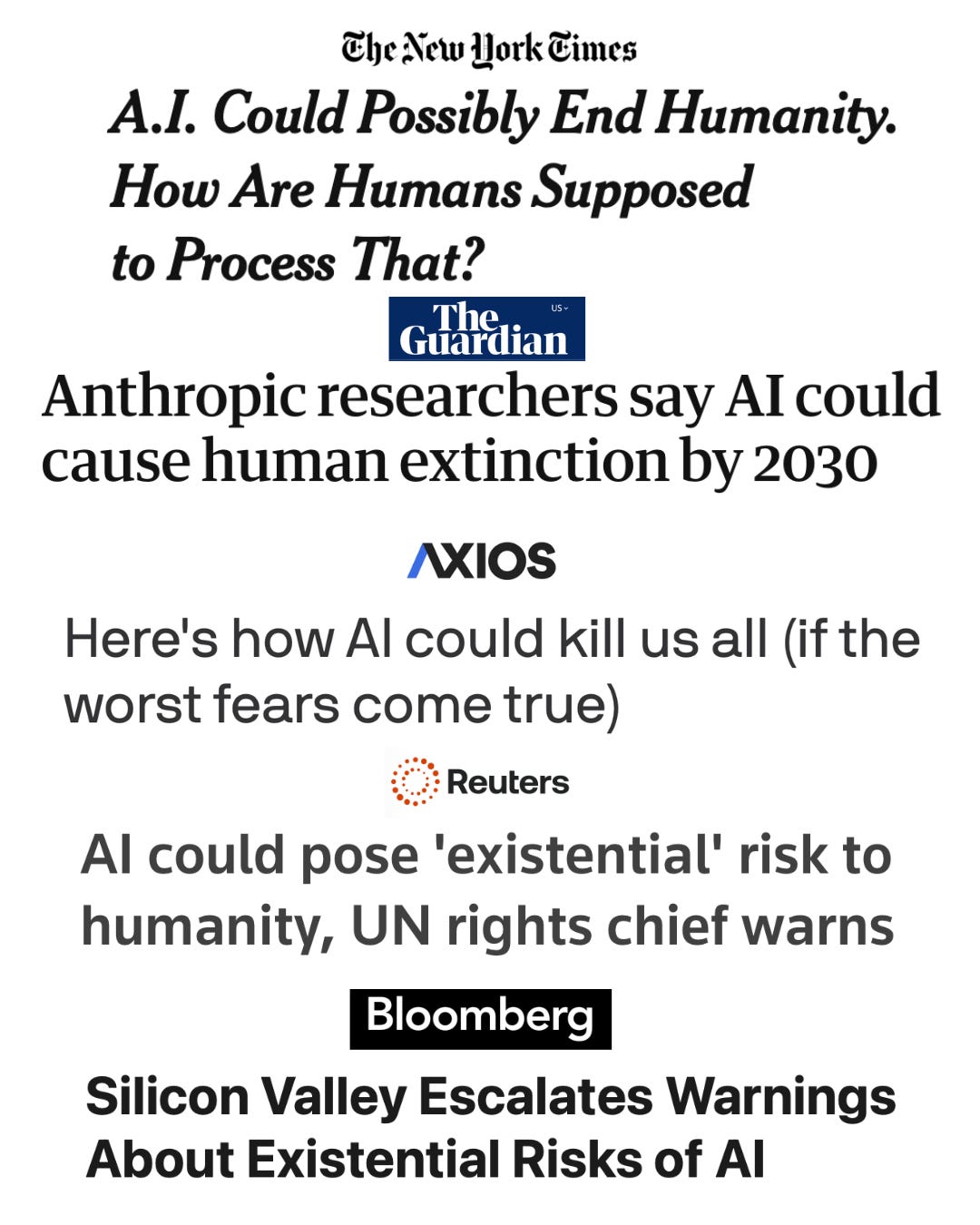
We’ve all seen the sensational headlines. And it’s not just the old school media. Social media influencers credulously amplify this coverage to their millions of followers, going viral with talk of human extinction. Thus dire warnings about a looming AI apocalypse (called things like catastrophic risk, existential risk or X-risk) dominate Americans’ collective imagination.
Then there are the anti-doomers, who run a racket of their own. The most prominent are Yann LeCun, until the end of last year Meta’s chief AI scientist, and Andrew Ng, who co-founded Google Brain and now runs the venture studio AI Fund.
In October 2023, LeCun accused Sam Altman, Demis Hassabis and Dario Amodei — the heads of OpenAI (ChatGPT’s developer), Google DeepMind (Gemini) and Anthropic (Claude) — of “massive corporate lobbying” aimed at regulatory capture, warning that if their fearmongering succeeded, a small number of companies would end up controlling AI. Ng, in an interview the same week, called the idea that AI could drive humans to extinction a “massively, colossally dumb idea,” and said large tech companies were manufacturing extinction fear because they would rather not compete with open source.
They may well be right about the motives of the companies they’re criticizing; but they have conflicts of their own.
LeCun and Ng are two of the most high-profile advocates of what’s called “open-weight” AI — meaning AI whose code is made publicly available in order to facilitate adoption. Anthropic and OpenAI, by contrast, opted for proprietary code that they rent to users. The latter would likely benefit from federal licensing requirements that only the big proprietary players could afford to comply with, whereas the open-weight businesses would be harmed by it.
What every faction has in common —from the proponents of some AI apocalypse to the anti-regulation types — is their disinterest in responding to the realistic risks AI poses.
The U.S. intelligence community provides the most reasonable account of the actual dangers. The Annual Threat Assessment is the U.S. intelligence community’s official list of national security threats: covering things like China’s military, Russian influence operations, drug cartels, etc.
In this year’s report, artificial intelligence is described as a threat in three different ways:
“[I]t is essential to make sure that humans maintain control of the machines and how AI is used.”
“These applications, however, also carry risks that require careful human engineering to appropriately mitigate risk of AI autonomy before they are broadly deployed.”
“[E]merging technologies such as AI and quantum computing are expected to have a significant impact on national security.”
That’s the sum total of what the eighteen agencies of the U.S. intelligence community have to say about the dangers of AI. No human extinction, no superintelligence, no machine uprising.
As the most recent Department of Homeland Security Threat Assessment puts it AI is merely “adding layers of complexity to the threats we face.” It identifies the following five problems:
Disinformation, deepfakes, and election interference,
Cyber operations and financial crime,
Violent extremist exploitation and radicalization,
Proliferation of chemical and biological knowledge, and
Breaking AI's safety controls, and poisoning the data it trains on.
Virtually all of these threats existed before AI. For instance, AI-fueled disinformation is the same old propaganda but in greater quantity and speed. Same with cyber operations and financial crimes (plus maybe some stealth benefits). As for “extremists” radicalizing people, anyone who’s used social media for the past decade or two knows that is nothing new, either. The chemical and biological concern goes back to at least the Clinton administration, biotechnology being the last apocalyptic threat. And the fifth pertains to situations in which humans have tampered with AI’s safety controls.
I’m not saying any of this isn’t worthy of concern. Just that it’s not the end of the world.
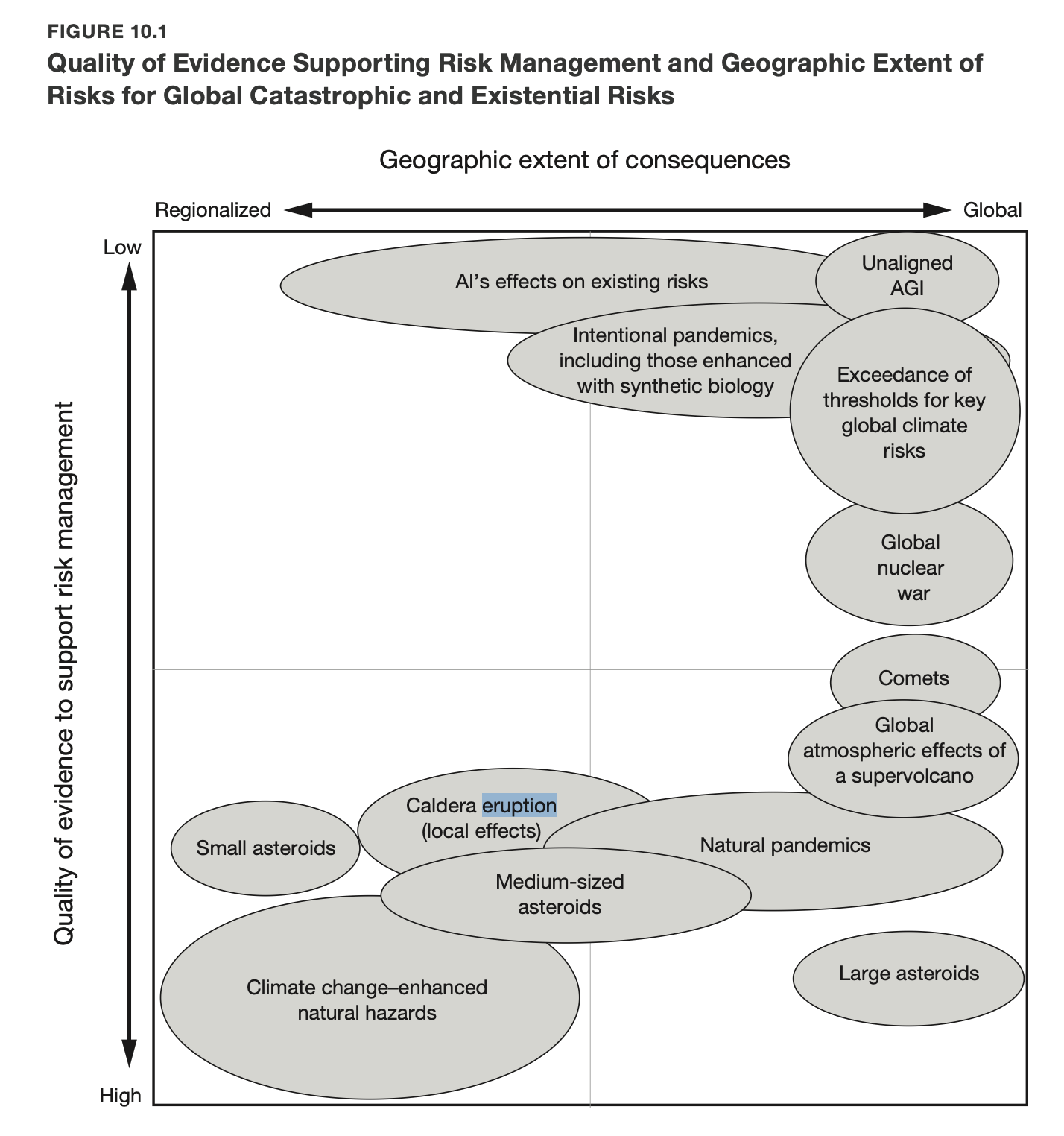
The RAND Corporation’s Global Catastrophic Risk Assessment analyzed civilizational threats and concluded that AI is merely an “entropy” engine.
“One can think of AI as adding entropy and chaos to already-wicked problems that humans face,” the RAND report says. “Chaos does not require the development of superintelligent or supercapable AI and is possible with existing and near-future AI capabilities.”
RAND, I’ll remind anyone not familiar, is no dovish institution. The Pentagon-funded think tank was built to think about thermonuclear war and is hardly shy about civilizational threats.
RAND’s companion study, On the Extinction Risk from Artificial Intelligence, explored similar questions specific to AI. The study identifies three plausible paths to human extinction, including engineered pathogens, geo-engineering, and nuclear war.
But there are major constraints preventing AI from precipitating any of these three events, both physical and operational.
RAND expanded on these constraints in a subsequent report exploring whether large language could make it easier for people to plan a large-scale biological attack. The authors found no statistically significant improvement in plans produced with the assistance of AI versus withoug them.
The National Academies of Sciences, meanwhile, finds that the bottleneck to bioterrorism is not access to information. It’s things like DNA synthesis screening, tacit laboratory skill, culturing, formulation, aerosolization — all of which require human intervention, are expensive and infamously prone to failure.
The government’s own analysts, who have no consumer product to move and no valuation to defend, have been telling us the answer for years in language so measured that nobody has bothered to read it. AI merely increases the magnitude and speed of threats we already have, ones that can be solved and will exist regardless of AI.
Is hyperbole the only register we’re able to communicate in?
It currently is, and none of this is going to change on the supply side. Businesses are going to cast their products in the most favorable light. Media is going to go with the headlines that draw attention.
I know, because I sometimes do it. When I published a piece last week headlined “Fuck 9/11,” I also knew the headline would generate pearl-clutching outrage, and that the outrage would carry the story a lot further than the argument would have on its own.
In a debate centered on whether a chatbot is going to become God, every major faction is cashing in — at the expense of us all.
— Edited by William M. Arkin
The sheer level to which AI has been pushed out is so jarring. Makes sense it’s exacerbating already-existing threats. It scares me on many levels & a large chunk of society’s quick acceptance of it has me feeling whacko
This makes me feel a bit better. Thanks, Ken.
I’m listening to BP now, stressed out.