
“Middle East Oil Exports Climb Back to Prewar Levels,” the Financial Times reported Wednesday in a headline that should be causing a media frenzy, if not riots.
Think about what the headline means. The supply is back to where it was before the war, but fuel prices are still making life hell for millions. So this was never just some unfortunate reality of the Iran War, like we were told. It’s price gouging, with big oil hiding behind the idea of wartime shortages as a pretext to jack up prices.


We were told the high prices was just a fact of life since the Strait of Hormuz was closed. It was bullshit then, as I tried to warn months ago. Now it’s even harder to deny.
And the scandal goes way beyond the $4-plus a gallon people are paying at the pump (or $6-plus in California). Oil factors into the price of virtually everything because of costs like shipping; so when fuel prices stay high, so do groceries, airfare, even mortgages.
The industry’s favorite defense is that it doesn’t set the price of crude. Fine. But it does set the price of what it makes from crude (also known as its profits), and that’s where the money is.
The gap between what a barrel of crude costs a refiner and what it sells the resulting fuel for is called the crack spread. It’s the industry’s margin, and it has exploded. The diesel crack climbed from $33 a barrel in February to $92 in August, then broke above $106 at the start of September, an all-time record.
Just take a look at oil industry profits.
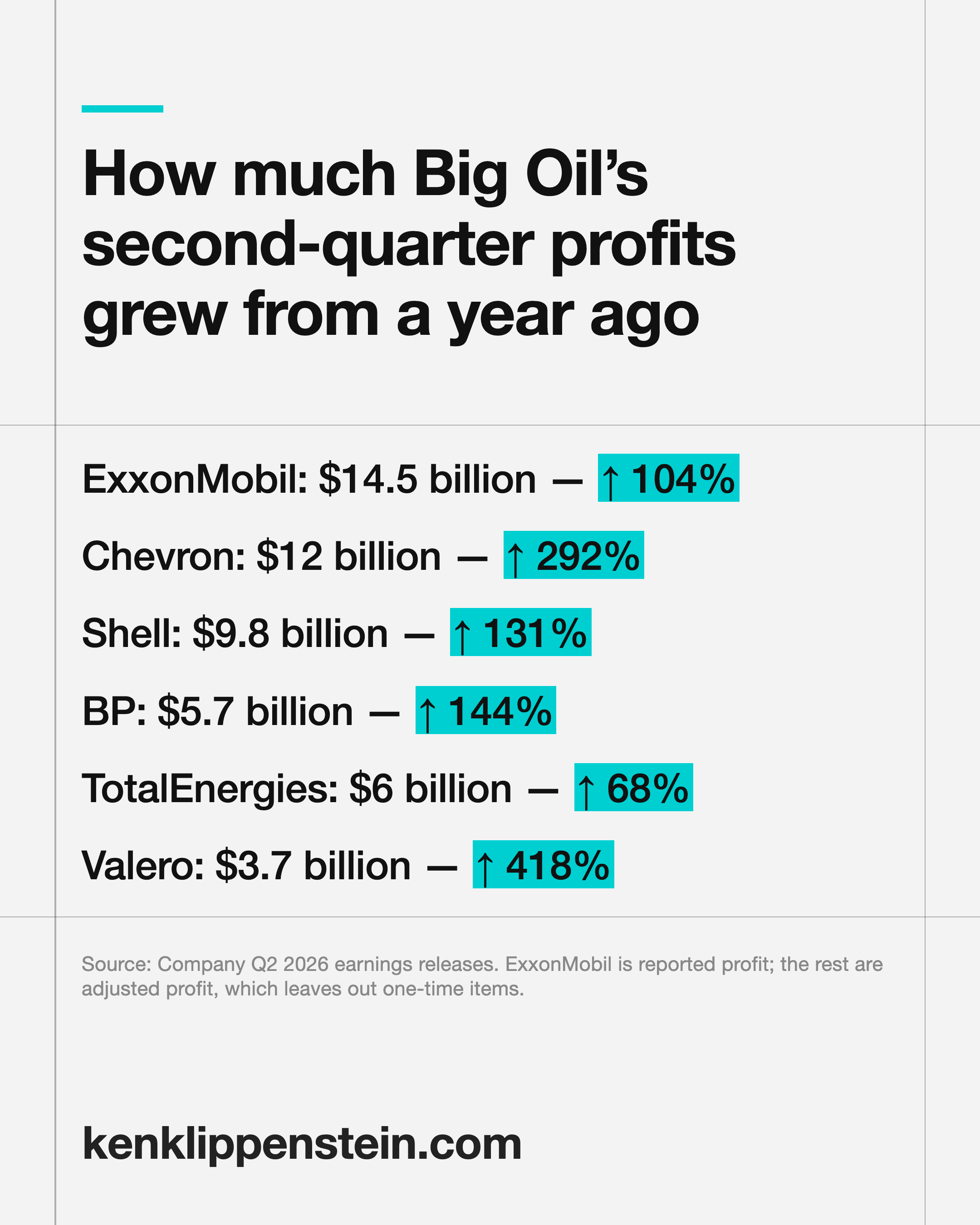
Industry executives can barely contain their glee.
“Adjusted downstream earnings increased primarily due to higher refining margins and favorable timing effects,” Eimear Bonner, CFO of Chevron, said on a July 31, 2026, earnings call. Those favorable timing effects were worth $1.4 billion to Chevron that quarter!
“What the current environment has provided is the prospect for PBF to generate significant value for our investors,” Matt Lucey, CEO of PBF Energy, said on a July 30, 2026, earnings call.
The “current environment” is his euphemism for war profiteering. “Value for our investors” means Wall Street makes money while you can barely make ends meet.
The industry will say crude is still expensive, and that’s true. Brent hit nearly $112 a barrel Thursday as Iran keeps attacking tankers, and shipping a supertanker from the Gulf to China now costs more than ten times what it did before the war. But that explains the price of crude. It doesn’t explain why the industry’s cut of every barrel ballooned to record levels, or why companies chose to export fuel while domestic supplies hit record lows.
Even Trump has noticed. He directed the Justice Department to investigate whether energy companies were price gouging, accusing them on Truth Social of keeping pump prices high as the crude they were buying got cheaper. Yet in the same breath he also can’t help bragging about the profits bonanza.
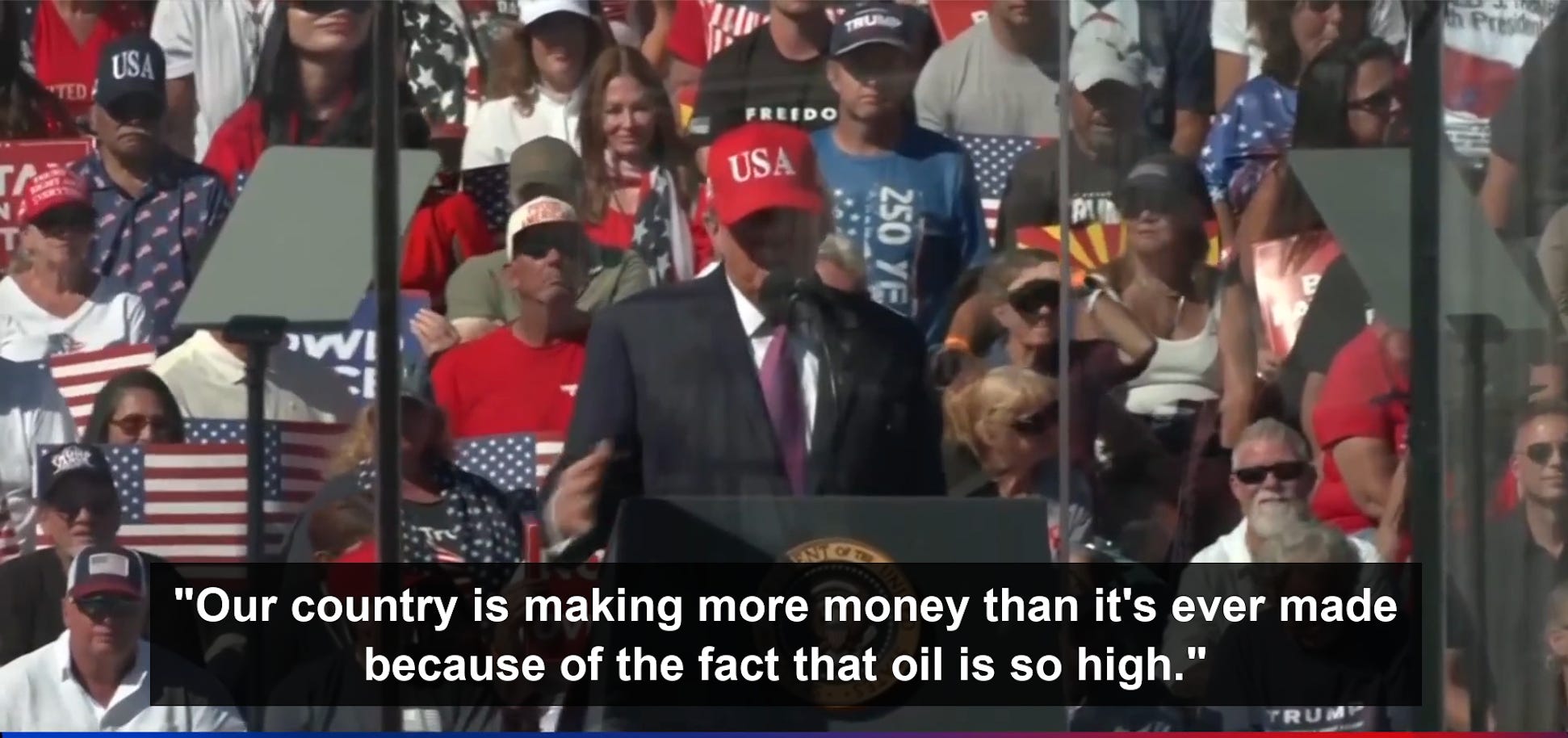
“Our country is making more money than it’s ever made because of the fact that oil is so high,” Trump said at an Oct. 14, at a rally in Bullhead City, Arizona.
The president, in other words, sees the profit bonanza. He just doesn’t see that it isn’t “our country” benefiting from it.
So why isn’t there an uproar? Because naked profiteering has been dressed up as a “national security” issue. Everybody understands price gouging, and everybody gets angry about it. But say “Strait of Hormuz” and suddenly it’s a subject for the expert class: shipping lanes, war-risk premiums, blockades, IRGC fast boats. The message is that this is too complicated for you, so pay up and trust the “strategic” experts who understand it. Meanwhile the oil companies hide behind the flag while picking your pocket.
When Iran closed the Strait of Hormuz, the oil found a way around it. Now the oil companies are the ones charging tolls.
— Edited by William M. Arkin
The Jones act waivers add insult to injury. Instead of the crude being shipped by US mariners from US Port to US port, it can now be shipped by foreign flagged vessels which pay their crew 1/3 of what US mariners make. More profits for the refineries at the expense of American jobs, with no effect on fuel prices.
When P.T Barnum is in the White House, congress, and the courts, I guess we all know what that makes us.