
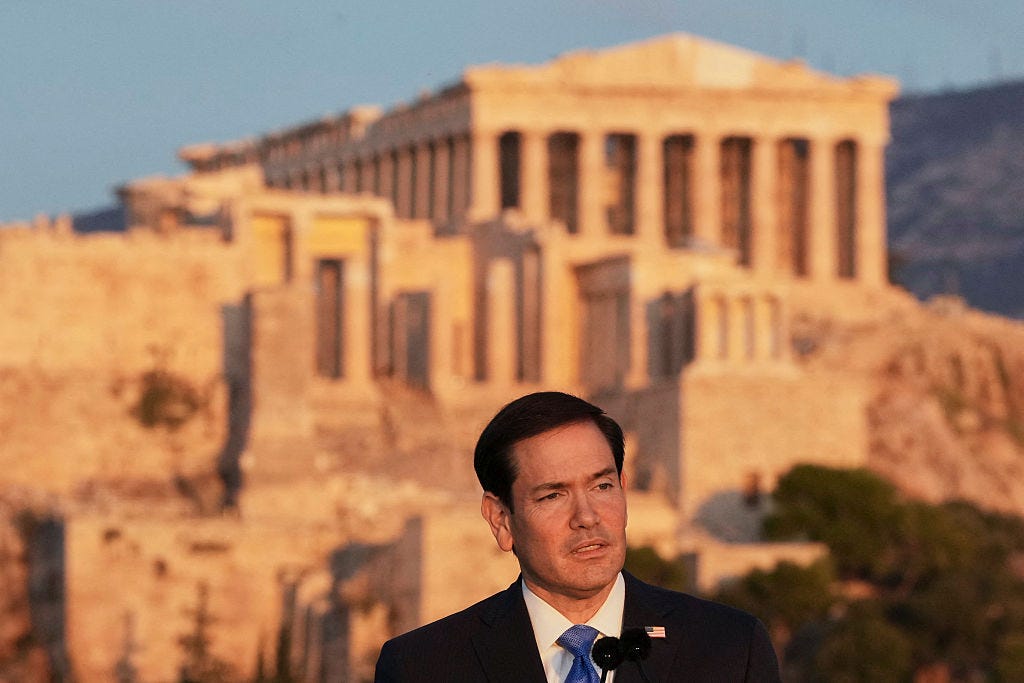
Secretary of State Marco Rubio has formally decided to bar some on the political “left” from visiting America, according to a diplomatic cable he sent to embassies this week.
When I obtained a copy of the internal cable banning those in vaguely “aligned groups” of “far-left terrorists,” I couldn’t help but laugh at the timing. The next day, Rubio was in Greece where, with the Acropolis behind him, he celebrated “free debate and public discussion, the contest of mind with mind.”
Rubio even praised Socrates, whom Athens executed on charges of “impiety” and “corrupting the youth.” In the same speech, Rubio leveled basically the same charge, saying that “in too many places, we taught our children to be ashamed of the countries they would inherit.”
Under the pretext that certain forms of speech can lead to violence, or even more vaguely, can pose some kind of threat to America’s economy, Rubio has laid out all of the ways that the federal government can decide which ideas are too dangerous and thus can be the basis for denying a visa.
Rubio’s cable reminds consular officers worldwide that Donald Trump’s national security directive NSPM-7 identifies things like “anti-Americanism, anti-capitalism, and anti-Christianity” views as so-called indicators of political violence. Trump’s directive also singles out views on immigration, race, gender, and traditional morality as relevant to determine threats to America.
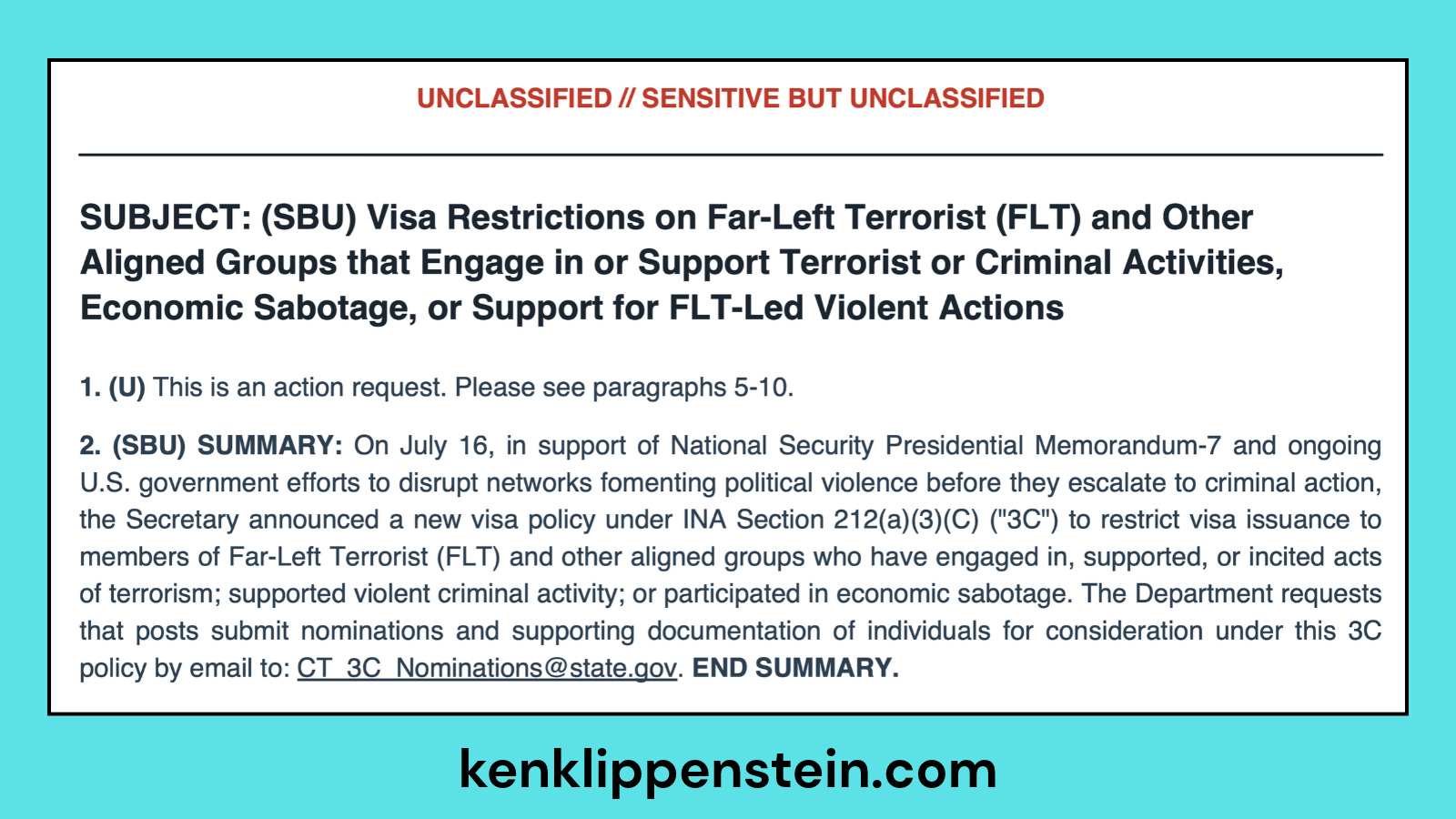

Rubio now implements NSPM-7 for the State Department, formally bringing ideological scrutiny to the visa process. He targets groups and individuals who are driven by “an overriding hostility towards the U.S. legal, economic, and political systems” as being inadmissible to the U.S., particularly if these groups and individuals consider the United States as “fundamentally illegitimate and oppressive.”
The cable unfortunately affirms the fears of my European friends — including many who sincerely love America — that they are no longer welcome in this country. For since they aren’t citizens, the First Amendment of the Constitution doesn’t protect their speech or association. That is the legal maneuver the administration is using to bar them from the country. But just because it might be legal doesn’t mean it’s good.
Rubio’s cable directs embassies to identify and nominate members of “Far-Left Terrorist” and “other aligned groups” for visa restrictions. It covers people who have engaged in, supported, or incited terrorism, supported violent criminal activity, or participated in what the department calls “economic sabotage.” Terms like “supported” and “aligned” make the line between expression, association, and participation consequential. The cable does little to explain where officials should draw it.
The memo also makes clear that the groups “do not need to be designated as Foreign Terrorist Organizations” or Specially Designated Global Terrorists, to be linked to the mythical “Antifa” organization. In other words, you do not even have to be on the administration’s list of officially designated terror groups to be barred from the country.
The broad policy was announced in July. As I reported before that announcement, the State Department was preparing to target alleged far-left terrorists and their allies for activities including economic sabotage against property. This cable provides the instructions for putting that policy into practice.
The cable defines “economic sabotage” as destruction or vandalism of public or private property, cyberattacks, swatting, and certain forms of “doxing” — a term elastic enough to apply to simply publishing the name and other identifying information of, say, ICE officials. Coordinating, facilitating, or materially supporting those activities also qualifies as threats of economic sabotage.
Such vandalism or cyberattacks come with no stated minimum damage threshold. “Aligned groups” comes with no clear definition. And the nomination form does not require a criminal conviction of any kind.
What the cable does do is ask for information from sources including foreign governments, law enforcement, and “media articles.” Washington officials review the nominations and control the resulting visa flags and revocations. The cable contains no list of people who are actually banned.
In Rubio’s speech in Athens, he praised the ancient Greeks’ appetite for argument and their refusal to accept limits. He celebrated Socrates, who “refused to abandon the inquiry into truth even at the cost of his own life.”
Rubio clearly appreciates an inconvenient thinker once he has been dead long enough. Living ones, though? Those are threats to national security.
They have opinions about capitalism, policing, and American foreign policy. They belong to groups. They might even regard some of our institutions as oppressive.
That’s the thing about controversial speech: it only seems obvious in retrospect. At the time, it always seems dangerous. That is the category of speech most worth protecting. Safe ideas don’t need any protection. Even Stalin supported speech he liked.
Later in his address, Rubio lamented that so many people yearn for “a world of perfect safety, a world devoid of risk or failure.” As a result, he said, “we build downwards.”
I sincerely agreed with that part. Too bad Rubio doesn’t.
— Edited by William M. Arkin
I paid money so I can write "Rubio is an idiot".
and they just get away with this?