
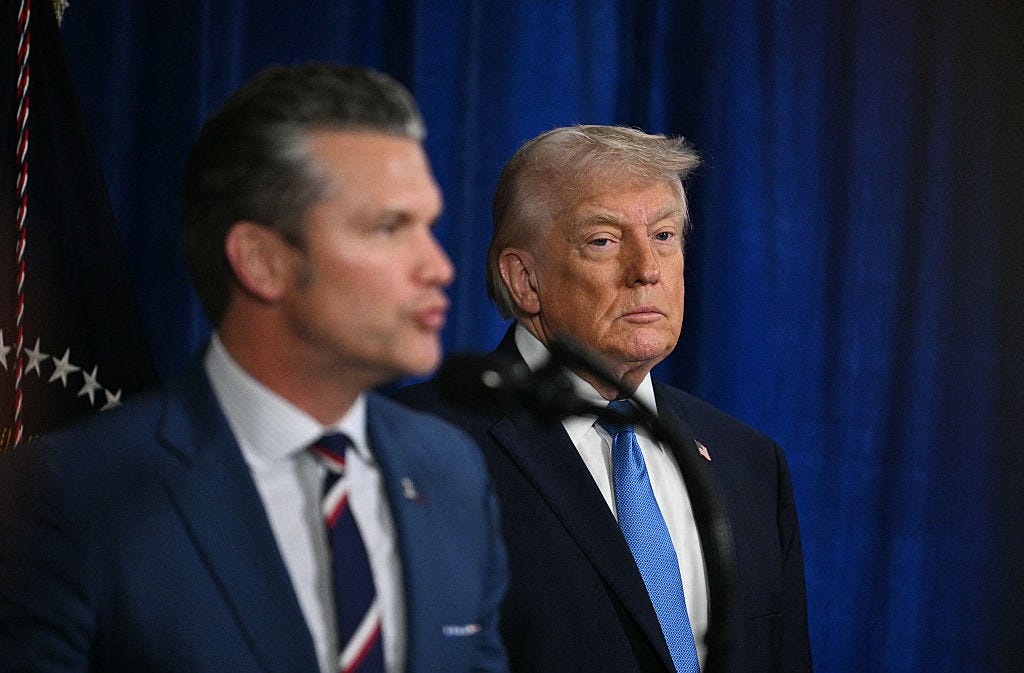
Trump’s dream of a third term runs through a cinematic attack on Iran that decisively ends the war and wins back public support. The target sets were drafted and plans ready, but then problems started piling up.
Now that plan rests on the edge of a knife, and which side the president lands — for or against — is anyone’s guess. My military source says it’s 50/50 at this point whether there will be an Iran strike. And even if there is, it won’t be as long or as extensive as what was initially planned.
But a smaller war doesn’t mean less danger at home. Iran has vowed retaliation beyond the Middle East. People in Trump’s orbit aren’t subtle about how they’d exploit an Iranian 9/11, fantasizing about invoking a national emergency. And Netanyahu just showed them how it’s done: lose an election, then blame foreign interference.
Here’s how the plan came apart.
“We will not be attacking Iran at any time prior to the Midterm Elections,” Trump said last month.
The potential for a strike to undermine his party’s electoral prospects was of course on his mind. But it was also about a schedule. The military wasn’t quite ready before. It didn’t yet have all of its pieces in place.
“We’ve knocked the hell out of them, and we may do it a little bit more,” Trump warned shortly before Halloween.
A third aircraft carrier was headed towards the Middle East, and the Navy said it would be fully ready by November. A second amphibious group, including a mini-aircraft carrier, also was on its way. Those two amphibious groups hosted an additional two dozen F-35 stealth fighters.
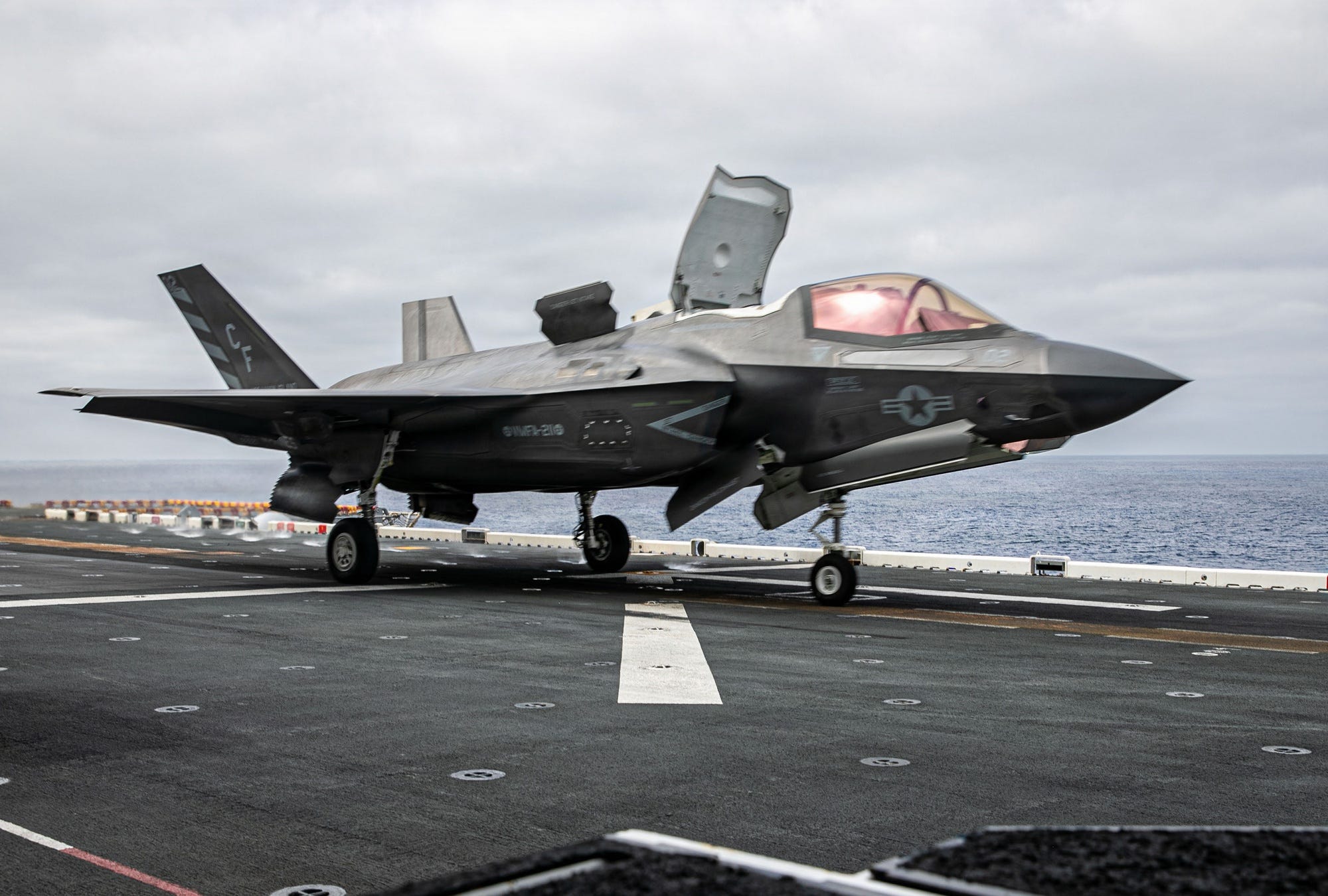
As the force built up, and as Trump’s threats of a renewed attack continued, Iran’s defense minister said that if the United States bombed again, Tehran would respond “without geographical limitations” — that is, beyond the Middle East. The CIA, meanwhile, was reporting that Iran had “substantially increased efforts to target U.S. personnel.”
Around Trump, the talk turned to what would happen if Iran struck back or meddled in the vote. The answer wasn’t nuclear war. It was a ruthless response at home: a national emergency, a crackdown in the name of national security, a suspension of this and that.
Then late last week, The Wall Street Journal started reporting leaks coming from a cautious Pentagon brass:
“The top U.S. commander in the Middle East briefed President Trump on Thursday on military options for Iran, a rare in-person visit to the White House as the U.S. weighs resuming major combat operations, according to U.S. officials and other people with direct knowledge of the meeting.”
The Gulf Arab allies, already licking their wounds from the effects of earlier Iranian attacks and the stand-off at the Strait of Hormuz, told Washington that they weren’t on board.
This is where the planned post-election strike started to unravel.
Yes, they’d defend themselves against Iranian attack, the Arab countries said, and they’d do so with the United States, but they didn’t want to participate in an attack itself.
Then the Israeli elections happened and Netanyahu lost his majority. The Israeli press reported that American Air Force fighter jets had landed at southern desert airbases in the country, and transports were bringing in bombs and supplies, a backup with the loss of some Gulf bases. But until a new Israeli government was sorted out, contingency planners didn’t count on Israel’s assistance.
The plan unraveled more.
But for the White House, there was lemonade in that lemon. Netanyahu asserted that foreign entities had interfered and indeed bribed voters to benefit the Arab-led parties. It was a “foreign takeover of the Knesset” and “the Islamization of Israel,” he claimed. His allegations didn’t get much traction, but Trump’s acolytes are taking notes in preparation for America’s election tomorrow.
Hegseth told the White House that a sea-based only attack without Israel and use of the Gulf bases for the direct offensive was still viable — and in some ways it was even preferable because it didn’t require anyone’s permission. The options for what to bomb were again presented at the White House.
Then, what to bomb started to come into play. During the summer, CBS first reported that the U.S. and Israel were targeting Iranian energy infrastructure, its power plants and oil refineries. It was really the only area to escalate as neither had been directly targeted by the United States in the February-April “Epic Fury” campaign.
The Gulf states objected, worrying about additional Iranian attacks on their own energy economies. Then, some of the brass spoke up in opposition, warning that such attacks (particularly on electrical power production) might not comply with the law of war, and in fact, might not fall within the objectives of the campaign as Trump had directed. Hegseth railed against the weaklings in uniform, even firing the top Joint Chiefs of Staff war planner, Army three-star general Brett Sylvia.
“Their plan is insane,” Senator Chris Murphy of Connecticut said last week (before suffering a stroke this weekend). He was alluding to Top Secret briefings that he and other senior members of Congress received about a bombing attack.
“There’s been open reporting as to what we may be planning, and the civilian infrastructure that we may be targeting,” Murphy continued. “It will lead to devastating escalation and the likely destruction of our commitment to the rule of law.”
At least two dozen other members of Congress, including more than a dozen Democrats, were also briefed, but never bothered to say anything publicly.
“One way or the other,” Trump says, the war on Iran will end.
J.D. Vance chimed in on Thursday:
“There’s a lot more we need to work on [with Iran], but the one thing I’ll tell you is, if you’re worried about another forever war, Donald Trump is never going to let this be a forever war. … He’s going to accomplish America’s objectives, and then we’re going to focus on the other things that we’re doing.”
To everyone’s surprise — even Hegseth’s — the president has pushed back on the bombing plan, at times calling it uninspired, worthless, and weak, according to multiple military sources with knowledge of the various presentations.
Though Donald Trump has a reputation for stubbornness, he’s changed his mind numerous times about Iran, worried about the economic impact, and frustrated about his own legacy.
Despite Hegseth’s fantasy of a vast conflagration, Trump has insisted that Iran’s nuclear weapons capability be the centerpiece, telling the generals that the story of the war needs to be complete elimination of Iran’s ability to pursue an atomic bomb.
“I’m going to do what no other administration has been able to do,” he told his team, my sources say. On Halloween, Trump hinted at this, saying that an attack would mostly deal with one or two remaining nuclear sites. He named Pickaxe Mountain, saying that completing the task of destroying the last remnants of nuclear capability could be accomplished very quickly.
Now what’s left? The Arab states have spoken up. The Israeli electorate has spoken. Donald Trump ended up questioning his own plan. Hegseth is holding onto the plan for dear life, a bully who has alienated every thinking person in the military — and, if rumors are true, even the president.
Trump’s a gambler who’s down, itching for one more hand. But does he fold, or go all in?
— Edited by William M. Arkin
At this point, I hope the Tangelo Hemmorhoid hangs in there until the end of his term. Not that JD isn't nearly as dumb, but if we're lucky, Trump might destroy both the Republican AND the Democratic Establishments.
Both need to happen.
It's the Democratic Establishment who gave us Trump to begin with.
Iran stood up to the USA and Israel. Trump is a deranged and vengeful man. 'Revenge is sweet so they say.'