
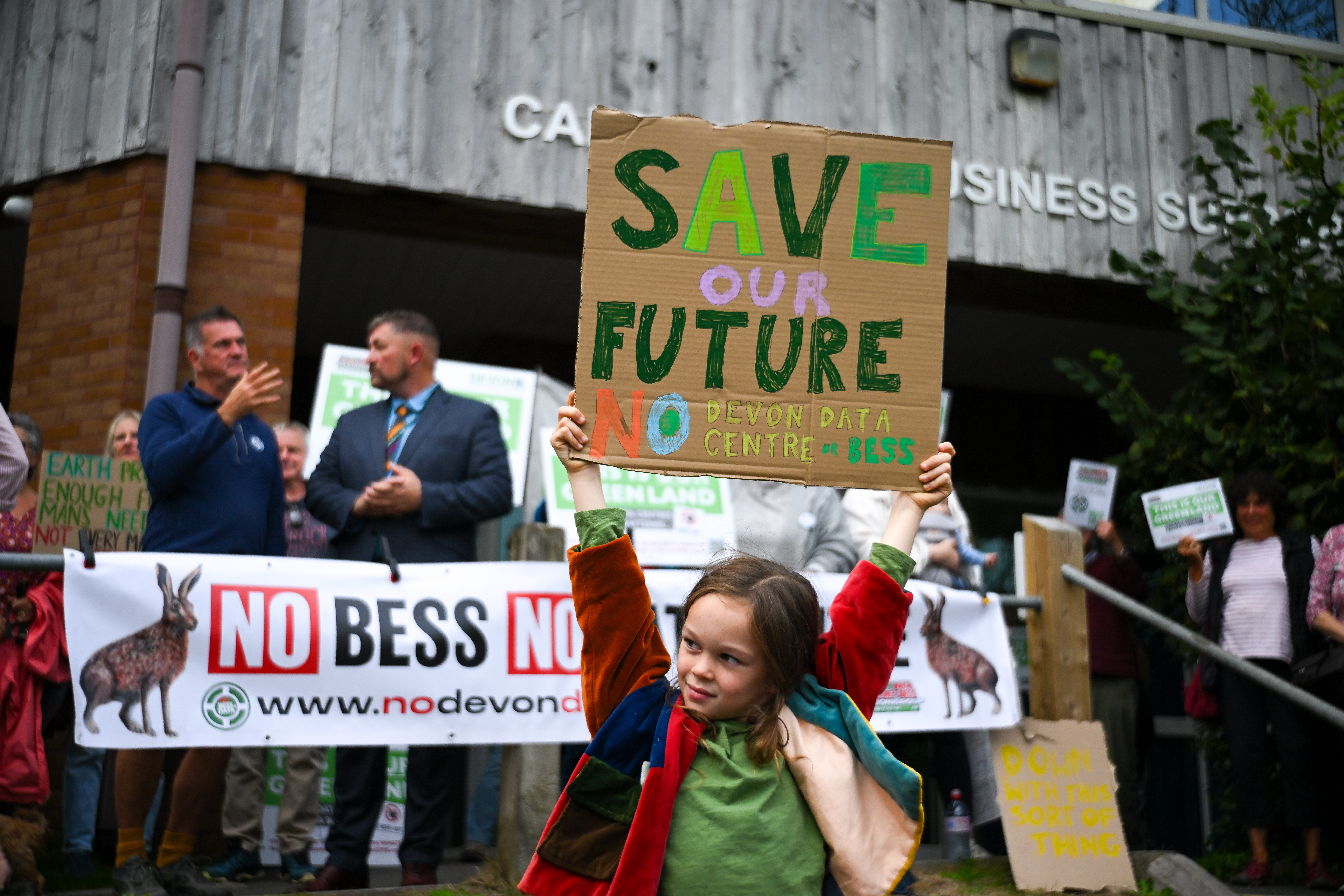
Anxiety over AI and data centers is widely held, but somehow the Trump administration has convinced itself the public concern was manufactured in China.
This week, in little-noticed remarks by President Trump and Justice Department warning, the administration declared war on protestors and opponents of AI, threatening“criminal liability” if they “further the propaganda or other goals of a foreign power.”
While that sounds like some modern day Tokyo Rose shilling for Beijing, with orders coming in over shortwave radio, the actual targets are just normal people who have no idea they are part of the government’s latest national security mirage.
Last week, the Justice Department instructed “citizens and noncitizens” that anyone furthering the “goals” of a foreign power in “any public activity” — including even “public demonstrations” — must formally notify the government to avoid arrest and prosecution.

Though they don’t identify any specific protests, it’s not hard to surmise who they’re talking about. Two days prior, President Trump began a spate of social posts declaring that opposition to AI is a traitorous, treasonous conspiracy theory tracing back to China.
“There is a SICK conspiracy going on against AI and Data Centers, and the only one that is happy about it is China,” Trump posted on September 14. “Conspiracy Theorists, Treasonists, Traitors, and Leakers, BEWARE!”
“The people that say AI is going to destroy the World, and that Data Centers are bad for your neighborhood,” Trump also posted, “are Revolutionaries, but Revolutionaries for a Bad and Evil Cause.”
In a third post, he blamed the skepticism of AI on an unnamed foreign country. “The only reason the AI/Data Center outburst is happening is because the United States is leading, by a lot, every other country,” he said
Most recently, on September 10, Trump alluded to using the criminal justice system to go after “BAD” actors in the AI space. “[W]e will also be looking for BAD, and we can do that, very easily, with our already existing Criminal and Civil Justice System,” Trump warned on September 19.
In other words, the president is playing the national security card. And it’s not just Trump. Congress, too, is getting in on the act.
In June, Senate Intelligence Committee chairman Tom Cotton (R-AR) asked then-acting Attorney General Todd Blanche to investigate “foreign influence efforts targeting the buildout of American AI infrastructure.” The letter continues: “Alarming reports indicate that a network of foreign actors, led by the Chinese Communist Party (CCP), is attempting to manipulate U.S. policy and public opinion on data centers.”
Cotton’s chief exhibit was Neville Roy Singham, a Shanghai-based American tech mogul whose network of left-wing U.S. nonprofits, Cotton claimed, has spent years producing content opposing American AI infrastructure, with the Chinese government as its “ultimate paymaster.”
“I write requesting the Department of Justice (DOJ) investigate foreign influence efforts targeting the buildout of American AI infrastructure,” Senate Intelligence Committee chairman Tom Cotton (R-AK) wrote to then-acting attorney general Todd Blanche in June. “Alarming reports indicate that a network of foreign actors, led by the Chinese Communist Party (CCP), is attempting to manipulate U.S. policy and public opinion on data centers.”
(Readers of this newsletter will recall my report last year in which a homeland security official told me that Singham was being scrutinized under the president’s national security order NSPM-7, explained here.)
Cotton’s letter went on to complain that “no entity in the [anti-AI] network has been charged under the Foreign Agents Registration Act (FARA). I therefore request that the DOJ launch a full investigation into these matters.”
“We can’t allow any effort by foreign adversaries to extort these fears and undermine our technological development,” Senate Intelligence Committee chairman Tom Cotton (R-AK) wrote to then-acting attorney general Todd Blanche in June. Cotton’s letter went on to complain that “no entity in the [anti-AI] network has been charged under the Foreign Agents Registration Act (FARA). I therefore request that the DOJ launch a full investigation into these matters.”
Days before Cotton's letter, top Republicans on the House Energy and Commerce Committee, led by Chairman Brett Guthrie (R-KY), raised nearly identical concerns. They asked FBI Director Kash Patel and the White House for a briefing on what they called foreign influence campaigns aimed at blocking American data centers.
“It is critical that this Administration takes any effort to undermine [winning the AI race] — particularly from foreign adversaries — with a great deal of seriousness,” they wrote.
Guthrie said in his own statement: “The fact that Chinese Communist Party-backed entities and other foreign adversaries may be attempting to influence decisions related to American data center infrastructure puts into perspective how serious of a fight we are in.”
And well before Trump weighed in, a chorus of private figures in his orbit were pushing the same line.
Start with David Sacks, the venture capitalist who served as Trump’s AI czar before stepping down to become co-chair of the President's Council of Advisors on Science and Technology. Sacks has been casting domestic resistance to AI as a gift to Beijing. After a Chinese model topped a coding leaderboard in July, he complained that “America is tying itself in knots: politicians and bureaucrats are banning new data centers … This is how you lose the AI race.” More recently, Sacks warned on Fox News against moves that would “just hand the whole ball game to China.”
Then there’s Kevin O’Leary, the “Shark Tank” investor behind a planned $100 billion data center in Utah. O’Leary, a vocal Trump supporter, has spent the past two years cozying up to the administration. That includes a January 2025 Mar-a-Lago sit-down with the president-elect, and a stretch lobbying Trump officials there in a bid to buy TikTok.
This Spring, O’Leary claimed that hundreds of millions of dollars from China were paying protesters to oppose data centers like his. One group he targeted, the Alliance for a Better Utah, shot back: “The only foreign interest in this data center is Kevin from Canada.”
It gets funnier.
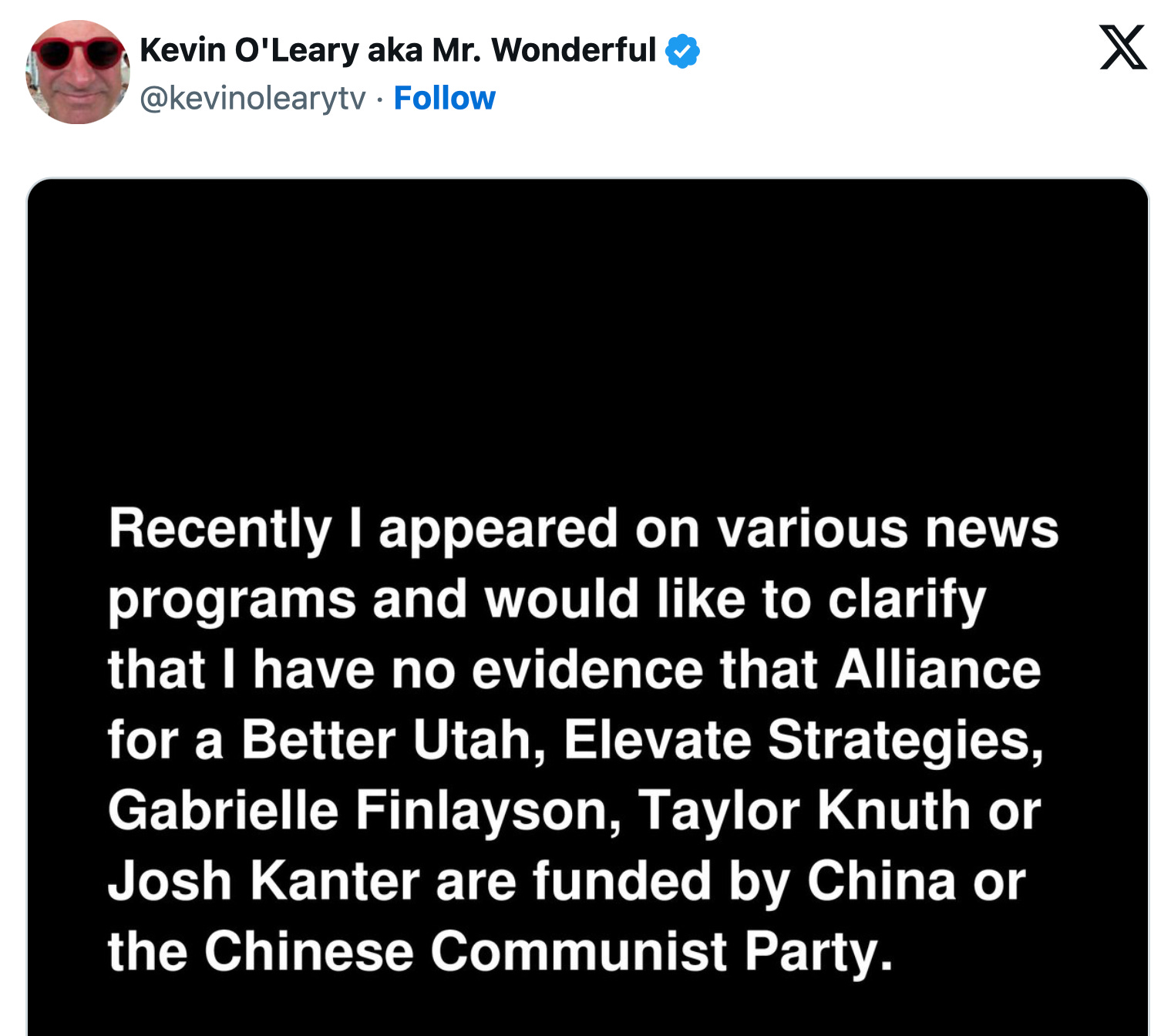
In a June 25 post on X, O’Leary conceded he had “no evidence” that the groups and people he’d named were funded by China, and Fox News aired apologies. Two of the groups have since sued O’Leary and Fox for defamation.
Whoops!
Then there are the industry groups, too numerous to list. A representative example: a spokesperson for the pro-AI Innovation Council told the Daily Caller that the anti-data center campaign was "a manufactured op by dark anti-American forces and foreign governments."
All of this rests on the premise that ordinary Americans wouldn’t oppose data centers unless someone in Beijing was pulling the strings. The polling says otherwise.
A Gallup poll conducted in March found that 71 percent of Americans oppose building an AI data center in their area. That’s more than the 53 percent who oppose a local nuclear plant. Nearly half, 48 percent, are strongly opposed, and the opposition crosses party lines, including 63 percent of Republicans. That’s not a fringe. It’s close to a consensus.
Nor is it technophobia. Nearly half of Americans now use AI chatbots, according to a February Pew surveyof more than 5,000 adults. Yet 40 percent said AI will hurt society over the next 20 years, compared with 16 percent who said it will help. What people distrust is how it’s being rolled out: 63 percent said AI is advancing too quickly, 71 percent said it will make their personal information less secure, and 67 percent had little or no confidence in the federal government to regulate it. Pew research last year found that 61 percent want more control over how AI is used in their lives, and about six in ten worry government regulation will be too lax.
In other words, the public wants a say, and it wants at least some controls in place.
The Trump administration’s response: treat opposition to AI and data centers as a counterintelligence matter. It’s not the first time the administration has played the national security card to clear the way for AI.
In June, the Justice Department intervened in an NAACP lawsuit against Elon Musk’s xAI over dozens of gas turbines the company was running without air permits to power a data center it maintained in Tennessee. The department asked a federal judge to throw the case out, arguing that the NAACP “threatens American national, economic, and energy security.”
To make the point, the government filed a sworn declaration from Cameron Stanley, the Pentagon’s chief digital and artificial intelligence officer. Stanley swore to the court that Grok was “a matter of paramount national security.”
The irony of the China puppetry gambit is that the approach is likely to backfire. Well, one of the ironies. Another is Trump warning about “Conspiracy Theorists” while alleging a vast Chinese plot for which his allies have produced virtually no evidence. (Though Kevin O'Leary will have plenty of time to find some during the discovery portion of his defamation suit.)
When people who distrust the government’s handling of AI are told their distrust is traitorous foreign propaganda punishable by jail time, it’s hard to imagine them trusting the government more. It’s easy to imagine them trusting it less, and wondering what the government is so eager to keep them from asking. That’s the downside of playing national security card, and it’s one that Washington never seems to think about.
Subscribe to make sure you see my next article, revealing how all of this will be formalized under a new government entity modeled off the military.
— Edited by William M. Arkin
Just want to stress how insane it is the Justice Department put this in writing: "public demonstrations designed to further the propaganda or other goals of the foreign power ... may result in significant civil or criminal sanctions"
I can’t understand a damn thing you wrote, Ken. Please rewrite in Mandarin. Thank you.