
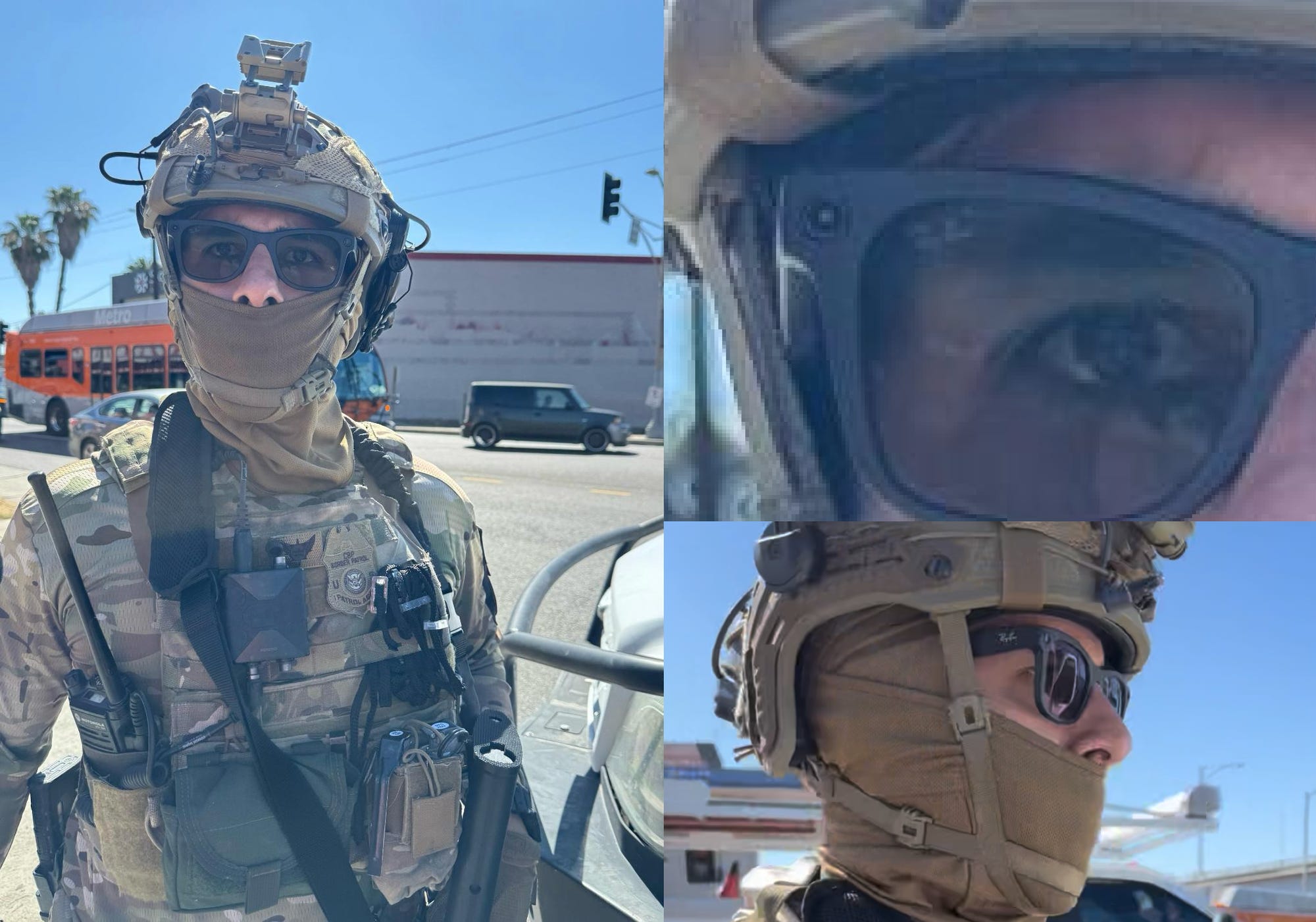
The Department of Homeland Security is developing specialized smart glasses that will allow federal agents on American streets to automatically identify “illegal aliens” from a distance, budget documents reveal.
These new ICE Glasses, building on available glasses that allow video recording and heads-up data display, will be able to pulse vast federal holdings of biometric data — from facial recognition to walking gait — to identify people in real-time.
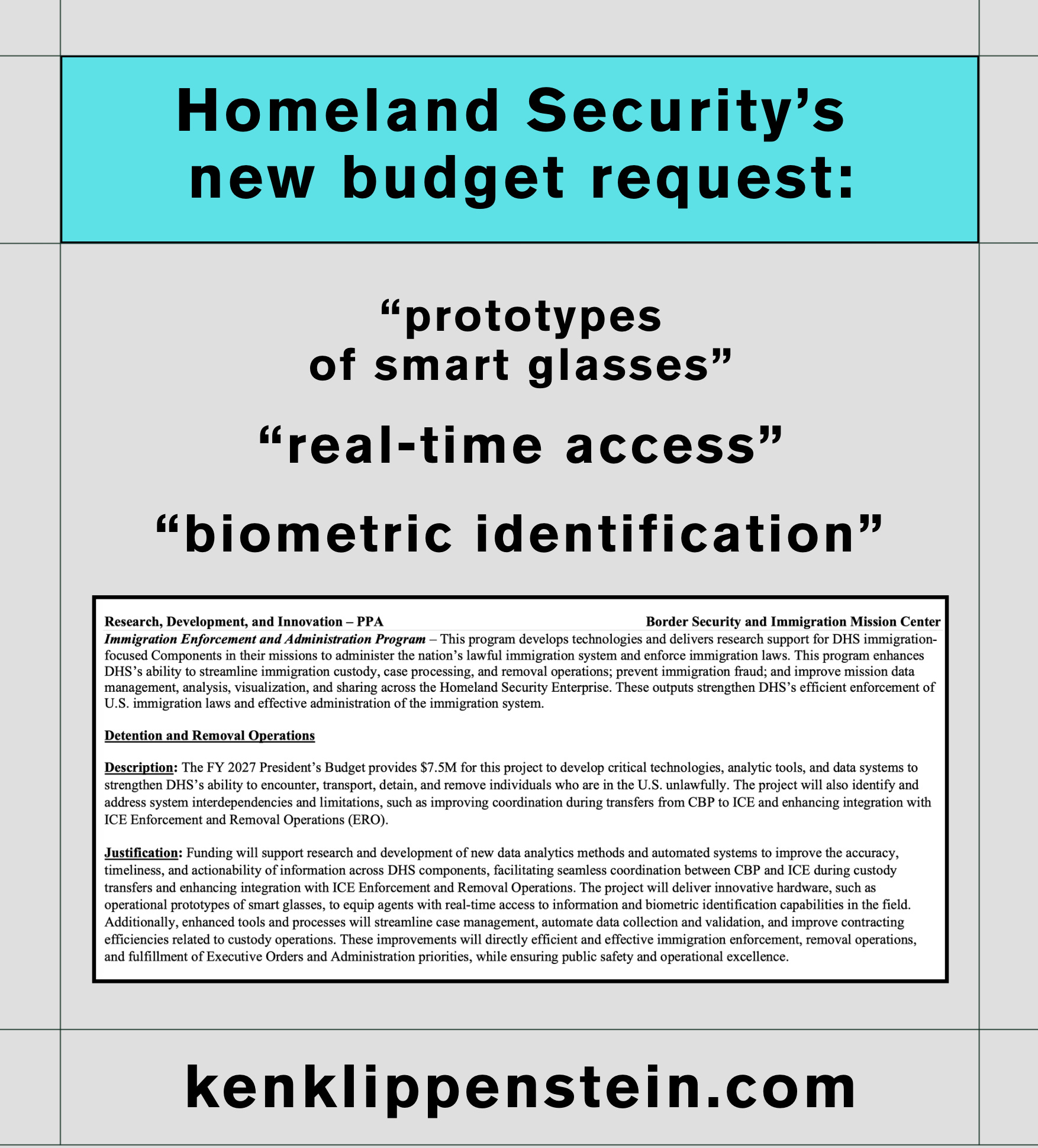
Per the budget document:
“The project will deliver innovative hardware, such as operational prototypes of smart glasses, to equip agents with real-time access to information and biometric identification capabilities in the field.”
A Department of Homeland Security attorney who spoke to me on the condition of anonymity said of the ICE Glasses project, “It might be portrayed as seeking to identify illegal aliens on the streets, but the reality is that a push in this direction affects all Americans, particularly protestors.” The official also says that the technologies and algorithms behind the smart glasses are as applicable to general government surveillance as they are to the current immigration war.
Commercial smart glasses are already facing major hurdles regarding privacy, ethics, and data security — and ICE Glasses will only deepen those concerns. They presumably will be two-way, not only able to detect, and with the help of AI, match to suspects already in databases, but also to secretly record people to add them to new domestic watchlists.
When Google introduced its own smart glasses in the early 2010s, dubbed “Google Glass,” the public backlash was so fierce that it led to a nickname for users: “glassholes.”
The intelligence community and classified enclaves of the military have been experimenting with smart glasses for years, and such displays have been used to help special operators to find and identify high-level targets that are on various terrorist kill lists.
Such specialized glasses enable the fusing of “identity intelligence (I2)” to include biological, biographical, behavioral, contextual, and reputational attributes “to identify and assess threat individuals and networks, their capabilities and capacity, centers of gravity, objectives, and intent,” according to a leaked document I reviewed.
ICE Glasses will presumably benefit from this research, providing federal agents with real-time awareness of the identities of anyone within sight and who is on one of homeland security’s various watchlists (the existence of which I’ve reported here).
The budget document says that the ICE Glasses should be available by September of 2027.
Biometrics are automated methods of identifying or verifying a person’s identity based on unique physical (or behavioral) characteristics. Fingerprints, facial features, iris patterns, even voice prints are analyzed by technology for border control or access.
Following 9/11, biometrics — and later identity intelligence — became a core tool for identifying and keeping track of terrorists.
From the original terrorist watchlist, the U.S. military developed its own “Biometrically Enabled Watchlist” (BEWL), a repository of identifying information of virtually everyone it came in contact with in the Middle East — detainees, prisoners, suspected terrorists, travelers, contractors, etc. BEWL is the military equivalent of the Automated Biometric Identification System (ABIS), a civilian agency biometric database that tracks international travelers. ABIS grew to hold more than 15 million biometric submissions in its first decade of operation, according to a 2015 report.
In ten years, ABIS more than doubled in size, and according to homeland security data, contains about 75 million biometric records today. The system’s prime contractor, Leidos, says that the system is able to process on the order of 45,000 biometric submissions per day, with surge capacity up to roughly 100,000 during major operations.
During the global war on terror, handheld devices like the Handheld Interagency Identity Detection Equipment, or HIIDE, became the collection workhorses that collected biometrics and fed ABIS and, eventually, BEWL. HIIDE is a rugged, battery‑powered device about the size of a small camcorder, with built‑in sensors for iris scans, fingerprints, and facial photos.
Troops in Iraq and Afghanistan used HIIDE to enroll people encountered at checkpoints, on patrols, or in raids — capturing their fingerprints, iris images, and faces, tying that data to a name or alias and basic biographical details, and then syncing those records back to the intelligence community. Once a person’s biometrics were in ABIS and analysts decided that they might merit closer tracking, the identity was promoted onto the BEWL, turning a scan on a handheld device into a watchlist “hit” that tells a soldier this is someone the U.S. military is actively looking for.
ICE Glasses eventually will do all of that in a more compact way. The secret recesses of the government already collect what are literally called “non‑cooperative biometrics,” where the data is captured without a subject’s consent. (The Defense Department sometimes prefers the more euphemistic term “non‑obtrusive biometrics” for collection that is silent, standoff at a distance, or otherwise invisible to the person being recorded.)
That’s the world of ubiquitous surveillance that the Department of Homeland Security is looking to reproduce here on American soil.
FBI Director Kash Patel hinted at the enormity of the biometrics effort in a social media post last December saying the Bureau “undertook a project earlier this year to vastly expand our overseas biometrics program,” adding: “We’ve worked with partners across the federal government at @DHSgov @CBP and more … to implement improvements at every level.”
Then in January, Patel announced that the FBI had “doubled intelligence production at our threat Screening Center” — which maintains the domestic terrorism watchlist — pointing to “sharply increased biometric matches…”
The ICE Glasses project is overseen by the Department of Homeland Security’s research and development arm, called the Science & Technology Directorate.
Though Congress has been notified of the project, no members have said anything publicly, including Homeland Security Committee leaders Bennie Thompson, Rand Paul, Andrew Garbarino, and Gary Peters.
When that federal agent near an ICE protest in Maine said, “We have a nice little database,” he wasn’t kidding. The only joke here is Congress.
— Edited by William M. Arkin
Complete waste of taxpayer money. This world of surveillance is based solely on fear and completely contrary to trust, good will, and the idea of humanity.
We are slowly anesthetizing ourselves to what the oligarchical elite is frameworking to be complete control based on monetary wealth and military industrial proliferation.
Thanks for all you do Ken.
Rand Paul, Glasshole