
The White House refuses to call its war in Iran a war, instead labeling it “major combat operations” — a maneuver to keep Congress out of the picture. And believe it or not, Congress is going along with it.
Setting aside the absurdity of the question of if killing a head of state is an act of war, there’s a deadly serious question here: what even is war anymore? Does last month’s killing of a Mexican cartel leader like El Mencho count? Or how about the kidnapping of Venezuelan ruler Nicolas Maduro the month before? The U.S. has gotten extremely good at decapitation operations like these, as I’ve written; so good that it could become a standard instrument of statecraft very soon. It’s a more important time than ever to decide what counts as war and who gets to wage it.
Representatives Ro Khanna and Thomas Massie, to their credit, have introduced a war powers resolution designed to reassert the constitutional authority of Congress over a declaration of war. But despite the profound evolution of warfare in the past decade alone, much of the rest of Congress seems little interested in updating the definition.
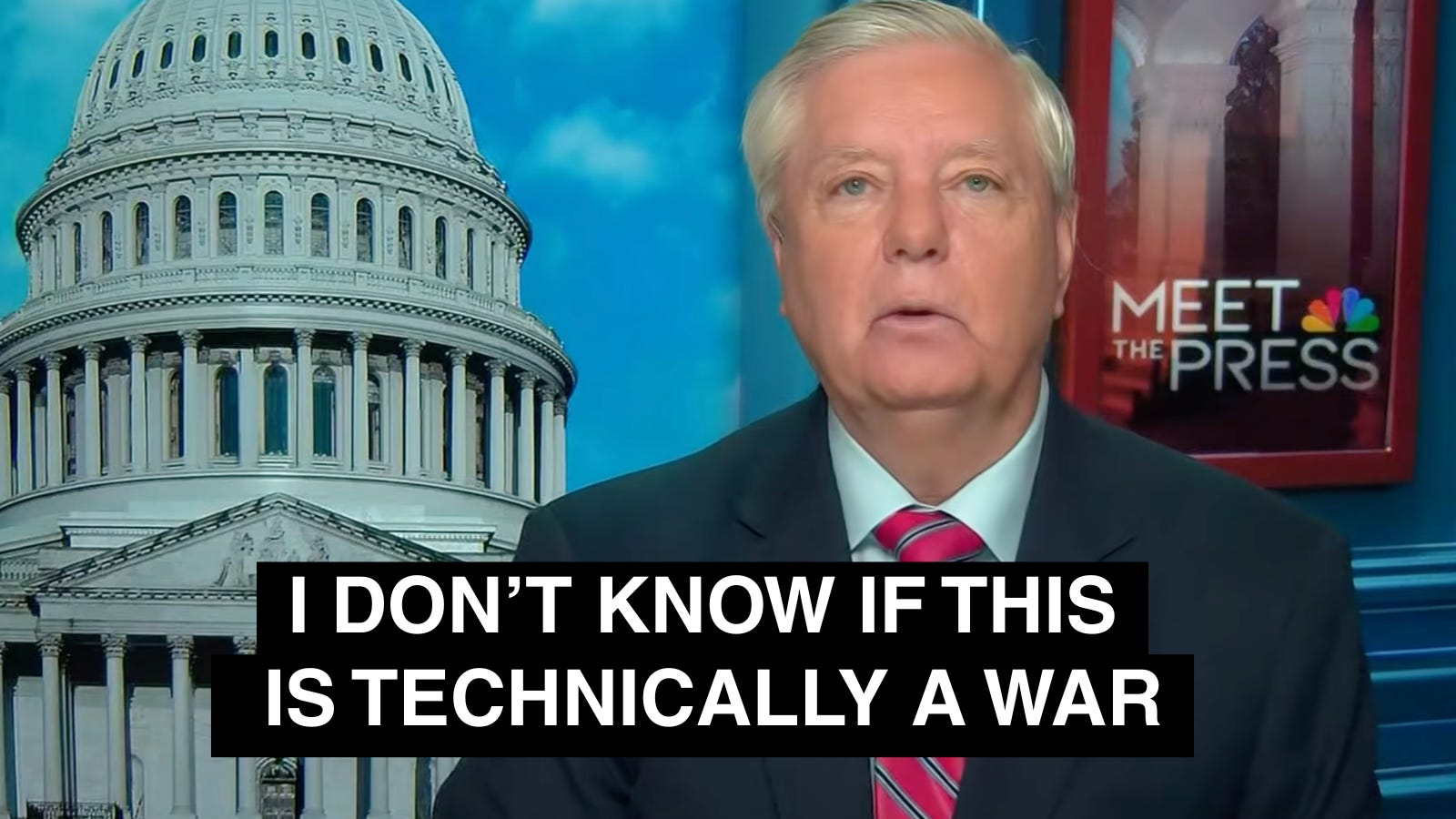
"I don't know if this is technically a war,” Senator Lindsay Graham said of the un-war in Iran on Meet the Press on Sunday.
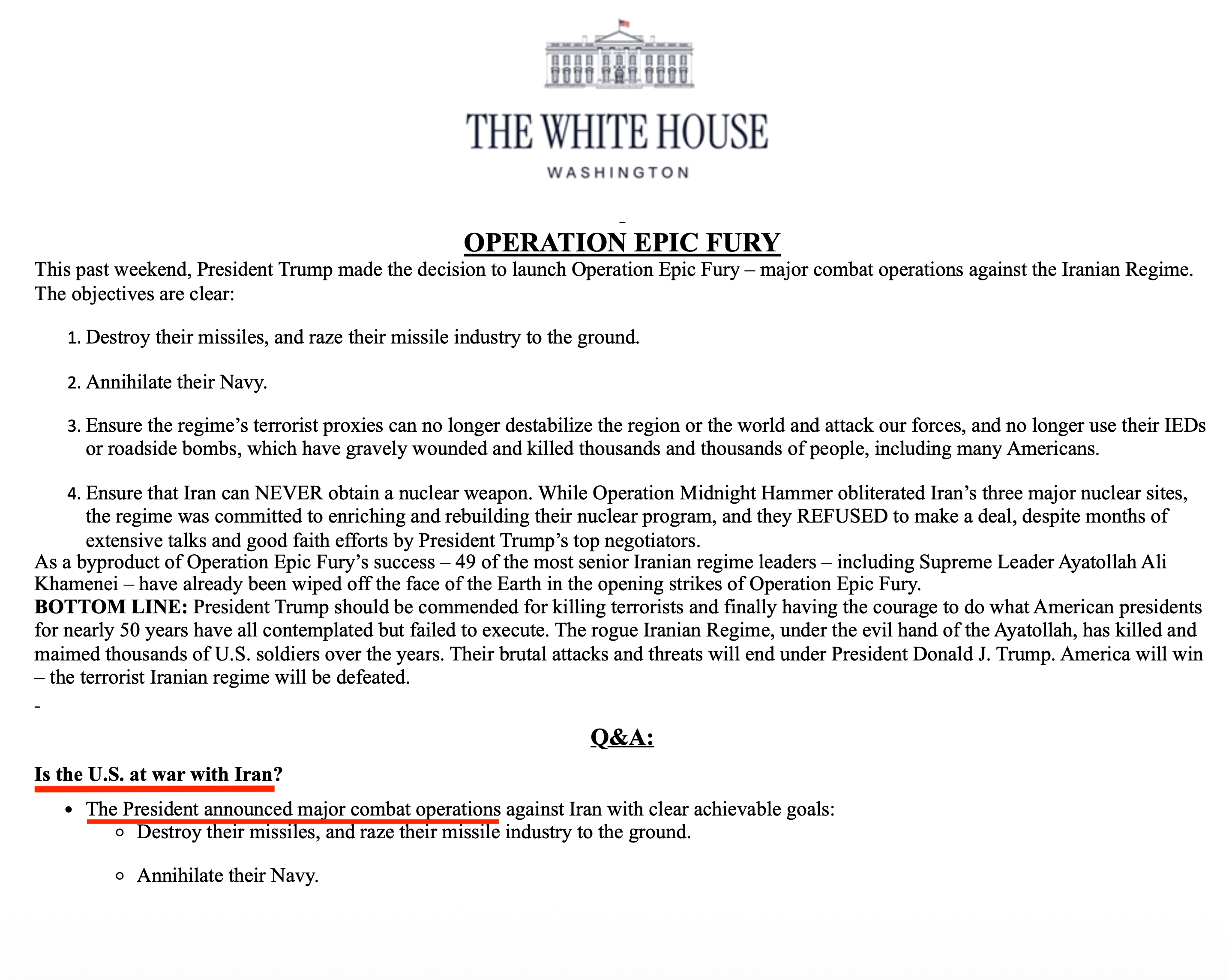
Graham, it turns out, was repeating White House talking points circulated to Republican members of Congress instructing them to push back on the question, “Is the U.S. at war with Iran?” by instead calling it “major combat operations against Iran…”
The messaging strategy devolved into farce today when Senator Markwayne Mullen insisted, “We haven’t declared war,” shortly after saying, “This is war.”
“I misspoke,” Mullen said when a reporter pointed out the contradiction.
But it is not just Trump loyalists who are playing word games. Democrats also have a hard time calling this what it is, with the party’s top officials using terms like “Military attack,” “military operation,” “military assault,” and the like.
Sen. Chuck Schumer says the strikes are “risking wider conflict”; Rep. Hakeem Jeffries says the operation has “brought us to the brink of a possible war.” Comments like these imply we aren’t already at war.
“Donald Trump has launched a large-scale military operation against Iran,” Mark Kelly of Arizona also flubs, he a retired Navy Captain who is otherwise willing to go to war with Hegseth to protect his honor.
So the question remains: What even is war in 2026? It’s a vital question that needs to be resolved.
First, it needs to be resolved because the public has been completely cut out of any involvement in the debate. It has been sold a bill of goods over the past decade that has conditioned them to think that ground armies (e.g. “boots on the ground”) and tanks slogging their way forward a la World War II is the only thing that qualifies as war. Thus today everyday war — what my editor calls ‘perpetual war’—persists without interference. The steady state remains untouched and is always there making the “decision” to go to war moot. Syria, Yemen, Somalia and more, mostly it just happens and few even notice.
Second, we need to make the 1973 War Powers Resolution more relevant to today. From Bill Clinton to Trump, successive presidents have used a variety of euphemisms – “air campaign,” “combat operations,” “kinetic military action,” “overseas combat operations,” “operations other than war,” “discrete strikes”—to avoid Congressional control over their use of the US military.
There are the very few members of Congress who have boldly labeled the Iran war a war, but their arguments also need to be updated for today’s decapitation realities and the nature of the majority of American conflicts.
“Gambling with American lives,” Bernie warns, an admonition that is questionable in an airpower-only conflict. The war will result in “increased instability in an already dangerous world,” Sanders adds. Wars of this sort that rely on air power just don’t pose as much risk to American service members as wars of the past. That isn’t an argument for the war, but for honesty about why this style of war has become so attractive to the decision makers.
Bernie finishes with his signature appeal:
“The people of our country, no matter what their political persuasion, do not want endless war. They want decent-paying jobs, and health care and housing that they can afford. They want their kids to have an excellent education.”
We’ll never get to the country Bernie imagines—one that invests in its people instead of its wars—if we don’t tackle the war machine itself. Not when the bombs start falling, but every day.
Because, again, something has fundamentally changed. The U.S. can now remove heads of state with terrifying ease, involving minimal troops, minimal risk, and minimal public awareness. That capability isn’t going away—it’s going to become routine. And a Congress that can’t even bring itself to call a war a war has no chance of governing the quieter, permanent killing that defines American power now.
The War Powers Resolution was written for a world where war had a beginning. We don’t live in that world anymore.
— Edited by William M. Arkin
Can I just point out how insane it is that congress is voluntarily ceding its own authority here
The uniparty strikes again!