
Nobody knows if we’re going to war with Iran, including Donald Trump, but the frenzied media coverage leaves the impression it’s already been decided.
The message of the coverage is clear: It doesn’t really matter what the public thinks; it has no role to play in the decision; and it is too ignorant to understand the issue anyway.
The public unfortunately seems to be going along with this story, which is particularly tragic given the triumph of activism we’ve observed of late in both ICE and Epstein. Again, no decision has yet been made about Iran!
It’s worth considering who benefits from this false impression of an inevitable march to war. First, there’s Donald Trump, who gets to be cast as the author of reality. Then there’s the military, whose much-reported “preparations” serve as a TV commercial for the only real inevitability here: their request for billions more in tax dollars. The media gets its views and its clicks by scaring shit out of everyone. The expert class gets to weigh in and sound sober and authoritative while basically saying nothing. And Congress gets to act out their own theater of authority, hemming and hawing about abstract questions of policies, procedure and legality—but never the basic question of whether this is good or bad, smart or stupid.
Even the Iranian regime benefits because they are allowed to increase control and repression in the face of “war.” But the public, of Iran or America? Not so much.
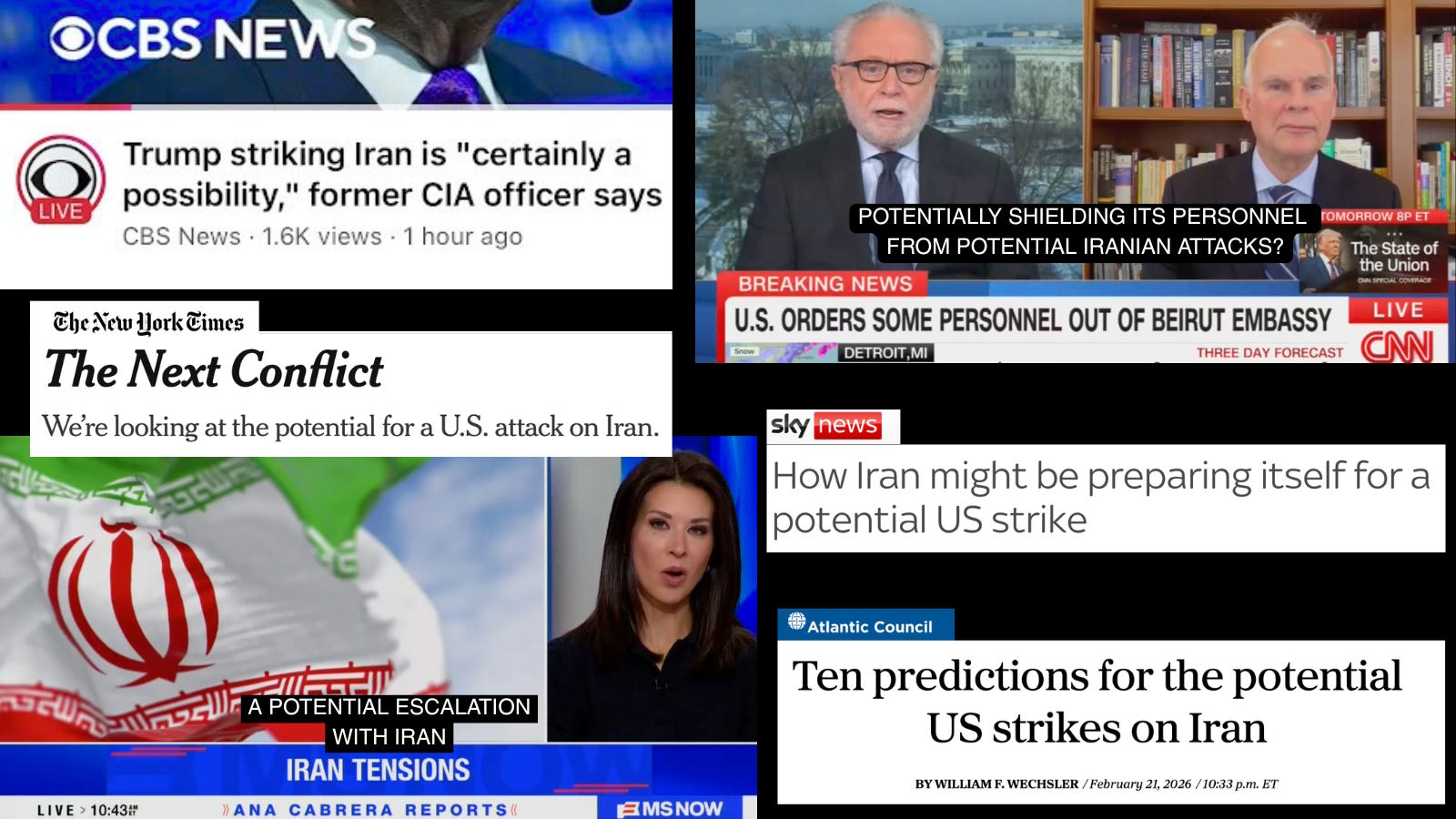
The barrage of media coverage says almost nothing about what has actually happened. Practically every headline is peppered with qualifiers like “potential” and “possible.” Yesterday, the New York Times reported that Trump “considers” a second, later strike, should the first potential strike he is also considering does not achieve its desired effect.
Some recent illustrations of the absurdity of this news cycle:
MSNBC host Ana Cabrera warns that “a potential escalation with Iran could be imminent.”
A CBS headline blares: “Trump striking Iran ‘is certainly a possibility.”’ [HOW CAN A POSSIBILITY BE CERTAIN!?]
Wolf Blitzer of CNN this morning asking, “Are we seeing signs of the United States potentially shielding its personnel from potential Iranian attacks?” His guest, some retired Air Force Col. Cedric Leighton, replied: “Usually when things like embassy evacuations occur, that means that action is imminent—or at least a very high possibility.”
I could go on and on with countless more examples of news stories that say nothing. But the benefit of the wall-to-wall coverage is clear. I took a look at CNN’s YouTube page and realized that its own Iran segment—“Trump prepared to strike Iran by this weekend”—has its second highest view count, racking up nearly 700,000 views. (Segments before and after don’t even crack 100k, to give you a sense of how much of a home run that is for CNN’s YouTube channel.)

Yes, the military is preparing, because, well, that’s what the military does. This isn’t the first time it’s had two aircraft carriers in the region (not even the first time in the past year). To say that this is the “biggest” deployment since the 2003 invasion of Iraq is itself questionable (because we don’t have any numbers of other steady state and crisis deployments) and irrelevant. Donald Trump could direct the attack of Iran with a pea-shooter if that’s all he had at his disposal, given how much of a wildcard he is.
“Are we going to war with Iran?” is the wrong question. Most important because I’d say we’re already “at war” with Iran, and that war has already escalated.
In the past year alone, we’ve seen:
Operation Midnight Hammer, the June 22, 2025 strike on Iranian nuclear facilities involving seven B-2 bombers and dozens of Tomahawk missiles;
Operation Rising Lion, the June 2025 attacks by the Israelis;
US strikes in Yemen, Syria and Iraq to do damage to Iranian “networks;”
Ongoing cyber attacks on Iranian government network capabilities;
The initiation of new covert (and special) operations to prepare for potential strikes;
Ongoing cover operation to facilitate and aid “regime change,” including the covert shipment of Starlink terminals into Iran to facilitate protests and organizing; and
Restoration of “maximum pressure” sanctions against Iran.
US forces have been building up since December, predating the Iranian crackdown on protesters. And since then, the following regional countries have announced that they will not permit American aircraft to use their airspace for offensive strikes: Saudi Arabia, the UAE, Qatar, Kuwait, Iraq, and Turkey. So whatever decision is made, any strike would have to heavily rely on ships, and would therefore face significant limits.
Again, no decision has been made!
In any case, war with Iran is already here. No one wants to acknowledge that because the “World War III” framing benefits the parties I mentioned earlier: Trump, the military, the media, and so on.
Everybody wins. Well, except us, the public.
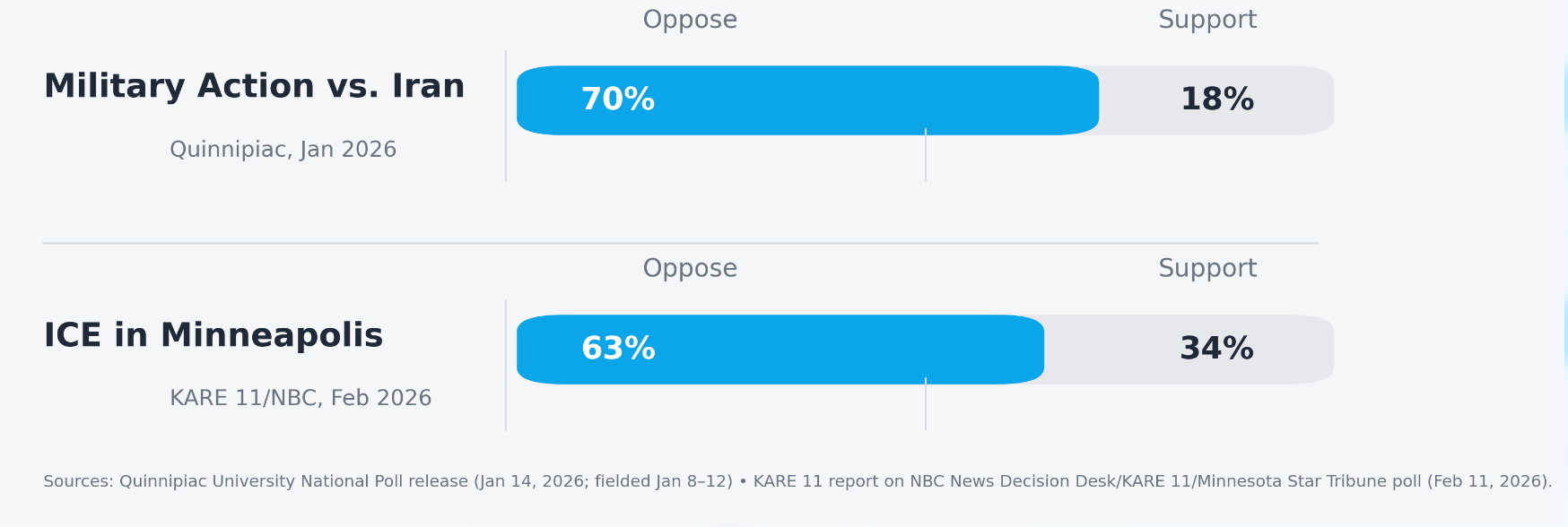
Never mind that poll after poll finds majority opposition to U.S. military action against Iran (even more than the majority opposed to ICE’s conduct in Minneapolis). None of this matters to Washington because they’re oblivious to the existence of anybody but themselves.
And as for the leaks in the New York Times and elsewhere describing how military action might unfold (i.e. demonstration strikes, attacks on nuclear targets, Iran’s ballistic missile infrastructure, its domestic security apparatus, or even regime change), even if all of these things happen, as the Midnight Hammer strikes showed, it will not resolve the issue. There is no operatic finish, no decisive end, to this style of endless war that the national security state can pretty much carry out wherever and whenever, while we foot bill.
Admitting you have a problem is the first step, as the saying goes; but that’s hard to do when the media constantly misdiagnoses it. The coverage lately reminds me of John Madden, the late football commentator infamous for his banal remarks.
We are indeed being gamed, right off the field and into the stands where only cheering can be heard.
— Edited by William M. Arkin
I’ve got a bad feeling about what’s coming.
For some reason I’m reminded of Zootopia and the advice for when asked a hard question…to just answer with a different question - America: “Why on earth would we want to go to war with Iran?” News: “Are we definitely maybe going to attack by ship? Yes, we probably could possibly do it that way.” 🙃