
We attacked Iran because the target was simply too tempting to pass up, military sources tell me.
No consideration was given to the what, the so what or the then what, I’m also told. The “high-value targets” were just too valuable: the Ayatollah, the Chief of staff of the Army, the Minister of Defense—at least 40 senior officials in total were killed. Trump 'approved' what was all but impossible not to approve. The president is captive to an intelligence machine built over decades that now produces kill packages so clean and seductive that it practically runs itself.
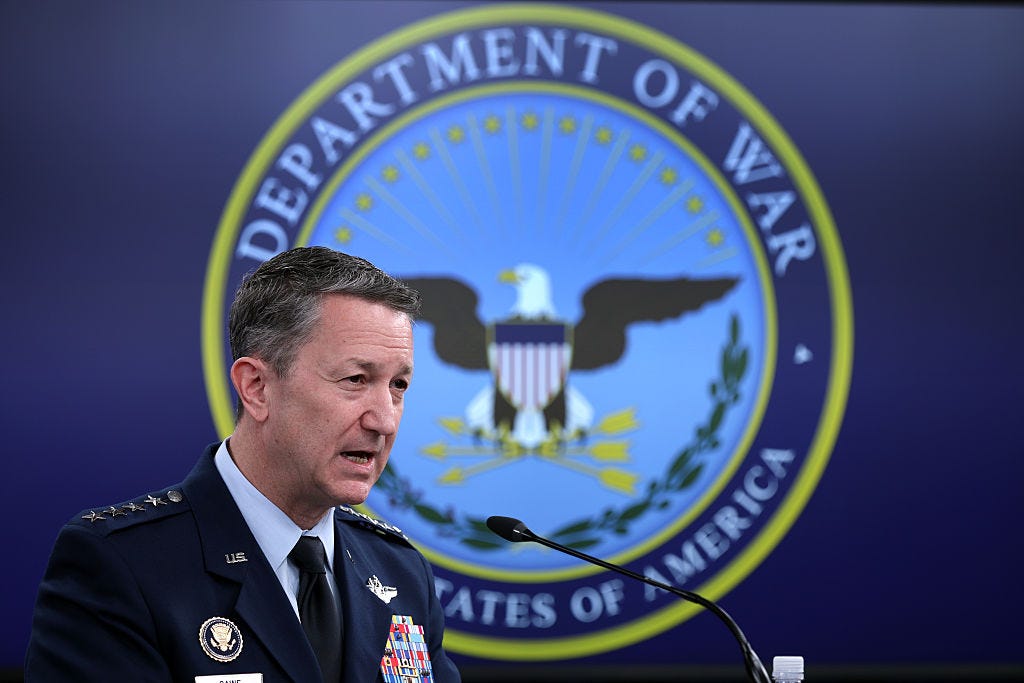
As the Pentagon bluntly put it, “a large-scale U.S. strike cut off the head of the snake,” summarizing its view of a crisp decapitation operation.
Trump gets away with all of this by pretending we’re not really at war—a falsehood with which Congress is happy to play along. Asked if the U.S. is at war with Iran, Sen. Lindsey Graham told Meet the Press: “I don’t know if this is technically a war.” Absurd as that sounds, Democratic leaders are adopting the same framing. Sen. Chuck Schumer says the strikes are “risking wider conflict” as if this isn’t already that; Rep. Hakeem Jeffries says the operation has “brought us to the brink of a possible war,” as if this isn’t already war.
If killing a 36-year-long head of state and his deputies isn’t war, what is?
The United States is at war with Iran, pure and simple. We have been for decades. We supported Iraq in its war against Iran. We’ve conducted special operations inside Iran. We’ve shot at Iranian coastal installations and sunk Iranian ships. We’ve undertaken constant covert operations in the shadows, from actual sabotage to planting cyber viruses. We shot down an Iranian civilian airliner, attacked targets on land, and conducted thousands of strikes against Iranian proxies in multiple countries from Yemen to Lebanon. We’ve labeled the country part of the Axis of Evil. We killed Quds Force head Qasem Soleimani in an aerial assassination and bombed Iranian nuclear-related sites. We’ve thwarted Iranian attacks on Israel and others, maintained a tripwire ground force in Kuwait, and hardened installations in the region.
From Jimmy Carter to Donald Trump, through Republican and Democratic administrations, the United States has frozen countless billions in Iranian assets; sanctioned Iranian companies; cut off Iran from the world banking system; banned Iranian oil imports and exports; and penalized non-U.S. companies investing in the country. We have designated the nation, Iranian organizations, and Iranian individuals state sponsors of terrorism and foreign terrorist organizations.
Add to this history that today, the American military machine continues to do its thing. In two-and-a-half decades of war since 9/11, it has perfected the ability to find and destroy a target, any target. I’ve previously written about the fundamental change that has occurred in the nature of warfare in the practice of decapitation. As we see here in the latest, the U.S. and Israel carried out an opening blow that killed Iran’s Supreme Leader Ayatollah Ali Khamenei and dozens of other Iranian leaders.
The military feat itself is the “reason” we are where we are. Pure and simple, meticulous intelligence work identified the routines and locations of the Ayatollah and others in Iran’s national security apparatus and when a set of meetings on Saturday morning were pinpointed, the tight-as-a-rubber-band machine snapped into action.
“Calling this ‘starting a war’ is a Democratic talking point,” Secretary of Defense Pete Hegseth said today, adding: “This is the elimination of a threat that has existed since 1979.”
Because we were already at war with Iran and have been for decades, those in charge didn’t think they had to ask permission (or even if they did, that they had time to do so). The target is hot, red hot, and we need to strike now to gain the maximum advantage, the briefers say. Yes, there are intelligence and diplomatic people who fret about the consequences, but like the wusses in Congress, they are brushed aside because this is an opportunity we can’t pass up.
That’s how it’s been explained to me.
As many of you may have noticed, I have not unleashed my own barrage of words over the US and Israeli war on Iran. I’ve followed the arguments for and against, unhappy that so much of what has been said and written focuses on Trump rather than Iran and the intelligence machine I’m describing, and that so many of the Washington responses opposing the latest attacks have been to fret about the paperwork behind war powers rather than the obvious need to redefine what war is.
In a rebuke of his own party’s rhetoric, congressman Eric Swalwell said this weekend, “Now is the time for values-based arguments against war with Iran,” adding: “NOT process (‘Come to Congress’) ones.”
His point is well taken, but I’m skeptical that the opposition to the strike is focused on the machine that made it inevitable, instead of focused on Trump individually.
We build this military and intelligence machine, we pay for it, we watch it out there constantly training, deploying, exercising, attacking this and that in a half dozen countries so when something like this unfolds, we shouldn’t be surprised. That’s what it’s for.
Several former senior military officials have groused to me that there’s very little scholarly analysis of decapitation as a policy in the open record, and certainly as it relates to major war (as opposed to counter-terrorism or counter-insurgency against non-state actors). And yet as I wrote earlier, we are witnessing a new breed of warfare with the ability of the military to perform near-instant decapitation. It is no longer the ten-year hunt for Bin Laden or the many unsuccessful attempts to get Saddam.
We need to adjust, for the old arguments about war, about going to war, and about the nature of war no longer apply in this strange new world.
Now, Donald Trump says that the “big wave” is still to come in the war, unsure himself of the outcome or even the point of Operation Epic Fury, which the lawyers are labeling “major combat operations” to further obscure the plain truth. Hegseth says that Trump “has all the latitude in the world” in deciding how long the war will last, while also reassuring that the Iran war will not be “endless.”
The “big wave” is merely another series of flights hitting more targets than yesterday. “Endless” is already here. And even if Iran’s theocracy is replaced by something else, the military isn’t going to fold up the machine and go home. Even if Iran ends up being something other than endless and a true democracy emerges, the machine will be there to continue to war with America’s many enemies.
It is the system that is our long-term problem, and our screwed up language and debate about war. For all the fretting about AI, an autonomous machine is already in charge.
— Edited by William M. Arkin
Fun Fact: the two countries we launched regime change invasions on, Iraq and Iran, did not supply any terrorists for the 9/11 attack. OTOH, our good buddies Saudi Arabia and Egypt did.
“You cannot simultaneously prevent and prepare for war.”
-Albert Einstein