
Today, a day after Pete Hegseth’s defiant press conference likening the congressional impeachment effort to an attack on the troops, we celebrate Veterans Day.
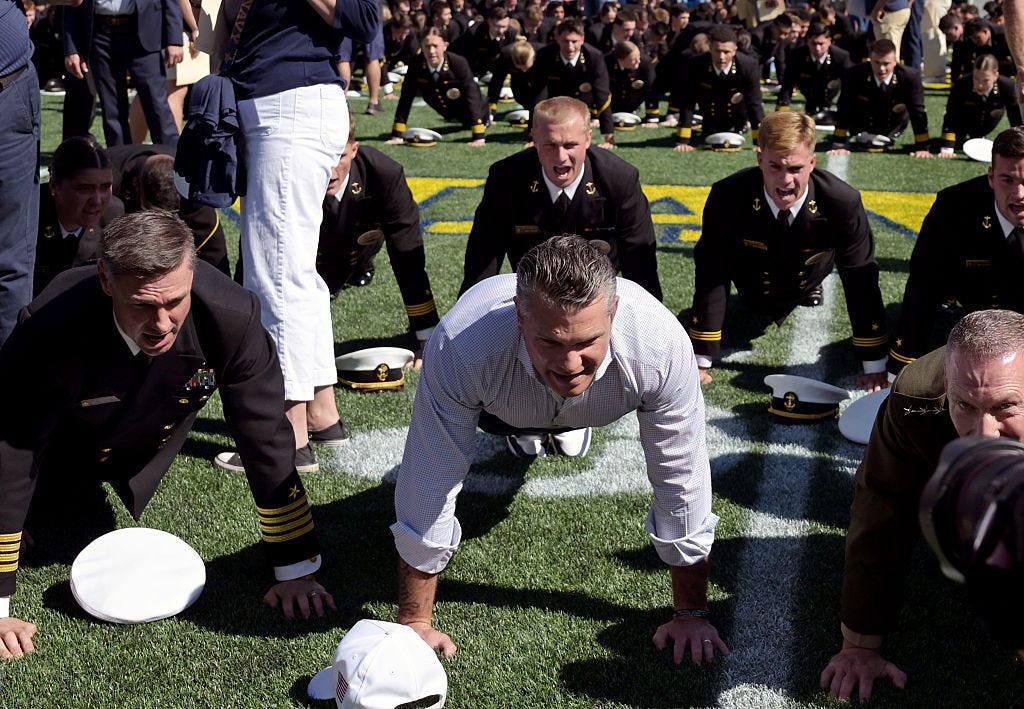
One might think that the secretary, who can’t pass up an opportunity to do calisthenics with the little people and fires the brass like they’re his own Apprentices, would be popular among ordinary service members.
He isn’t.
I’ve noticed it anecdotally with the ones I know, and I see it on troop message boards. The military skews heavily conservative, yet a good half of active-duty troops and veterans criticize the secretary for his lack of humanity and humility. What’s striking is that their complaints aren’t the ones you hear from Hegseth’s critics in Washington, and virtually none appeared in the formal Articles of Impeachment introduced this week.
Many of the service members who dislike him share Hegseth’s premises. They’re skeptical of DEI, they don’t think much of Congress, and they want tougher standards for those who serve today. Their problem is that he doesn’t live up to any of it. They see a man playing identity politics while claiming to end it, playing soldier instead of doing a civilian secretary’s job, and running a war that has been careless with the very troops fighting it.
Almost none of them object to the Iran war on legal grounds. They do object, however, to how it’s been run, and the parts particularly under Hegseth’s control.
“Just as bad as DEI”
You won’t find much love for diversity programs on these military and veterans message boards, and Hegseth’s defenders pitch him as the cure. “Hegseth is trying to restore the military to a service of honor and discipline—not social engineering,” one member writes this week.
His critics use the same language against him. They don’t say he’s wrong to go after DEI. They say he’s practicing his own version of it.
“Firing competent leaders based on sex and race is just as bad as DEI he claims to be fighting,” another commenter writes.
A separate commentator says that “Firing generals not on their ability but if they were a person of color, female or attended a covid meeting is totally political and has no place in the military Chain of Command.”
They’re right. Hegseth’s removals include Joint Chiefs Chairman Gen. CQ Brown, the second Black officer to hold the job, and Adm. Lisa Franchetti, the first woman to lead the Navy. (The administration also fired Coast Guard Commandant Adm. Linda Fagan, the first woman to lead a military branch.) In April, with the war underway, Hegseth pushed out Army Chief of Staff Gen. Randy George. NBC reported that Hegseth has blocked or delayed promotions for more than a dozen Black and female officers.
“He’s violated many public laws on promotions,” another commenter says.
The objection is about merit, the very value Hegseth says he stands for. “Like with Trump, he hires and fires based on loyalty to a party or person, not merit,” another writes.
Hegseth’s banning beards and denying waivers for those who cannot shave gets the same treatment. Hegseth ordered that troops who still need a medical shaving waiver after a year of treatment be kicked out altogether. Most of those waivers are for a painful skin condition far more common in Black men. An Air Force study found that almost 65 percent of shaving waivers went to Black men, who made up about 13 percent of the group studied. Troops don’t describe this as enforcing a standard. They describe it as sorting people by race.
“A tiny number of white men require shaving waivers for medical reasons,” a commenter writes. “A far larger number of black and Hispanic men do. There is no reason to enact such a policy on objective grounds.”
Another calls it one of “the clearly racist policies.”
Even the trans ban draws complaints about how it was carried out. About 1,000 transgender troops were pushed out after the Supreme Court let the ban take effect. “Agree or disagree with trans people being in the military, the fact is they were allowed to join,” one wrote. “Hegseth had them kicked out with no respect to their service and no warning.”
Not anti-war; anti-incompetence
In Washington, the case against Hegseth’s war is about war powers and “war crimes.” On the troop boards it’s about logistics: how long rotations last, whether bases were protected, given that Iran’s missile and drone capabilities were well known, and whether the fighting men (and women) were actually the first consideration of Mr. Warfighter.
“He’s left sailors without resupply, and troops without shelter,” one writes.
The most bitter complaint is that troops and their families were left exposed. Hegseth, one writes, left “military members (and their families) in harm’s way without warning or fortifications despite knowing they were about to be under attack.”
The damage is real. Iran and its allies have hit at least 16 U.S. military sites across eight countries. The repairs will run to billions, which are not counted in the Pentagon’s $25 billion estimate of the war’s cost. Commenters put this down to poor planning, not bad luck.
Then there’s what happened afterward. About 1,300 Navy family members fled Bahrain after Iranian strikes, many with little more than a suitcase, and most still don’t have their belongings. The Pentagon denied a blanket extension of their financial support, which ends November 30. “People who were evacuated from CENTCOM still haven’t been made financially whole after abandoning all their possessions,” one writes.
The policy on rotations comes up again and again. “My friends who were supposed to be in my wedding party still haven’t come home from their ‘6 month rotation’ to Centcom that ‘ended’ in August,” one writes. Sailors on the USS Abraham Lincoln were at sea for more than 250 days. Why? So that Hegseth could run around bragging that only 10 percent of the military was involved in the war. The sailors, meanwhile, are expected to take it, because that’s what they signed up for.
Some are also incensed that the human costs are being hidden. “He’s hidden from the public deaths, injuries,” one writes. “If you heard his speech he only mentioned 18. That number is in the 20’s, but they are not counting it because ‘operation epic fury’ was over.”
That holds up. On Tuesday, Hegseth said “18 Americans have given their lives in Operation Epic Fury.” The Pentagon’s own count is 23 dead. Fifteen are listed under Epic Fury and eight under “Overseas Operations,” a category the Pentagon created after the White House declared Epic Fury over in May. And we still don’t have a precise accounting of the injuries. Why? Because Pete Hegseth is more concerned about how his war looks than about the actual wellbeing of those under his charge.
The same concerns about troops’ welfare show up when it comes to vaccines. In April, Hegseth made the flu shot optional, ending a requirement that dated to 1945. By June, 275 trainees at Lackland Air Force Base in Texas had the flu, and only about 40 percent of new trainees there were vaccinated. “How long did it take a flu outbreak to occur after changing immunization policies and dropping vaccine rates to less than 40%?” one asks.
“Wannabe platoon leader”
The most telling complaints are about what Hegseth’s job actually is, a point many troops say their own comrades get wrong.
When Hegseth is criticized, his defenders often reply that the secretary has always been a political appointee. Critics say that misses the point of civilian control. “He is not military, he is a civilian appointee,” one writes. The job is oversight, and in their view Hegseth would rather be in the field. He “spends more time being a wannabe platoon leader than a senior civilian leader whose job is strategic planning.”
Hegseth’s fans tend to justify his purges by pointing to an incompetent or overly political brass. “I have seen too many generals that were only pencil whipping problems!” one writes, referring to officers who sign off on problems on paper without actually fixing them. Hegseth’s critics agree the brass needs accountability. Their question is who holds Hegseth accountable. “It all boils down to accountability,” another writes.
His war with Congress produces the same split. Plenty of troops share his contempt for lawmakers. What bothers them is the double standard: a service member who talked to Congress the way Hegseth does would be in serious trouble.
“Secretary Hegseth’s recent behavior in literally taunting The Congress would not be tolerated of any of the uniformed service, civil servants or DoD contractors,” one wrote. “It is behavior unbecoming of the SECDEF and will end up resulting in negative impacts on the services.” Another: “I love to dog on Congress as much as the next American. However, his manner of address and how he loops in Congress shows great disrespect.”
Soldiers see the same double standard in Signalgate. Troops can lose their clearances for far less than discussing strike plans on a commercial messaging app. “He lost me immediately when he compromised national security in a signal chat,” one says.
Then there’s Hegseth’s attack on Sen. Mark Kelly, a retired Navy captain. Hegseth went after Kelly, including by threatening to cut his retired rank, over a video telling troops they could refuse illegal orders. Some veterans saw that as an attempt to strip free speech from people who had already served.
Culture warrior
Hegseth has made the “warrior ethos” his brand. His critics in the ranks don’t dispute that troops need to be tough. Some praise his fitness push and say service members must be fit to fight. What they object to is warrior culture treated as an identity rather than a skill.
“Being a warrior is not a 12 year old macho fantasy and hasn’t been for hundreds of years,” one wrote. “We don’t need people to charge a phalanx, that method of war died a long time ago. War is more brain than brawn now and Hegseth actively attempts to erode that constantly.”
“When warrior culture becomes cult,” another writes, “the professionalism ends.”
Hegseth’s naked favoritism toward his right-wing Christianity makes it worse. Hegseth holds monthly Christian worship services at the Pentagon, and at one during the war he prayed that “every round find its mark against the enemies of righteousness.” Critics don’t say faith has no place in the military. They say it shouldn’t be used to justify things that need real justification. “He needs to stop with religion peddling,” one writes. “Instead of using faith and religion as an excuse or reason to push warrior mentality, maybe come up with substantial reasons.”
Several pointed to “treating people with dignity,” which they described as a foundation of the laws of war going back centuries. For them it’s part of what separates a professional military from a mob.
The beards come back here too, as a matter of priorities. “General Grant had a beard and he won HIS war,” one writes. “Just saying…”
Erasing our history
Hegseth’s erasure of history is usually covered as a culture-war story. The troops tend to see it as a professional loss.
In 2025, Pentagon websites scrubbed pages on Jackie Robinson’s Army service, the Navajo Code Talkers, the Tuskegee Airmen and Iwo Jima flag-raiser Ira Hayes. Several came back only after an outcry. The Naval Academy pulled nearly 400 books from its library.
During World War II, the Code Talkers built a code the Japanese never cracked. The Tuskegee Airmen escorted bombers over Europe. That’s the history Hegseth scrubbed, and troops took notice.
“He’s removed hundreds of years of knowledge and experience,” one wrote, “right as we need it the most.”
Who still likes him
Hegseth has his fans in the ranks of the armed services for sure, and I don’t want to suggest otherwise. “Leader and motivator,” one writes. Many of them buy the pitch that he’s the cure for a “woke” military.
One commenter offered a theory of where support breaks down: “The average war fighter is supportive...the average support soldier is non supportive and there is a racial and of course LGBQT aspect to who supports him.”
It’s a telling remark. If accurate, Hegseth’s base in the military is made up of the combat-arms troops whose image he has built his brand on. His critics are the people who keep the whole operation running: logistics, supply, the support jobs. They are, by the way, the vast majority of soldiers, sailors, airmen, Guardians, and Marines. They’re the ones who are the majority of veterans today. Their service mattered in the great wars of the past and they matter today.
But Hegseth has no time for or interest in them.
— Edited by William M. Arkin
i don't think he will be there much longer.
The Guard at the Tomb of the Unknown Soldier did more for democracy today than Congress and the Supreme Court over the past 2 years.