
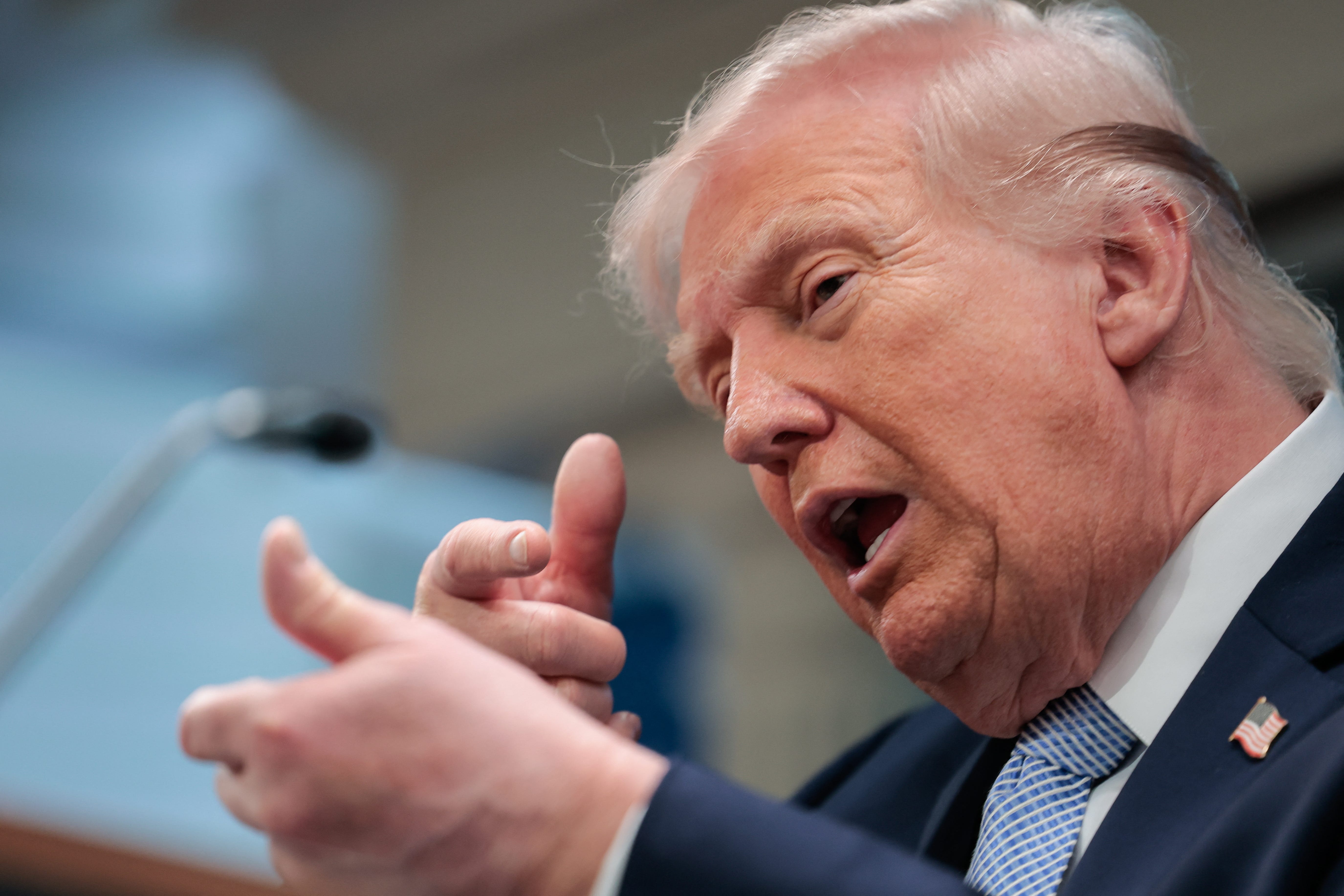
“A whole civilization will die tonight,” Donald Trump announced today, threatening to rain down hell on Iran.
Don’t let the bravado fool you: he’s scared.
On Monday, the president made a rare show of submission, bowing not to Washington or Wall Street, but to the people.
“Unfortunately, the American people would like to see us come home,” Trump said of the Iran War on Monday, visibly irritated. “If I had my choice, I’d keep the oil; but I also want to make the people of our country happy.”
The Iran war is deeply unpopular with Americans, basically every poll finding a majority opposed since the war began on February 28 — an extraordinary fact that media have largely glossed over. It is virtually unprecedented not to see a spike in popular support when Washington launches a military operation, so much so that political science has a term for it: the “rally around the flag” effect.
In the case of the Iran War, it’s not that the spike in support was small or short-lived. It never happened at all.
I do not pretend to know what the president will decide at 8pm ET, his deadline for Iran. I doubt even he knows. But the unprecedented public skepticism is clearly on the top of his mind. And it’s very likely on the Pentagon’s mind, too. When the commander-in-chief demands “a plan” (as Trump has), the military obliges; but in fraught situations like these, it exercises some discretion in how those plans are briefed, filling it with low percentages and high risks to send a message to the bomber-in-chief that it isn’t the preferred option.
And the polling could not be more clear that this isn’t the preferred option.
“Even in the most controversial wars, like Iraq, when the war initiates, people tend to rally around the flag … this is remarkable that at the very beginning of the war, there’s overwhelming opposition not only from liberals and the left, but … from much of Trump’s base as well,” politics professor Stephen Zunes of the University of San Francisco says.
CNN’s data guru Harry Enten made this point in greater detail in a segment this week, crunching decades of data about rally around the flag effects across every major U.S. military engagement in the Middle East. The numbers are stark. During the beginning of the Iranian hostage crisis, Jimmy Carter’s net approval jumped 32 points. George H.W. Bush saw a 31 point surge in the first month of the first Gulf War. George W. Bush got 14 points out of the 2003 Iraq invasion.
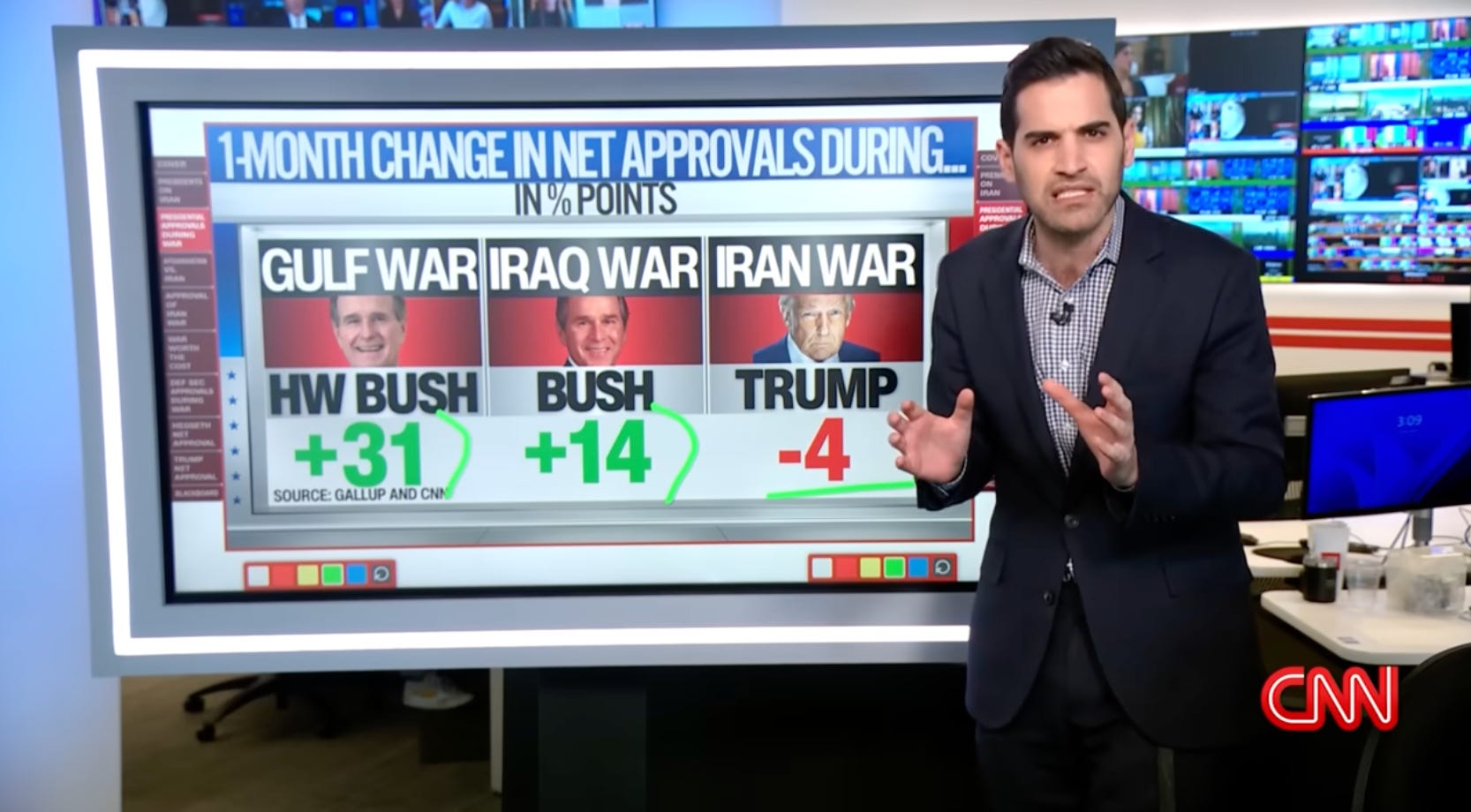
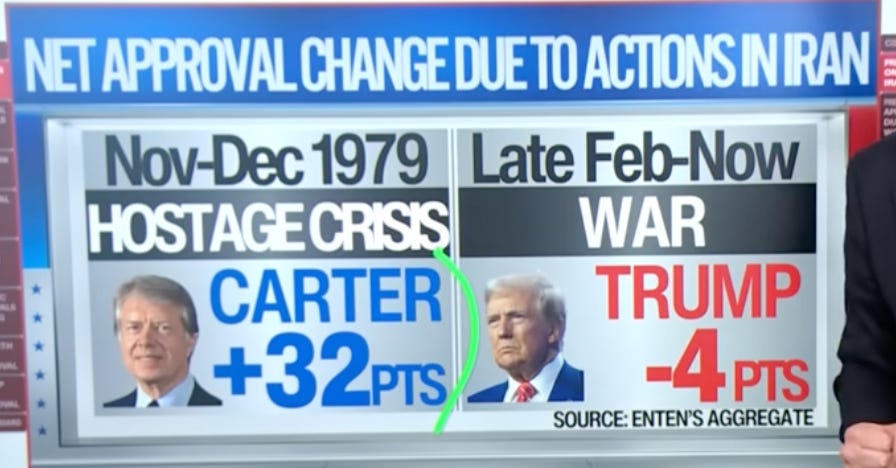
Trump? One month into the Iran War, he is down four points — making him the only president in the modern era to lose ground after launching a war.
Enton compared it to the one recent precedent he could find: Biden’s botched Afghanistan withdrawal, which cost him six points and, as Enton put it, effectively ended his presidency politically. Biden never recovered.
Whether the Iran War is the death of Trump and Trumpism remains to be seen, but the picture looks grim. The war started 12 points underwater in public polling and has since dropped another 10 — and only 29 percent of Americans say it’s worth the cost, compared to 59 percent who said the same about the 2003 Iraq War at a comparable point.
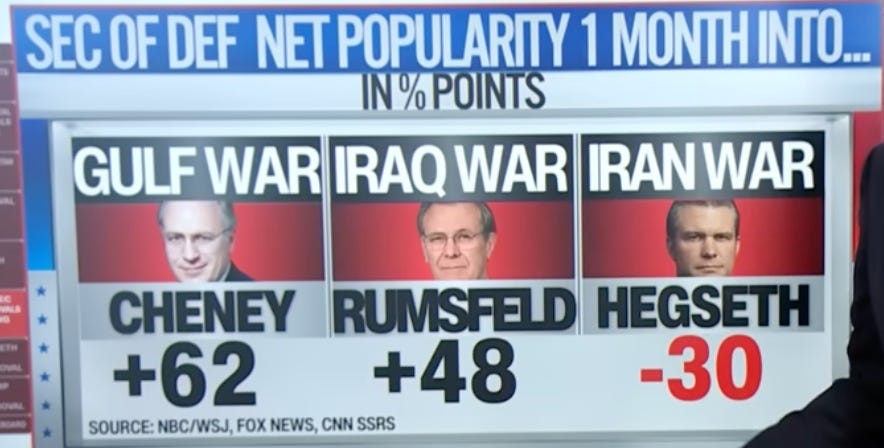
Secretary of War Pete Hegseth is 30 points net unfavorable, versus Donald Rumsfeld’s plus 48 at the equivalent moment in Iraq — a nearly 80-point gap. Dick Cheney was plus 62 during the Gulf War, a gap of over 90 points.
Trump’s approval on the economy has hit 27 points underwater; on foreign policy, 25 points underwater.
The dumb guy explanation for all of this is — incidentally, the explanation you’ll find in basically all the major media coverage — is that Americans are just feeling the pinch of gas prices. But that doesn’t explain the immediate opposition to the war from day one, before any of the economic effects started to kick in. And I don’t think Larry in Wisconsin is worrying about oil futures and the Strait of Hormuz.
What makes Americans’ quiet skepticism all the more incredible is that it exists despite a tsunami of propaganda they’ve been bombarded with about the war. This week has been dominated by glowing media accounts of the made-for-Hollywood heroics involved in the rescue of the American pilot downed in Iran, the CIA’s role, their escape training, the evasion of IRGC military dogs and hunters, and on and on.
Trump has pushed this personally, trying to desperately associate himself with something, anything popular.
Before the shoot down and the rescue, the American public was saturated with media coverage that mostly highlighted the excellence of our weapons systems, the exquisite intelligence, and how perfectly it’s all being carried out — the surgical strikes, the careful target selection, the assurances that civilian casualties are being minimized, the retired generals nodding along on cable news about the operational brilliance on display.
This is a war of the future, relying overwhelmingly on the acceleration of decision-making fueled by AI with again the message that air power provides minimal U.S. casualties. Check the news coverage on any day though: there is hardly a word about what is actually being bombed and why. It’s all 90 percent destroyed here, ahead of schedule there, practically ignoring the fact that civilization is being strangled in the routine.
This is exactly the kind of ostensibly low-stakes war that the national security system has been perfecting for decades now, not so much because it is manipulating the public on purpose but because it wants to reduce the friction of public (and presidential) opinion and interference, thereby minimizes opposition.
And then there’s the massive social media blitz the Trump administration has run, a spectacle that even a grizzled internet veteran like myself had never seen anything like. The Pentagon and its allies have been posting polished strike footage — bombs finding their targets, infrastructure vaporizing in infrared — with the cadence of a TikTok influencer. It is war as spectacle, war as highlight reel, designed for maximum virality. The administration has essentially been its own embed, cutting out the journalistic middleman entirely and pushing combat footage directly into the feeds of millions of Americans. By any historical standard, the propaganda infrastructure behind this war is without parallel.
And yet it hasn’t moved the needle. At all.
Americans just aren’t buying it anymore, this idea of fully automated luxury warfare. And the president knows it.
Just about the only group that doesn’t know it is the major media, which treats every event as contingent on Washington (always the protagonist in its reality), or what the Europeans or international community say, or the price of oil and the state of the stock market.
I see a civilization here at home that is bigger than any of those things, one that’s gaining the confidence to question the national security state. Trump again sees it, too (though he also sees the roughly 70 percent of his own party who support the war).
Will he listen?
— Edited by William M. Arkin
The fact that the entire country isn’t halting everything to address this is the problem. American exceptionalism and complacency has largely landed us here. We now have a US president openly threatening genocide and a non existent opposition party that can only seem to pen strongly worded letters of condemnation as opposed to taking any real action. The steady and rapid decline of this nation has been harrowing to watch, even more harrowing is watching the populace go about life as if nothing is happening
Not buying it.
See the fatman on the flying trapeze, but don't look too close!