
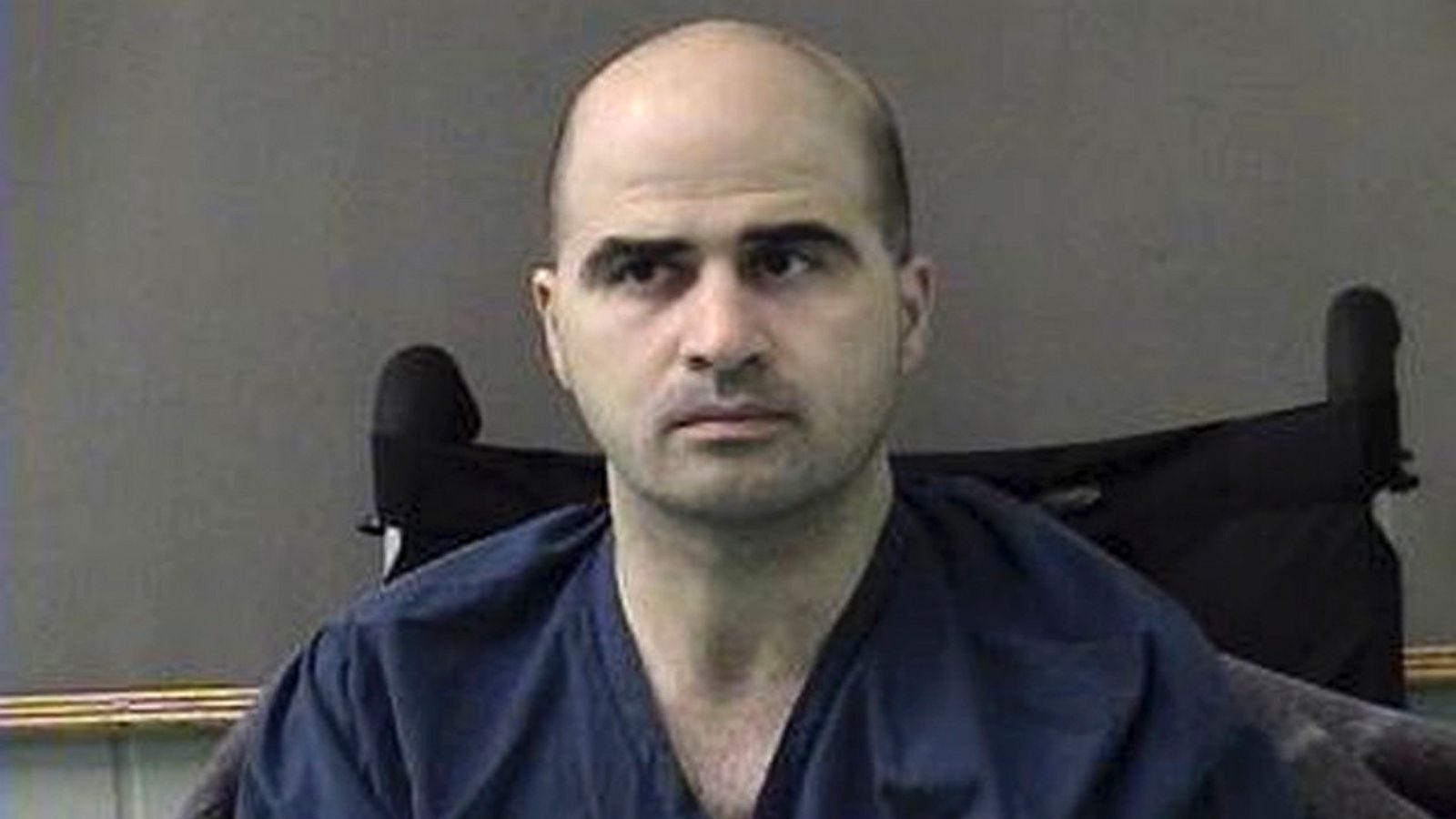
Pete Hegseth may have finally found a publicity stunt that even Donald Trump is uneasy with.
Despite the president’s tough talk about the execution by military firing squad of Fort Hood shooter Nidal Hasan, Hegseth’s desire to livestream it is something that even Trump can’t stomach. Since Trump cast doubt on the livestream, reports have claimed he had a change of heart upon realizing Hasan is wheelchair-bound.
If true, how reassuring that neither he nor Hegseth had the foresight to consult Wikipedia beforehand! (His change of heart also came after everyone from the Catholic Church to the National Association of Evangelicals condemned it.)
But there’s another reason Trump might’ve gotten cold feet, one that’s hardly gotten any attention: the grim fact that military protocols assign the president a creepily intimate role in military executions. They all but make Trump the executioner — an image that he may not want associated with the grotesquerie of a livestreamed snuff film.
That’s right: there are laws and military regulations on this. They virtually give the president his own livestream into the process.
A military court can sentence someone to death, and military appellate courts can uphold that sentence. But the death sentence “may not be executed until approved by the President,” according to federal law. In other words, the president can’t wash his hands of this and pawn off the decision on military courts, the Pentagon or Pete Hegseth. Trump alone must approve it, affirmatively and explicitly.
But that’s just the beginning. Under Army Regulation 190-55, § 2-1, the Army’s Judge Advocate General prepares a package for presidential consideration after military appellate review. The package includes the trial record, decisions of the military appellate courts and the Supreme Court, any clemency petition, and the Judge Advocate General’s recommendation.
Once the president decides, the Army formally transmits that decision through its chain of command. The “condemned prisoner” (literally the legal term) must then be personally informed of the president’s decision by the commandant of the U.S. Disciplinary Barracks at Fort Leavenworth.
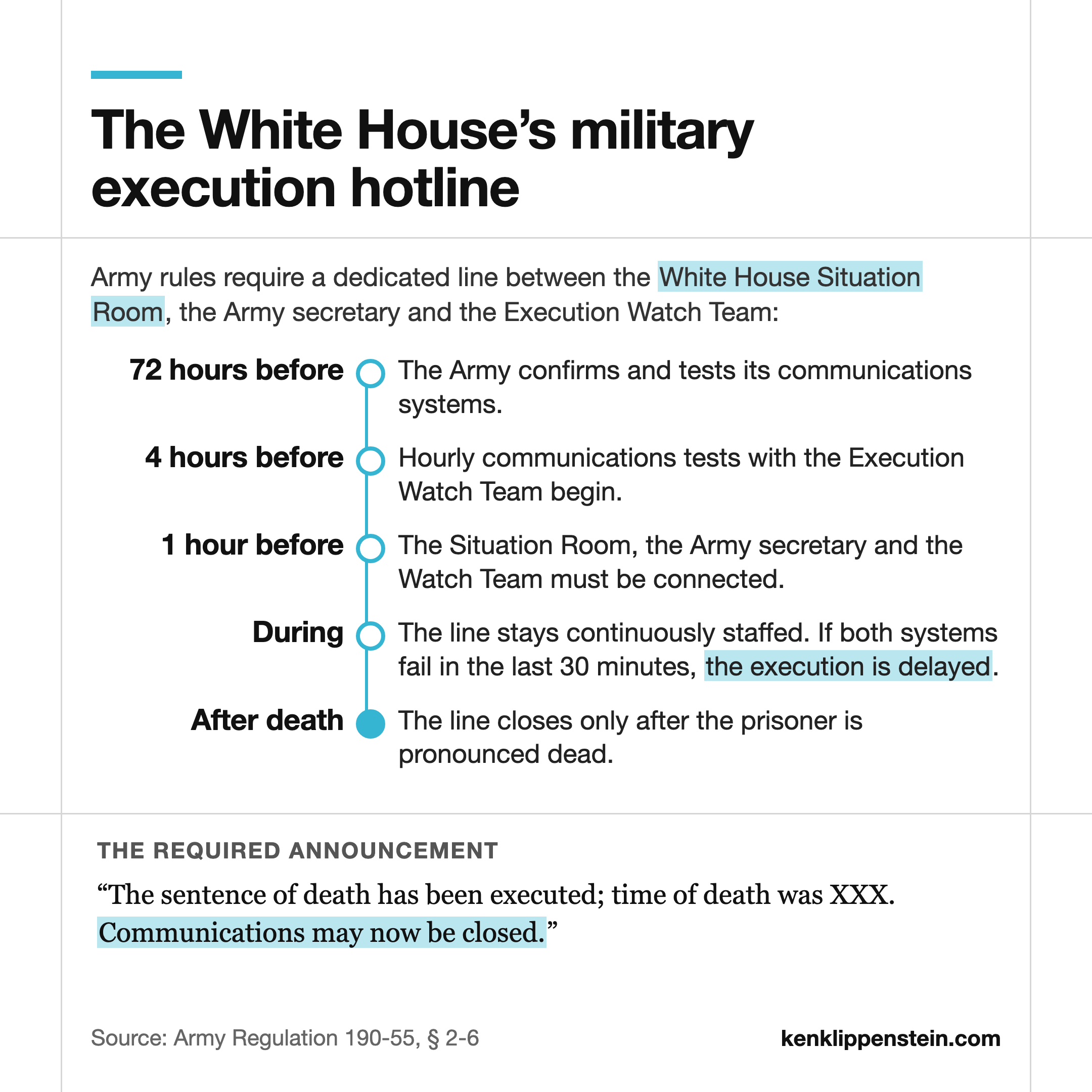
Next, Army Regulation 190-55, § 2-6 requires a dedicated communications network be established between the White House Situation Room and the military personnel responsible for executing the prisoner. The connections run through the Secretary of the Army and the Execution Watch Team, which is responsible for the condemned prisoner’s custody.
The regulation lays out an exact countdown. At least 72 hours before the execution, the Army must test its communications systems. Four hours out, hourly tests with the Execution Watch Team begin. No later than an hour before, the line must be up and running: from the White House Situation Room to the Army secretary to the team guarding the prisoner. It stays manned without interruption throughout, and it isn’t closed until the prisoner is pronounced dead.
So crucial is the president’s role that under military policy, should both redundant communications systems fail during the 30 minutes immediately preceding the execution, the proceedings must be delayed until communications are restored.
Even after the condemned is pronounced dead, the president’s role still has not ended.
Army Regulation 190-55, § 2-6(f) requires the Execution Watch Team officer in charge to make an announcement after designated personnel pronounce death. The prescribed language reads:
“The sentence of death has been executed; time of death was XXX. Communications may now be closed.”
Only then are the dedicated communications terminated.
I can see why the president might have lost his nerve.
— Edited by William M. Arkin
Useful background. Thank you.
You always bring the info Ken.
I guess executing a man in a wheelchair by firing squad before the midterms is a bad look. Fort Hood is not the same as 5th Avenue -