
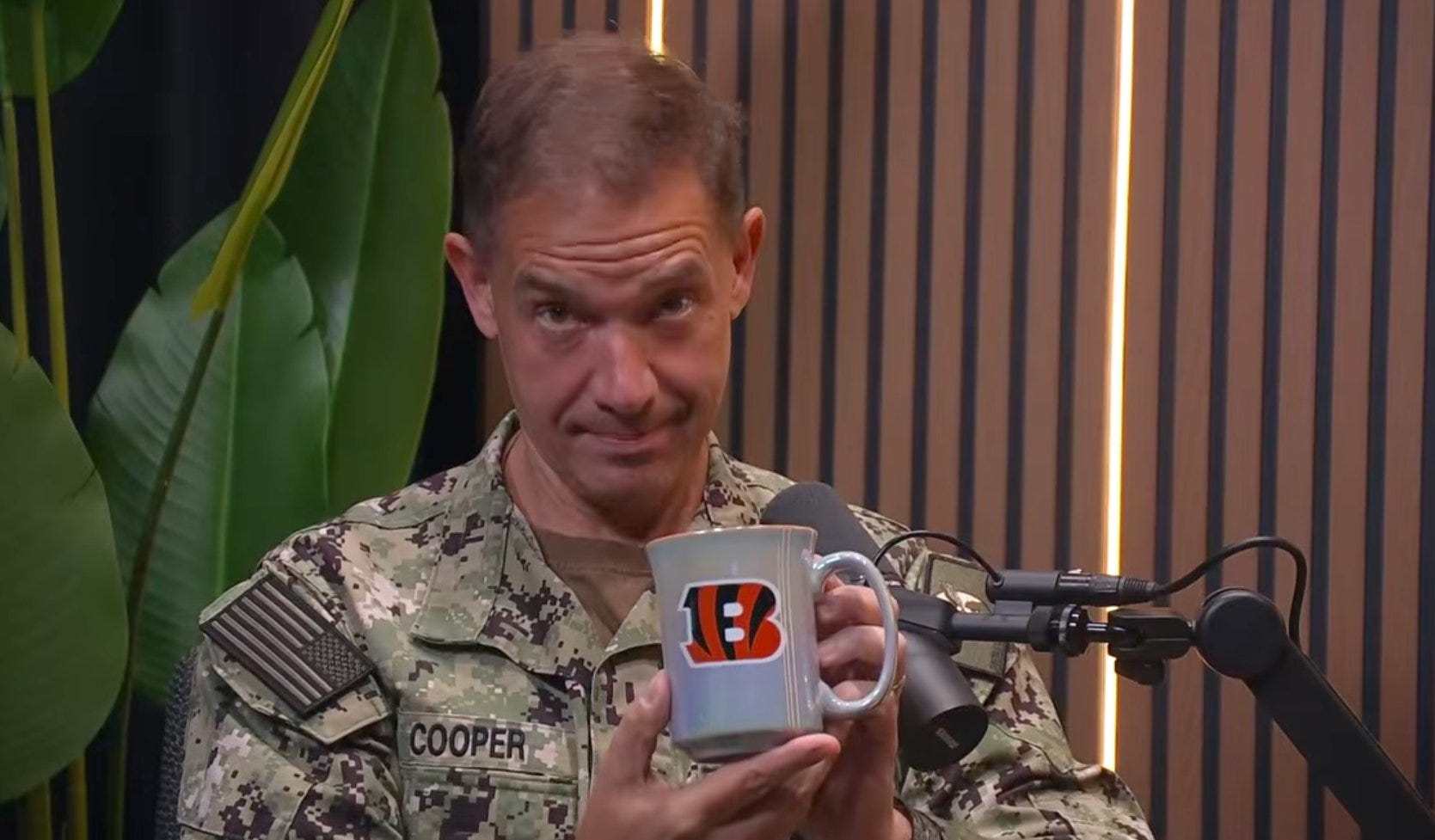
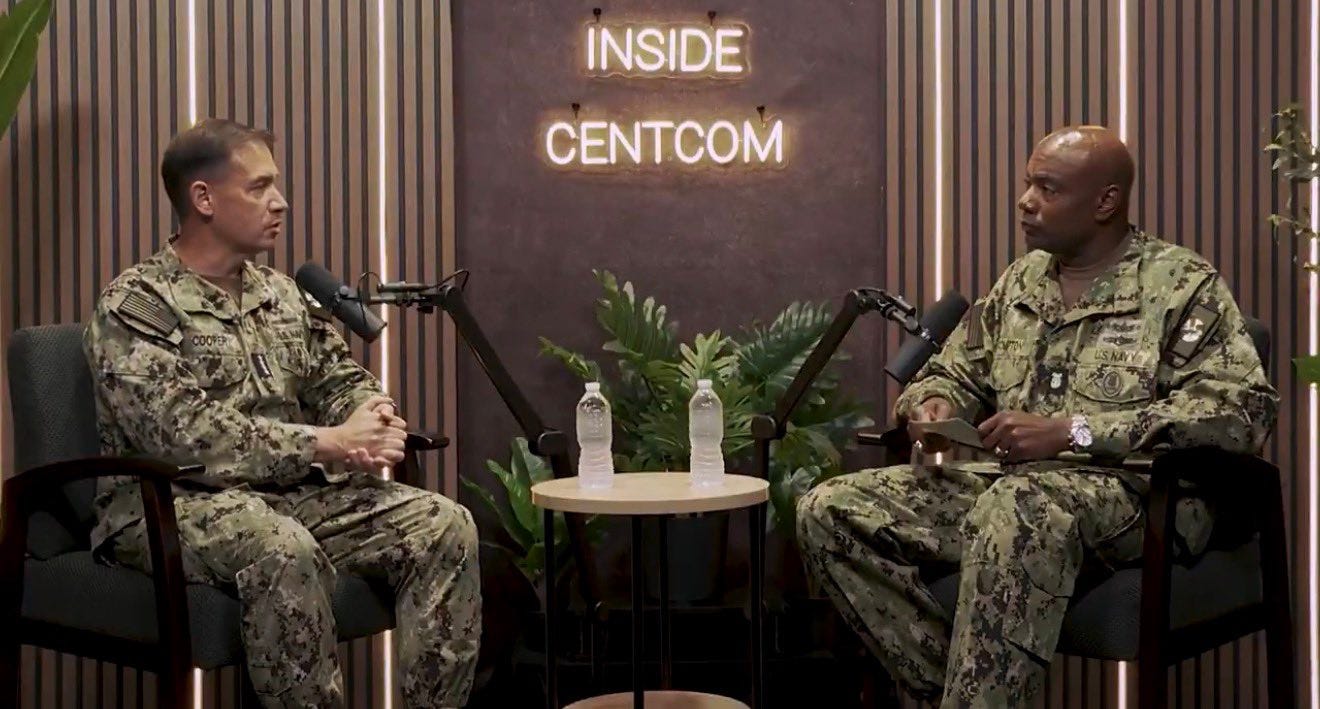
Today, the military command for the Middle East unveiled its new podcast, “Inside CENTCOM,” featuring its commander, Navy Admiral Brad Cooper — the man most responsible for the Strait of Hormuz crisis and skyrocketing gas prices.
The timing couldn’t be more hilarious. The entire country just voted against his Iran war, and there’s Cooper, the architect, grinning and chatting up his workout routine, love of french fries and basketball. Asked about Operation Epic Fury, he says only that “I just couldn’t be prouder” and how even amidst the war he guards the “sanctity” of his workouts.
Considering that Cooper never bothered to make keeping the Strait of Hormuz open an objective of the war — which sent oil prices soaring — maybe he should’ve spent less time working out. But judging from his breezy podcast appearance, Cooper sleeps like a baby.
“Let me be clear: the Strait of Hormuz is controlled by the United States and our regional partners, not Iran, and it remains open for business,” Cooper said last month in a video infomercial for the war. It was on the same day oil hit $110 a barrel. It was his George W. Bush “MISSION ACCOMPLISHED” moment. But Bush, at least, was a politician. Cooper is a uniformed officer, and the whole point of a uniformed officer is that they are supposed to stay out of politics.
Meanwhile, all the knives are out for Pete Hegseth. Good riddance.
But Cooper is even more responsible for your gas prices. He wrote the war plan, oversaw the strategy and the implementation, and even directed the day-to-day operation.
“The greatest trick the devil ever pulled was convincing the world he didn’t exist,” the saying goes. Cooper is a perfect example. Most Americans couldn’t pick him out of a lineup, and these days, that’s how the Pentagon brass likes it.
No matter what the mess in the White House or the nation’s capital, the uniformed military likes to say that it is above politics. Generals and admirals, the story goes, give their best “military advice” and just report the facts about their area of responsibility.
When the brass wants the public to like them, they roll out PR, like a podcast about French fries and free throws. But behind the scenes, they’re keenly aware of who’s in power and what their bosses want to hear, and they have politics of their own. (If you have any doubt that the brass has politics, look at Vice Adm. Nancy Lacore, fired by Hegseth in August 2025. On Tuesday, she won a House seat in South Carolina as a Democrat.)
To understand how Cooper could pass off ‘Hormuz is open for business!’ as objective fact, rather than what it plainly was — a nakedly political statement defending the Iran war, and one backing Trump and burnishing his own record — you have to understand what his position as CENTCOM commander entails.
While the Secretary of Defense is responsible for overseeing war plans, it’s the uniformed military that’s responsible for writing them. By law, this task falls to the “combatant” commander, which in the case of Iran, is Brad Cooper.
Internal Pentagon documents I’ve obtained show what his plan for Iran actually set out to do. It had four objectives, none of which mentioned Hormuz:
Destroy the Iranian air force.
Destroy the Iranian navy.
“Reduce” Iran’s ability to attack its neighbors and U.S. forces with missiles and drones.
Destroy Iran’s ability to manufacture those missiles and drones.
Now, who’s to blame for Iran is on everyone’s mind — Donald Trump’s included. Even Vice President JD Vance conceded the morning after the elections: “The reason we lost is the war.” Asked about the remark hours later, Trump agreed, saying, “I think it’s largely true because it drove the gasoline up a little bit short term.”
As I’ve reported, Trump has already backed off a large-scale renewal of strikes on Iran. But he insists it’s because the war already hit practically all of its targets, telling Politico: “We’ve knocked them out already 90 percent.”
Where does Trump get a number like that? From Cooper’s briefing slides delivered to the White House, and from the numbers game that Cooper and the Pentagon play so exquisitely.
Here’s how it works. Trump says he wants to go to war. It’s Cooper’s job to design the plan. Trump tells him we have to stop Iran from getting a nuclear weapon. Instead of explaining to the president that no such nuclear weapon is imminent, Cooper salutes and goes off to follow orders. In a way.
This is where the passive aggressiveness of the brass kicks in. It’s how the Pentagon works, whether the president is Trump, Obama or Bush.
“We’re going to war because that’s what the commander in chief says,” they tell each other. Then come the spoken and unspoken rules: Maximize gains. Minimize losses. Protect the force. Preserve the honor, and the position, of the American armed forces.
So they write a plan that satisfies Trump and Hegseth’s bloodlust but looks “judicious” and expert in that there are specific goals and “metrics” to measure progress. If things go right, the brass takes credit. If they go wrong, their fingerprints are nowhere to be found on anything that smacks of political decisions.
For Iran, Cooper and the rest of the uniformed leadership decided the best way to manage two crazy people at the top was to focus solely on destroying Iran’s offensive military capacity. Whatever Trump said publicly, there were those four objectives, and that’s what Cooper focused on in the bombing.
Destroy Iran’s nuclear program? It wasn’t one of Cooper’s objectives. The official plan, which Hegseth and Trump approved, didn’t even mention it. Trump used the nuclear threat to justify the war in public, but it was a political goal, and a made-up one. So Cooper left it out and stuck to targets nobody could call political.
And what about regime change? The brass hid behind the fact that that was Israel’s job. Trump could spout off all he wanted; the American military could always say that wasn’t its objective.
I know everyone says the administration never thought about the Strait of Hormuz. But Cooper did. He just didn’t make keeping it open a sub-objective of destroying Iran’s navy. In retrospect, in fact, the naval campaign he designed was a joke, which is remarkable, since he’s a Navy man.
Some facts: Cooper went after Iran’s navy aggressively. Ten percent of all targets attacked from February to April were naval. “At sea, we destroyed 161 vessels in total,” Cooper crowed to Congress. “150 ships are at the bottom of the ocean,” bragged Gen. Dan Caine, chairman of the Joint Chiefs. It sounds logical and comprehensive, like a game of Battleship gone very wrong for the Iranian side.
Then Iran closed the Strait, and the news media latched onto the idea that Trump and Hegseth never thought about it.
And yet, as part of their naval campaign, Cooper’s forces did attack Iranian mines, Revolutionary Guard speedboats and coastal missile sites. Cooper in fact claims his campaign eliminated “more than 90 percent of Iran’s once-massive inventory of over 8,000 naval mines.” Caine says half of the Guard’s small attack boats were destroyed.
Why only half? Because the big boats got more attention and had a bigger impact in those daily briefings.
It really is that dumb.
The point was more the scoreboard than it was denying Iran this capability. Every day, Cooper delivered a higher score to the Pentagon and the White House: 10 percent destroyed! 20 percent! All of Iran’s submarines (all three of them) sunk! 60! 70! 80! 90! Easy peasy.
What the news media and the expert world have hardly noticed is that Cooper used those numbers to hide a faulty strategy. He spent too much firepower on big warships and other targets that made for good statistics, and not nearly enough time thinking about how Iran would actually fight a naval guerrilla war. And he did that with no constraints from Washington whatsoever. He just focused on the wrong thing.
The proof is in what came next. From June to September, almost all American bombing of Iran targeted its naval and anti-ship forces: small boats, missiles, small bases and radars and communications. His own forces had to go back and fix Cooper’s disastrous emphasis.
Cooper made the same mistake on land. He failed to build up enough defenses to protect U.S. bases from Iranian missiles and drones. That cost billions of dollars in damage and left American troops dead and wounded. Anticipating Iran’s capability (and strategy) was his job. He just didn’t do it very well.
On his podcast today, Cooper said that “no one could have imagined the trajectory of events that we would be on.” Imagining was his job, too. Instead, he was more interested in pleasing Trump and winning some statistical battle than in doing what was best for America or the world.
If Hegseth is the only target, the American military walks away patting itself on the back, they get more money, and Cooper, once he retires, gets consulting contracts, joins boards of directors for defense and technology companies, and makes money as a commentator on, say, podcasts.
He’s already auditioning — on your dime.
I’m experimenting with a subscriber-only live chat for each story. Subscribe below to join us.
— Ken

— Edited by William M. Arkin
I cannot believe this moron has a podcast. You’d think one in his position wouldn’t have the time.
Too weird.
Since Trump is stumped for a way out of the Iran mess, perhaps the next Congress will deny the funds and that will be that.