
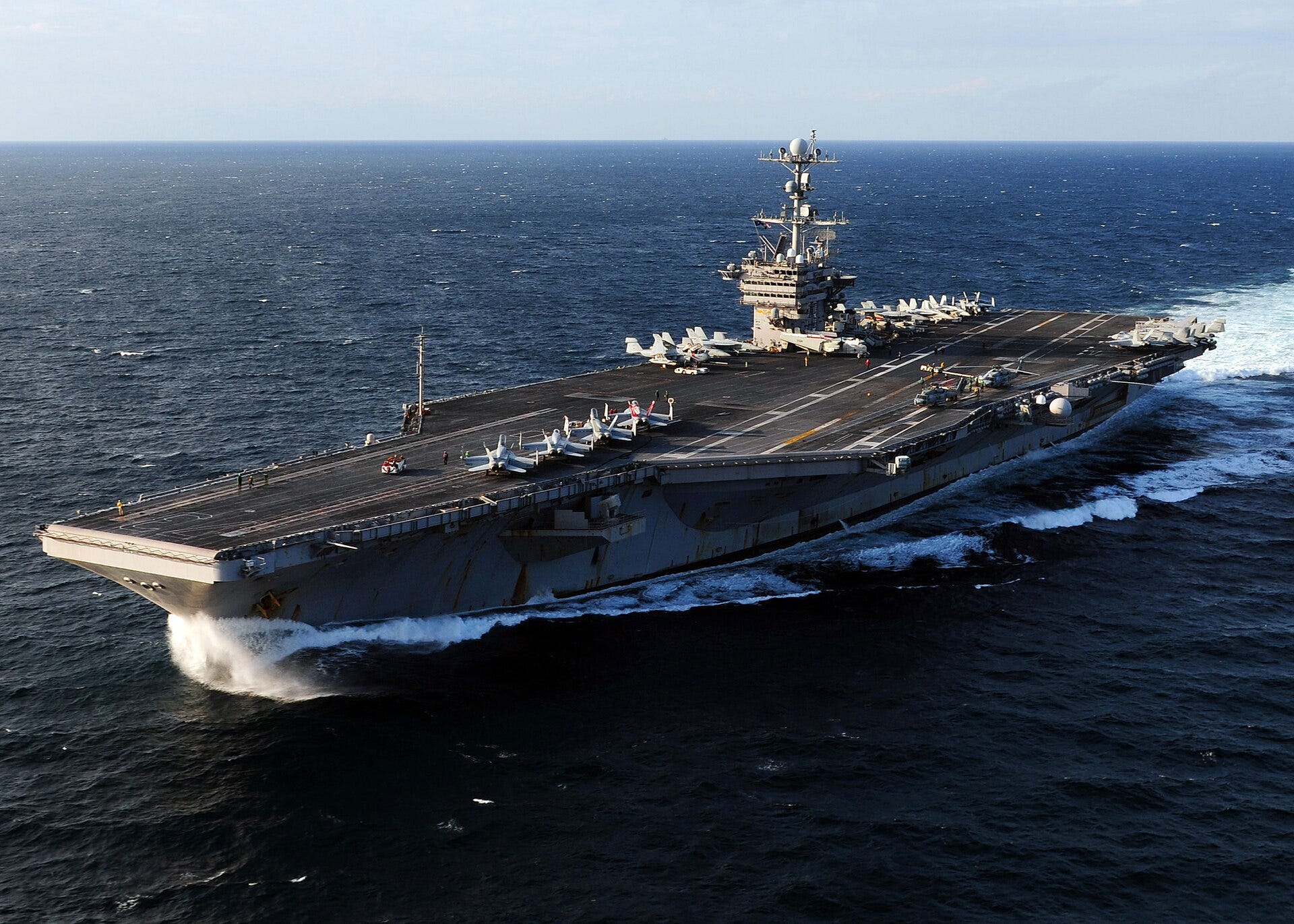
Robert Pape's newsletter last week ran a big scary headline: “The Third Carrier Has Arrived — Trump's Strike Window Is Open.”
Translation: a third giant U.S. warship had shown up near Iran, virtual proof that Trump was about to commence a massive invasion. But a week later, one of the aircraft carriers returned home. No invasion.
What happened?
If you don't know Robert Pape, you've probably still seen him. He’s a professor who TV shows and newspapers love having on to talk about the Iran War. His fancy title gives them cover for Alex Jones-level headlines like “Many Will Die,” which actually ran on PBS's Amanpour and Company (see screenshot below).

On paper, Robert Pape is exactly the kind of expert Washington is always telling you to trust. He’s a Truman Scholar with a PhD from the University of Chicago. He taught at Dartmouth, then went back to Chicago, where he’s now a tenured professor of political science and runs a research center on security threats.
In practice, he’s a tent-revival preacher in a sharp suit, barking about the end times.
Since Trump launched the Iran War at the end of February, Pape has been preaching the gospel of the “escalation trap,” the theory that we’re now locked into a practically inevitable spiral of military escalation against Iran. Where an end-of-days preacher would speak in tongues, he speaks in Latin, peppering interviews with terms like “casus belli.” And like every doomsday prophet, he keeps getting the date wrong.
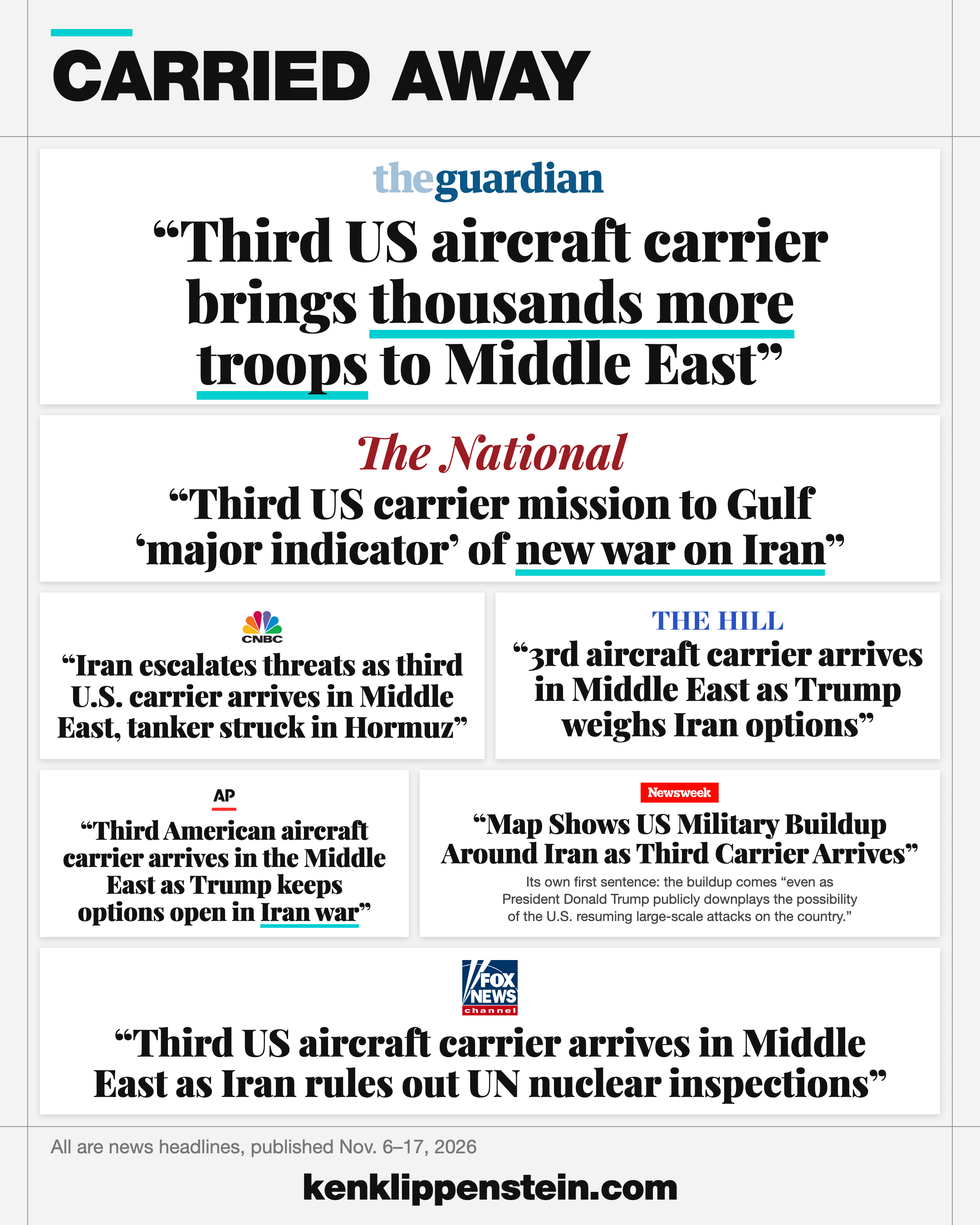
So when a third aircraft carrier pulled into the region last week, professional prophets like Pape got right to work, supplying the media with its usual quota of panic.
The news media piled on. OMG! Aircraft carrier means 55,000 troops in the region! More than ever! Iranian dirty bomb! WMD!
What you'd have to dig to page 3,000 to find is that within days of the Roosevelt's arrival, the USS George Washington left the Middle East and sailed back to Japan. Home for the holidays.
If you're wondering why you heard all about the three-carrier buildup but nothing about it ending, look at how little attention the media gave it.
The Washington Post, which had run its own three-carrier story, covered the departure with a short AP wire item: “US military returns to 2 aircraft carriers in the Middle East.” Bloomberg’s departure story led readers back to the threat, claiming that somehow the Roosevelt gave Trump more military options. CBS News buried the departure in a live blog saying that Tehran may still be working on chemical or biological weapons. And no outlets seemed much interested in President Trump’s post-midterm admission that the war “is effectively over.”
The media would not have had to look far to learn that the third aircraft carrier was sent over not as some kind of operatic buildup to total war, but simply to take the George Washington's place. Back in September, USNI News, the U.S. Naval Institute's news site, reported that the Roosevelt had left San Diego to relieve the George Washington. That's how carrier rotations work (especially amid holidays): the new ship shows up, the two overlap briefly, and the old one leaves. The same thing happened in August, when the George Washington replaced the Abraham Lincoln.
And as for the 55,000 troops figure, the media makes it seem as if Marines are chomping at the bit. The reality? That includes everyone: not just warfighters but cooks, logistics, intel people, and on and on.
Pape's “escalation trap” theory says governments stumble into wars, which means nobody in particular is to blame. Not Trump, not the Israelis, not Hegseth’s ego, and not the Pentagon bureaucrats shuffling ships around on a schedule.
Pape fell into an escalation trap of his own, as did the media, by inflating this whole threat into a zeppelin.
This happens because the media’s entire incentive structure is built around promising big explosions. There is an endless market for telling people it’s DEFCON 1, that war is imminent, that the countdown has begun, that the fuse is lit — and almost no reward for telling them that nothing happened, or that the military quietly stood down.
Once outlets and pundits crank the dial to red, they can’t turn it back down without losing the audience’s attention. Every routine deployment has to be framed as the prelude to a massive strike; every quiet de-escalation gets buried or ignored. The result is an information ecosystem permanently locked on the brink of war, where the only story worth telling is that the next explosion is just around the corner — even as the warships are literally sailing away.
Pape will presumably cram Iran into his next book as proof his theory works, whether or not the real world cooperates.
The real story is actually an encouraging one: millions of ordinary Americans voted against the Iran War so decisively that they stood up to the Pentagon and won.
— Edited by William M. Arkin
This kind of doomsday comment by Pape, besides selling papers, also can be used as justification to constantly inflate the military budget, which way too many folks profit from..