
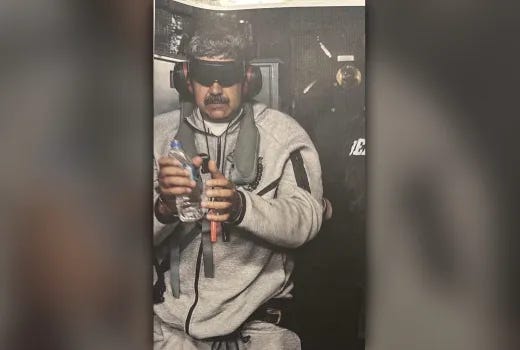
“This was an audacious operation that only the United States could do” — President Trump announcing the arrest of Venezuelan leader Nicolas Maduro.
“Beginning today, we will govern expansively and audaciously” — Zohran Mamdani’s inauguration speech.
Audacity is in the air. That’s the word used by President Trump to describe the arrest of Venezuelan leader Nicolas Maduro and his wife. Zohran Mamdani in his inaugural speech also vowed to govern New York “audaciously.”
It’s a poetic illustration of two radically different visions for America: one of muscular national security and the other of a bold economic agenda. Yet the media reception couldn’t be more different. Compare the hysterics over Mamdani’s proposal for a rent freeze (what ever happened to that mass exodus of the wealthy?) to the barely concealed glee over Trump’s decapitation operation in Venezuela.
In fairness, the operation was nothing if not audacious. Trump hinted at the sheer scale of the secrecy involved during his Saturday press conference.
“I’m not sure that you’ll ever get to see it, but it was an incredible thing to see,” Trump said, referring to the clandestine operation. “We had many helicopters, many planes, many, many people involved in that fight.”
The president wasn’t exaggerating. Behind the Delta Force operators and Night Stalker pilots, behind even more secret pilots and operators and people on the ground, behind the CIA case officers recruiting and servicing sources, behind the NSA analysts listening in, behind the imagery analysts, and on and on and on, were policy makers, planners, logisticians, maintainers, weapons handlers, thousands of support staff from weathermen and women to doctors and nurses standing by for the worst possibilities.
All of that was kept secret from the public and even Congress. Why? Because as Trump put it, Congress “has a tendency to leak” — one of the more casual expressions of contempt for transparency I’ve ever seen. But Secretary of State Marco Rubio was even more blunt.
“You can’t congressionally notify something like this,” Rubio said in an ABC interview, explaining: “It will leak. It’s as simple as that.”
We pay for those secret televisions that the national security masters watch. We pay for the worldwide network. We pay for the IT infrastructure, the satellites that literally carry the secret news. But we don’t even get to know the broadest contours of what that system is learning so we can debate the policy it is informing. Nor even do the politicians we elect.
Thousands of soldiers and civilians and contractors, spies and diplomats, knew and kept secrets about this operation. Hundreds of foreign officials — our so-called partners — knew the staging areas and intelligence bases in their own countries. They knew but we could not know, not even generally, lest we question and debate the wisdom of the operation or the outcome that it would produce.
The process of secrecy is not just “tactical,” to keep ship movements from the Venezuelans. It is also to deceive the Congress and the American press, in theory the watchdogs for the public.
The Trump administration lied through its teeth about not pursuing regime change on the dubious technicality, an intelligence official tells me, that Maduro did not legally represent a legitimate government.
“It was a trigger-based mission in which conditions had to be met,” the Secretary of State added to justify the silence.
What that means is pinpointing the location of Maduro. The trigger event took place early Saturday morning, but unlike a Hollywood movie in which the operation materializes out of nowhere, they planned the raid for months, prepared it and rehearsed it and painstakingly brought together all of the pieces. Then the covert action machine generates the outcome it was designed to, with minimal input from the putative deciders, up to and including presidents.
The reason this system is tolerated is its apparent elegance.
Even I, a bone deep critic of the national security state, couldn’t help but admire it, at least abstractly. When I first read about Maduro’s arrest, my immediate reaction was frankly awe that something so, yes, audacious, was carried out successfully. What other thing our government does goes so smoothly? And that, I guess, is the appeal to policymakers.
When Barack Obama was running for reelection in 2012, Vice President Biden’s signature line on the campaign trail was, “Osama bin Laden is dead and General Motors is alive.” (That was a secret operation of the same ilk.) Obama was feted for his “brave” decision and books were written about how magnificent it all was. National security puffed.
When Trump carried out the assassination of Iranian General Qasem Soleimani on January 3 — six years to do the day of Maduro’s arrest and another similar secret operation — it was perhaps the only time ever that the press uniformly heaped praise on the president.
Politically, covert operations work.
Though Maduro was deposed for multiple reasons, including his nationalization of Venezuelan oil and his relations with countries like China, Russia, and Cuba, and so on, Trump has taken care in (most) of his rhetoric to cast the war on Venezuela and the war on cartels as about fentanyl.
Millions of Americans are outraged and devastated at the war scale death toll exacted by the drug, and though one can fact check the president to death on his words, he is the master at looking for big, bold ideas to fight common problems that resonate with the electorate. Especially when there are no other examples of an audacious vision being advanced.
Before Mamdani, that is.
— Edited by William M. Arkin
A media handjob?
Impress me by picking up Netanyahu and Gvir.