
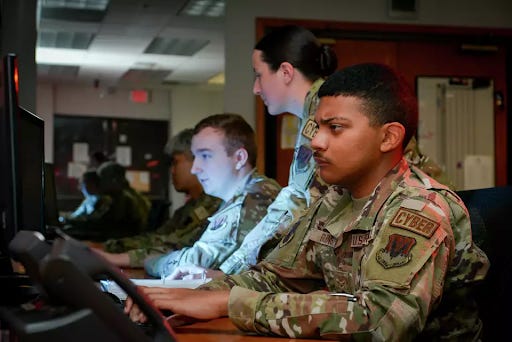
Secreted away inside a windowless building at 7700 Potranco Road in San Antonio, Texas, is a darkened room that serves as the hub of Task Force Raider. This military task force is secretly at work as part of a government-wide “election security group,” guarding against “interference” in the upcoming midterm elections.
Interference, however, is a loaded word. While it connotes the Kremlin hacking into polling places or changing the election count, Task Force Raider is actually more focused on the broader category of “influence”, specifically Russian or Chinese attempts to change minds rather than to change votes.
But the real target is the American people, whom the federal government sees as vectors for foreign influence.
“The entire election security scare is to indulge President Trump and assuage Democrats, all of whom fear interference and shenanigans, but not from foreign shores,” says a senior military intelligence officer, who spoke to me about the secret effort.
He and other military officers expressed unease with the sprawling mission. It encompasses everything from sending millions of anonymous text and voice messages abroad, to outright deleting social media posts or taking down entire websites, as documents I obtained reveal.

All of this is in violation of longstanding prohibitions against any military involvement in elections whatsoever, yet enjoys the support of both major political parties.
What’s more, for all the handwringing about election interference, the Trump administration hasn’t substantiated that any country (or any other foreigners) are planning to interfere or have any chance of meaningfully altering an outcome. But that hasn’t stopped the federal government from designating election security the number one “operational priority” — a mission that insiders are calling “no fail.”
That is the mission directive that Pete Hegseth issued to the San Antonio cyber establishment last week, as I reported on recently. Yet because Hegseth’s war is highly classified, takes place in cyberspace and entails a healthy dose of covert actions that would shut down potential attacks as well as cut off normal influencers and common citizens who seek to sway voters (what some might call ‘democracy’), nothing has been written about Hegseth’s actual election interference.
“These are not merely Keystone Cops battling against pimple-faced amateurs and anarchists,” says a retired senior military officer who has been involved in election security since the 2016 presidential year. “Every capability that the US possesses, in Cyber Command, the CIA, NSA, and other agencies, the Russian and Chinese governments also have,” he says. “We are literally involved in a daily battle in cyberspace.”
Despite this underground war, the officer questions the growing military involvement in safeguarding voting. “Influencing the influencers? That’s creating a precedent that I’m not comfortable with,” he said. As he sees it, this is not just a slippery slope to boots on the ground at polling places but of building and having federal government capabilities that will eventually be able to control public speech and assembly.
The officer, who describes himself as a nonpartisan believer that the Constitution always comes first, points out that the hundred-plus-year prohibition against posting federal soldiers at polling places had good reason behind it then and good reason now.
“Granted, those in uniform are subordinate to an interagency civilian effort,” he says, “but the construct of only fearing boots on the ground is obsolete. We need to update our thinking, and the law, to include the cyber world. And we need to counter the idea that a robust, even foreign-based debate, requires federal intervention.”
To understand how close we are to abridging the First Amendment, consider that earlier this month, Senators Adam Schiff and Alex Padilla of California wrote to the heads of half a dozen social media companies to warn that they — YouTube, Twitter (X), Facebook, Instagram, TikTok, and Google — weren’t doing enough to “combat misinformation and disinformation … during the 2026 midterm elections.” It was a wholly partisan letter with a predictable dose of Donald Trump this and Donald Trump that. But there it was: two prominent Democrats and liberals threatening that Congress must “consider investigations and legislation to remedy” election mis- and disinformation.
“Congress shall make no law,” the military officer says, when asked about the proposed legislation. “It’s the first sentence of the First Amendment to the Constitution. Period.”
Now, however, a law, and control, is the norm. And Hegseth, for whatever reason, wants the Pentagon in on the action, that is, under the misleading guise that it is only working against “foreign” actors.
The military has been quietly involved in protecting federal elections against cyber attack since Donald Trump appeared on the national stage in 2016, in the context of WikiLeaks, Kremlin influence operations and their hacking of Hillary Clinton’s emails.
Whether any of what happened was important enough to have the slightest impact on the American vote or not, the Obama White House was spooked enough that it gave the CIA covert action authorities to shut down websites and social media accounts — including taking a Russian military-created website called “DCleaks” offline — that might release additional materials. Whatever you think about Obama’s motivations or Trump’s, the essence of the government action then, as it is now, is that it restricts free speech.
Task Force Raider (or its predecessor) was mobilized to assist Homeland Security and the FBI in “defending” the United States. To pull together the right people with the greatest talent, the Task Force operates under a “best athlete” approach, picking the most qualified individual regardless of military service, civilian agency or defense contractors. Eventually, over 350 people got to work on the task force.
A $10 million Rewards for Justice program was unveiled, and over 56,000 “psychological operations” (PSYOPS) messages were posted over the internet. The influence warriors of Task Force Raider sent over three million (!) text and voice messages to people in “countries of interest,” according to documents I’ve obtained. All of this took place in secret.
Some of the work and preparations were focused purely on defense. One unit, the “Demon Chasers” of the “91st Cyber Operations Squadron,” the military’s premier offensive cyberspace squadron, contributes its expertise to the mix. Working from their 42,600-square-foot “multi-domain” secure facility that contracting documents say is authorized to handle Top Secret “sensitive activities” (SA), “sensitive compartmented information” (SCI), “special access program” (SAP) level information, offensive cyber operations (OCO), and “special technical operations” (STO), the 91st specializes in freezing out communications.
One document says that the squadron, and its Special Program Office, has the mission to “degrade, disrupt, deceive and exploit adversary telephony and information system.” It cut its teeth in Afghanistan, where it perfected “cellular coverage blackouts,” that is, the ability to shut down cellphone communications in a limited area.
Another unit operates a “malware lab” that collects together software and data from all sorts of adversary hacks and cyber operations, conducting analysis of “malicious artifacts,” and writing counter-software to thwart incoming attacks and implants.
An enormous part of the overall effort is “persona operations” — where soldiers and other literal keyboard warriors create false identities and fake internet addresses to operate in cyberspace without government attribution, to scout the web and surf social media, to engage individual users, and to do some influencing of their own.
My sources who are privy to this Top Secret effort all agree: the military is not just thwarting foreign actors from sowing discontent. They are also regulating what appears in social media, regulating legitimate debate.
Cyber Command’s (CYBERCOM’s) Joint Force Headquarters – Cyber, operating from its war room inside the National Security Agency-Texas facility in San Antonio, oversees Task Force Raider and other military election security efforts. On the million-square-foot “security hill,” not far from the NSA facility at the former Kelly Air Force Base, another unit has built a “state-of-the-art weapons system to mimic the collection efforts of foreign intelligence services,” according to documents I’ve obtained.
After the 2020 elections, the Joint Force Headquarters activated an election security “enclave” to support “the most sensitive activities.” The Pentagon defines such activities as “activities that, if compromised, could cause enduring adverse effects on U.S. foreign policy or military operations, or lead to significant embarrassment for the U.S. government, its allies, or the military.”
In other words, actions that might damage the federal government and the military, not actions that might damage democracy.
Online support for Palestinians and opposition to Israel’s conduct in the Gaza war; vitriol against Donald Trump, or ICE, or the CIA and the FBI; or “disinformation” in general? None of these are a serious threat to our democracy. Yet somehow the federal government and the Pentagon have convinced us that they need to take extreme action, including controlling speech, to counter it.
What Americans see of military involvement in the election, they pretty clearly don’t like. When video circulated of DC National Guardsmen appearing in front of a ballot drop box, it quickly went viral, stoking outrage.
What people don’t see is that the military is also eyeing the vote in a much more systematic way in cyberspace. Why isn’t anyone asking what they are actually doing? And who is the actual target? And what is it that they have in mind to do on or before election day to carry out their own influence campaign?
— Edited by William M. Arkin
Keep up the good work, Ken. AFAIK you're the only person covering this.
Honest to fucking god we are so fucked. It's beyond a slippery slope...
Breaking Points interviewed the author of a new book about Weimar Germany & possible similarities between US & Germany.https://youtu.be/Guh_Caj5uoE?is=VjEeRSej7lFdNgOp