
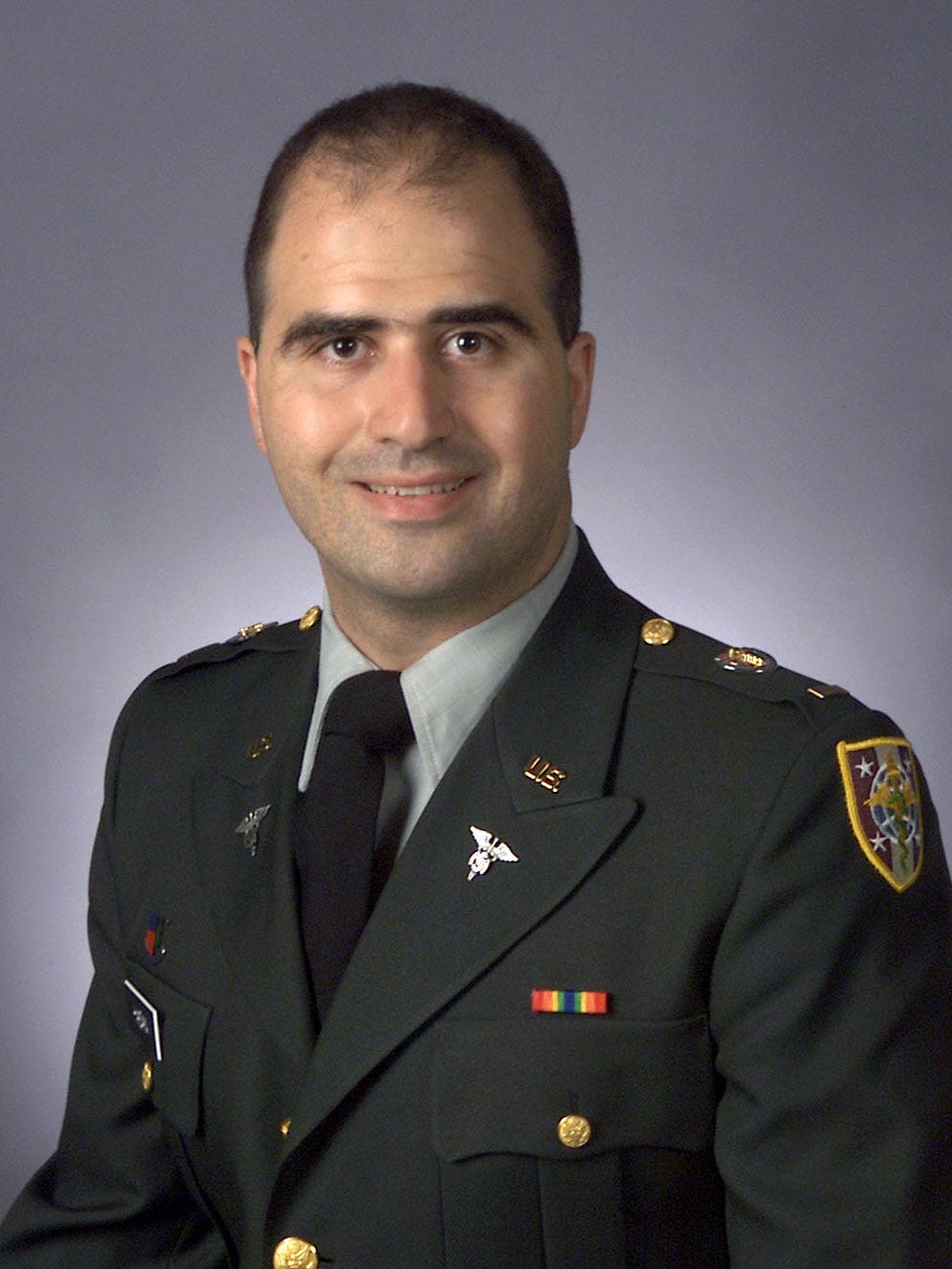
The livestream is off, but the firing squad isn’t. Nidal Hasan, the Army soldier who killed 13 fellow troops at Fort Hood in 2009, will still be shot to death by Army riflemen on December 3.
“Death penalty through firing squad, and he deserves it,” Donald Trump said of Hasan earlier this month.
He doesn’t deserve it — but not for the reasons you might expect.
Execution by firing squad is regarded as a “soldier’s death,” long considered an honorable end and part of a military tradition that separates those who served from mere criminals. That’s why leaders from Nazi Germany to Saddam Hussein sought to die by firing squad, and why they were always denied.
That Pete Hegseth, a former Army Major obsessed with restoring the military’s “warrior ethos,” does not know this is outrageous. It is also a gift to Nidal Hasan, who has been remarkably clear about his desire to be seen as and treated like a soldier. That is, a soldier for Allah (as he refers to himself).
Hasan during his court-martial said that he had “switched sides” in “America’s war on Islam.” He later wrote a letter to ISIS leader Abu Bakr al-Baghdadi, asking the then-leader of ISIS to make him a citizen of the Islamic State. “It would be an honor for any believer to be an obedient citizen soldier,” he said, signing his name with the acronym “SoA” for “Soldier of Allah.”
“Fighters,” Hasan said in a separate letter he wrote to the Pope, “have a greater rank in the eyes of Allah than believers who don’t fight.” (This letter was also signed “SoA.”) Hasan has formally argued in court that the shooting was a lawful act of combatant defense to protect Taliban leader Mullah Omar and Taliban fighters in Afghanistan from “imminent harm at the hands of U.S. soldiers.” That is, when he himself was serving in the United States Army.
Soldier. Fighter. Combatant. Hasan clearly wants to be seen as a legitimate warrior.
Oblivious to military tradition and Hasan’s desire to be treated like a soldier, Hegseth is actually rewarding him.
On July 26, 2006, Saddam Hussein told the judge presiding during his trial:
“I ask you, being an Iraqi person, that if you reach a verdict of death, execution, remember that I am a military man and should be killed by firing squad and not by hanging as a common criminal.”
Saddam’s request was denied. He was executed by hanging on December 30, 2006.
The U.S. Army has drawn the same line with its own soldiers. In 1917, after a race riot in Houston, the Army sentenced 13 Black soldiers to death. They asked for the firing squad. Why? “It’s more dignified,” a relative of one of the condemned men, Sgt. William Nesbit, told CBS News in 2024. Instead, they were hanged at dawn, with no chance to appeal. (In 2023, the Army threw out their convictions, with Army Secretary Christine Wormuth saying they “were wrongly treated because of their race and were not given fair trials.”)
Hermann Göring, Hitler’s chosen successor, asked for a firing squad too. When the Allies refused, he swallowed cyanide in his cell hours before his hanging. His suicide note, in a translation by biographer Werner Maser, explained why: “Would that I might be shot! However, executing the German Reichsmarschall by hanging cannot be countenanced.”
For centuries, and across societies, militaries have wrestled with how to execute a soldier for desertion, treason or even murder. The firing squad came to be seen as the honorable end, death at the hands of fellow soldiers. Hanging was the degrading alternative, reserved for those who didn’t deserve that honor.
The U.S. Army even made the distinction official. Its 1943 Manual for Courts-Martial provided for both methods but spelled out the ranking: “Hanging is considered more ignominious than shooting.” It associated hanging with murder, mutiny, spying and rape.
The officers who actually had to make this choice understood it. In 1944, a court-martial sentenced Pvt. Eddie Slovik to death for desertion. He became the only American soldier executed for desertion since the Civil War. Behind closed doors, his judges briefly argued over whether to hang him or shoot him. One of them, Capt. Benedict Kimmelman, later recalled how it ended: “consensus was quickly reached on the firing squad, as the less dishonorable means.”
So why is Hegseth honoring a terrorist mass shooter with a soldier’s preferred ceremonial punishment — one that was denied to literal Nazi leaders?
Because full metal jackass, as I call him, is more cable news buffoon than a former officer who knows anything. Military sources tell me Hegseth didn’t even realize Hasan was paralyzed from the chest down and confined to a wheelchair when he announced the firing squad. And one military JAG tells me Hegseth didn’t know that Nazi military leaders at Nuremberg had insisted on a firing squad, only to suffer the indignity of hanging instead.
But if the significance of the firing squad is so widely understood in the military, why aren’t soldiers saying so? Put simply, they’re scared. Here you’ve got to give Hegseth his due: few defense secretaries have so thoroughly cowed the ranks into keeping their mouths shut.
“People have gotten the memo that it’s career suicide to speak up in this environment,” one retired officer who still works for the military told me on condition of anonymity. He continued:
“It’s not just Hegseth, but the entire leadership in Washington. Whether it’s something controversial like this execution or even a probing analysis of what went right and wrong in the Iran war, everyone knows to keep their counsel to themselves.”
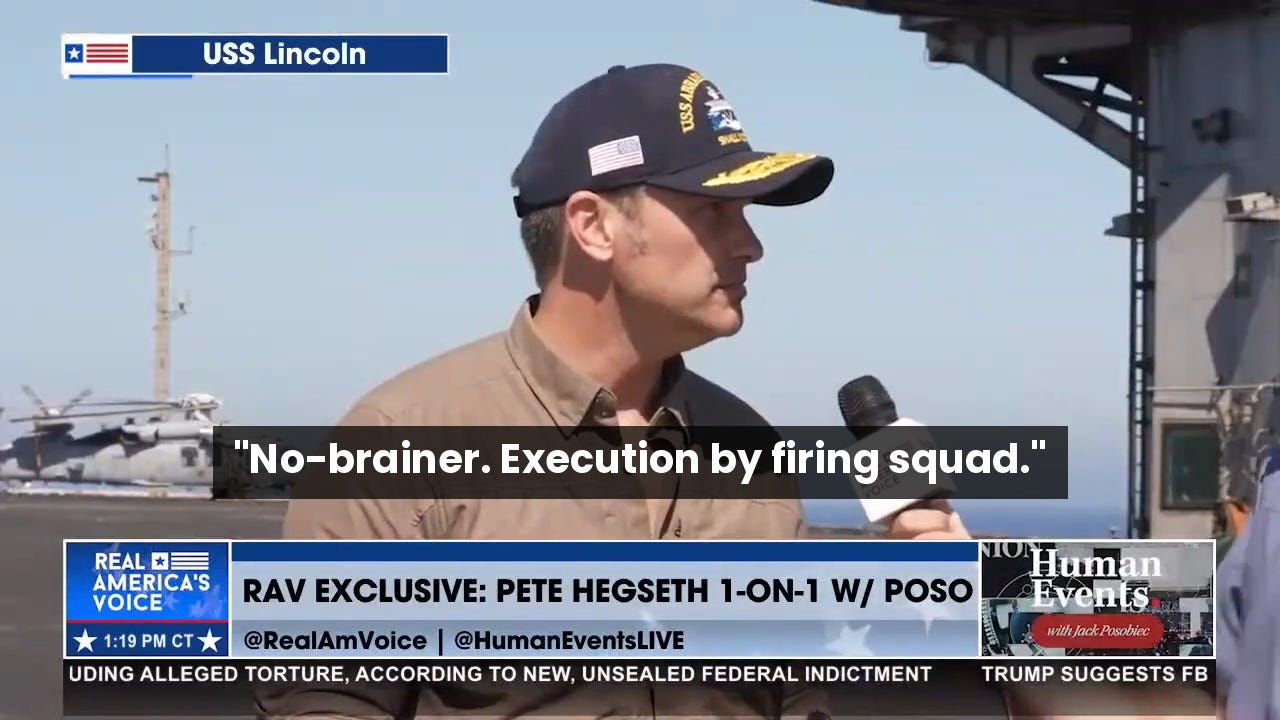
Hegseth, in an interview with commentator Jack Posobiec, provided his rationale for the firing squad execution of Hasan.
“It was a radical Islamist attack in uniform inside the ranks, and so he’s going to get a firing squad of soldiers — as it should be,” Hegseth said, adding: “No-brainer.”
No brain indeed.
— Edited by William M. Arkin
Full metal jackass nails it.
The Founding Fathers were far from saints, and we are still paying for their sins--but they weren't morons.
Terrific story!